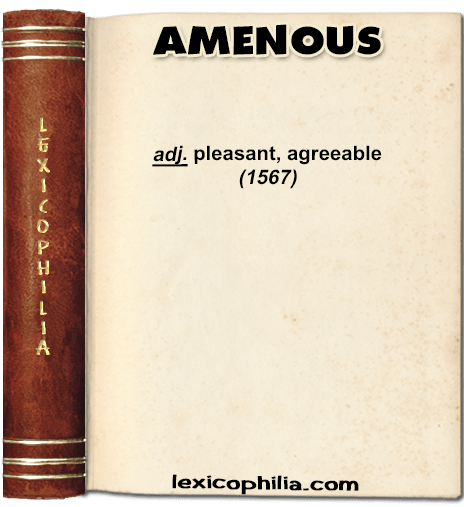
Word of the Day: AMENOUS

ETYMOLOGY
from Latin amœnus (pleasant) + –ous

EXAMPLE
“…Whose mynde was none other but to pass the time, and their predestinate perpetual captivitie in the amenous varietie of over reading and revoluting many volumes and sundry books of divers sciences and strange matters…”

From: Some Specimens of the Poetry of the Antient Welsh Bards
By the Rev. Mr. Evan Evans, 1764
A Poem Entitled, The Ode of the Months, composed by Bwilym Ddu of Arfon, to Sir John Griffydd Llwyd, of Tregarnedd and Dinornig

Word of the Day: ADIAPHOROUS

ETYMOLOGY
from Greek ἀδιάϕορ-ος (indifferent) + -ous

EXAMPLE
“…From all which may be inferred, that dissentions among the protestantes are not merely personall, or but pointes adiaphorous, indifferent, being as it were but peccant humors, and not true or formed diseases in their church, but they do concerne most profound doubtes of their religion, since otherwaies they would neuer anathematize, or condemne one an other with such acerbity of wordes…”

From: Whyte Dyed Black
Or A discouery of many most foule blemishes, impostures, and deceiptes
– Thomas Worthington, 1615

Word of the Day: AMICOUS

ETYMOLOGY
from Latin amicus (friendly, loyal, loving, favourable) + -ic-ous

EXAMPLE
“…as by which each single species draws and assimilates that only to it self, which it finds most amicous and congruous to its nature; and if so it be, then have we no more to do, than to learn how to prepare our Ferments, and apply them accordingly…”

From: A philosophical discourse of earth relating to the culture and improvement of it for vegetation,
and the propagation of plants, &c. as it was presented to the Royal Society
– John Evelyn, 1675

Word of the Day: AFFECTIOUS

ETYMOLOGY
– from affection on analogy of cautioncautiousactionactious, etc.

EXAMPLE
“…and geif ze think it meit, I pray zou, wryt ane afectious letter to my mother, that scho may mak delygens…”

From: Memoirs of the Maxwells of Pollok
By William Fraser, 1863
“Lady Elizabeth Maxwell to Sir John Maxwell of Pollok, 23d July, c. 1580”

Word of the Day: AMOREVOLOUS

ETYMOLOGY
from Italian amorevole (loving) + -ous

EXAMPLE
“…that the Espousals between him and the Infanta might be ratified, within ten days after the dispensation unstopt the way unto them; and he would leave it to the Princessa to shew her Cordial and Amoreuolous Affections how soon she would prepare to follow after him.…”

From: Scrinia Reserata: a memorial offer’d to the great deservings of John Williams, D. D., who some time held the places of Ld Keeper of the Great Seal of England,
Ld Bishop of Lincoln, and Ld Archbishop of York:
containing a series of the most remarkable occurences and transactions of his life, in relation both to church and state.
By John Hacket, a1670

Word of the Day: ABDERIAN

ETYMOLOGY
from Abdera, in Thrace, the birthplace of Democritus, who was much given to laughter, and who was styled the Abderite

EXAMPLE
“…T’obvaricate his dearest health, and vary
His armes from Temple into Mortuary.
His mirth’s Abderian laughter; does but tend
To make him agelastick in the end
…”

From: Ἐπιλοιμια ἐπη
Or, The Anatomy of the Pestilence.
A Poem, In three Parts.
Describing
The deplorable Condition of the City of London under its merciless dominion, 1665
By William Austin, 1666

Word of the Day: ASSOPIATE

ETYMOLOGY
– irregular from French assopir, modern assoupir, or Italian assopire
from Latin as- = ad- to + sopīre (to lull asleep)

EXAMPLE
“…that it wes not intended as ane justificatione of the Band, for they did imagine that all of that kynd was already assopiat, bot that it was his Lordships owne privat thoughts, quhilk wes not to come without the bounds of his owne charter-kist…”

From: Memorials of Montrose and His Times
Edited by Mark Napier, 1848
XXIV. Montrose’s Declaration Before The Committee of Estates, August 1641