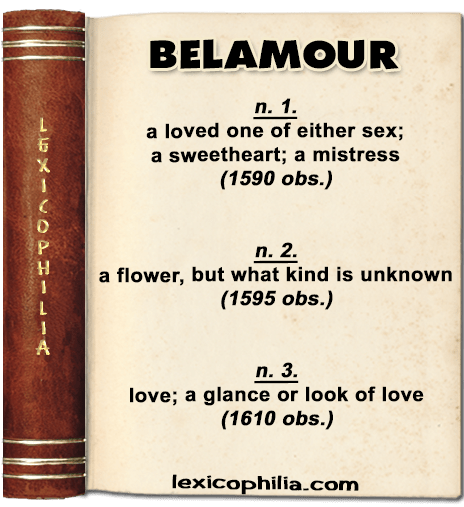
Word of the Day: BELAMOUR

ETYMOLOGY
from French bel (fair) + amour (love)

EXAMPLE (for n. 1)
“… Loe loe how braue she decks her bounteous boure,
  With silken curtens and gold couerlets,
  Therein to shrowd her sumptuous
Belamoure,
  Yet neither spinnes nor cardes, ne cares nor frets,
But to her mother Nature all her care she lets.
…”

From: The Faerie Queene
By Edmund Spenser, 1590

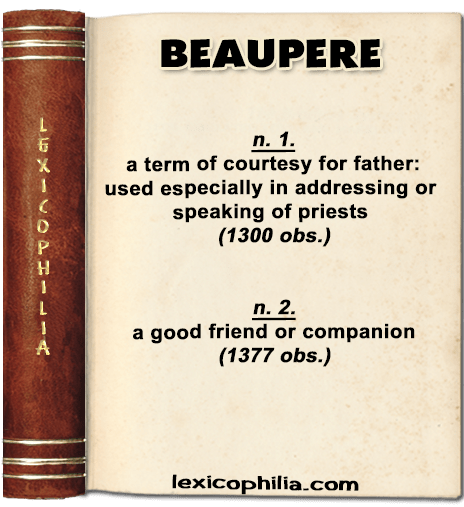
Word of the Day: BEAUPERE

ETYMOLOGY
from Old French beau (fine, good_ + pre (father), or, in sense 2, per, peer (equal, peer):

From OED: In Old French, beau père was politely used in addressing every one whom one called ‘father’; i.e. one’s own father, a ‘father’ in the church, a god-father, a step-father, a father-in-law, an elderly man occupying a fatherly position in one’s regard; about the 16th or 17th century, this use of beau became obsolete, and beau-père was retained as a distinctive term for ‘father-in-law’ and ‘step-father’ as distinct from a real father. In English the use appears to have been much more limited.

EXAMPLE
“… Tho he hadde his tale itold and ymaked al his wise,
He sat adoun and the Bischop of Cicestre gan arise. “
Beau pere,” he seide to the Pope: “me thinȝth hit
faith to the,
“To desturbi thing that falleth: to harm of communeaute;
…”

From: The Life and Martyrdom of Thomas Beket, c1300
Edited by J.H. Black, 1848

Word of the Day: BEDOOZLE

ETYMOLOGY
perhaps from  bedazzle + bamboozle 

EXAMPLE
“… O Shadrack, my Shadrack! Prissilla did speak,
While the rosy red blushes surmantled her cheek,
And the tears of affection
bedoozled her eye,
Shadrack, my Shadrack! I ‘m yourn till I die!
…”

From: The Gazette of the Union, Golden Rule, and Odd-Fellow’s Family Companion
A Saturday Family Journal of General Literature, Odd-Fellowship and Amusement.
Volume X – From January to June Inclusive, 1849
From the Scrabble Hill Luminary

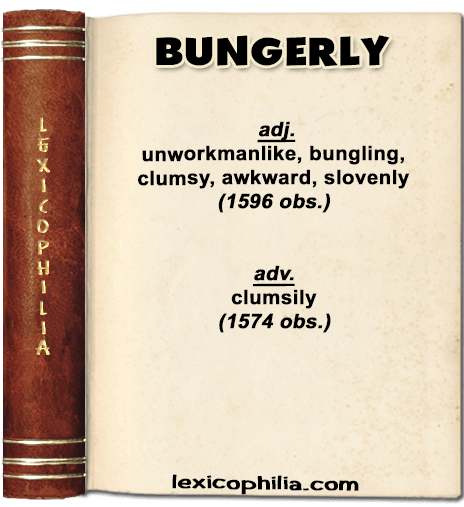
Word of the Day: BUNGERLY

ETYMOLOGY
? from bunger (? for bungler) + -ly

EXAMPLE (for adj.)
“… I saw her conferring with no worseman then Master Snagge. The bungerliest vearses they were that euer were scande, beeing most of them bought and cut off by the knees out of Virgill, and other Authors. …”

From: Haue vvith you to Saffron-vvalden. Or, Gabriell Harueys hunt is vp.
By Thomas Nashe, 1596

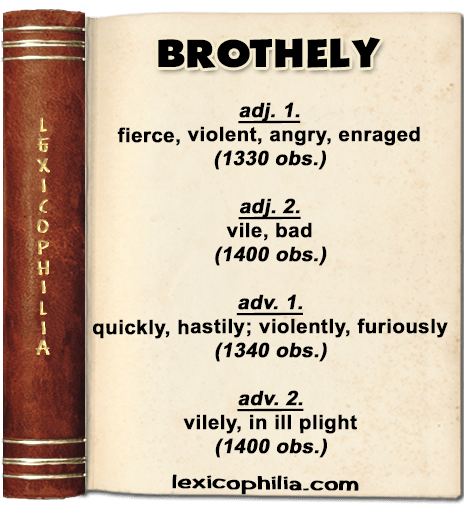
Word of the Day: BROTHELY

ETYMOLOGY
Middle English: in sense adj. 1, from broth (impetuous, violent, wrathful) + -ly;
sense adj. 2, possibly a derivative of brothel

EXAMPLE (for adj. 1)
“… þan said Isaac tille him, “ert þou his mayntenour?
Fulle
broþely & brim he kept vp a trencheour,
& kast it at Statin, did him a schamfulle schoure.
His nese & his ine he carfe at misauentoure.
…”

From: Peter Langtoft’s Chronicle, (as illustrated and improv’d by Robert of Brunne), 1330

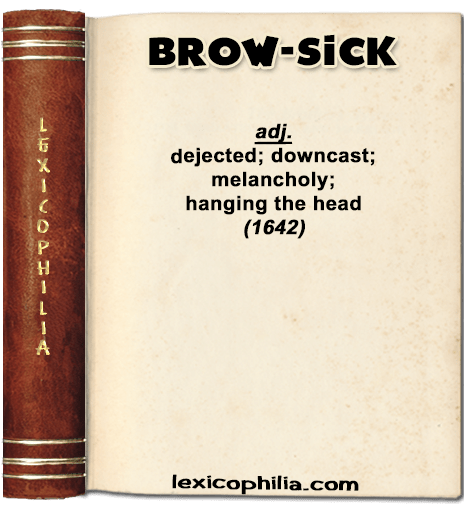
Word of the Day: BROW-SICK

ETYMOLOGY
from brow + sick

EXAMPLE
“… Besides though, I confess, Parnassus hardly,
Yet Helicon this Summer-time is dry:
Our wits were at an ebbe or very low,
And, to say troth, I think they cannot flow.
But yet a gracious influence from you
May alter Nature in our  
Browsick crew.
Have patience then, we pray, and sit a while;
And, if a laugh be too much, lend a smile
. …”

From: The Last Remains of Sr John Suckling
A Prologue of the Author’s to a Masque at Witten, 1659

Word of the Day: BABBART

ETYMOLOGY
probably from a first element of uncertain origin + ‑ard (suffix)

EXAMPLE
“… The hare, the scotart,
The bigge, the bouchart,
The scotewine, the skikart,
The turpin, the tirart,
The wei-betere, the ballart,
The go-bi-dich, the soillart,
The wimount, the
babbart,
The stele-awai, the momelart,
The evil-i-met, the babbart,
The scot, the deubert,
The gras-bitere, the goibert,
The late-at-hom, the swikebert,
The frendlese, the wodecat,
The brodlokere, the bromcat,
…”

From: The Middle English “Names of the Hare
(Bodleian Library MS Digby 86)

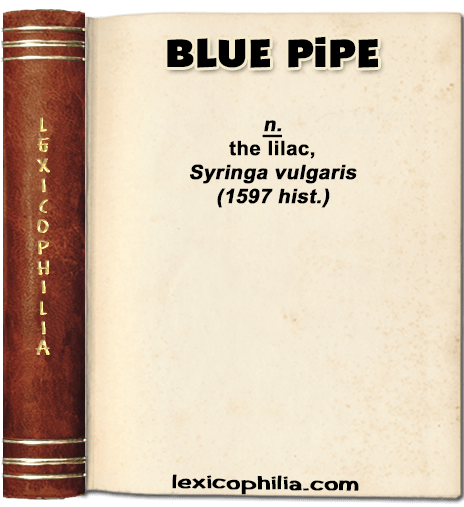
Word of the Day: BLUE PIPE

EXAMPLE
“…The blew Pipe groweth likewise in manner of a smal hedge tree, with many shootes rising from the roote like the former, as our common Priuet doth, whereof it is a kind. The branches haue some small quantitie of pith in the middle of the wood, and are couered with a darke black greenish barke or rinde. The leaues are exceeding greene and crumpled or turned vp like the brims of an hat, in shape very like vnto the leaues of the Poplar tree: among which come the flowers, of an exceeding faire blewe colour, compact of many small flowers in the forme of a bunch of grapes:…”

From: The Herball, or Generall Historie of Plantes
By John Gerard, 1597