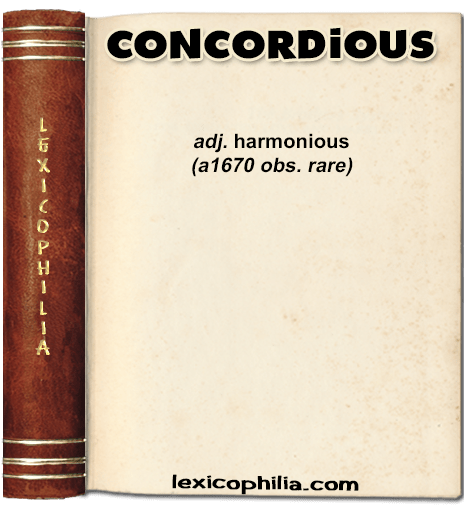
Word of the Day: CONCORDIOUS

ETYMOLOGY
– from Old French concordieux-euse,
from medieval Latin concordiōsus ,
from concordia,  
from concorsconcord (of one mind) + -ous

EXAMPLE
“…the King found himself at more Leisure and Freedom, in the Absence of the Lord Marquess, to study the calling of a Comfortable and Concordious Parliament, wherein the Subject might reap Justice, and the Crown Honour…”

From: Scrinia Reserata: 
A Memorial Offer’d to the Great Deservings of John Williams.
By John Hacket, a1670
The Life of Arch-Bishop Williams

Word of the Day: CONFARREATION

ETYMOLOGY
– from Latin confarreātiōnem, a noun of action from confarreāre (to unite in marriage by the offering of bread), 
from con- + farreus (of spelt, corn, or grain), farreum (a spelt-cake),
from farfarr-is (grain, spelt)

EXAMPLE
“…And if fell out that, that iust number coulde not bee founde, the vse of confarreation, or marriage with a cake of Wheate, either not vsed, or only of a few: whereof he alleaged many reasons, though the chiefest was, the carelesnes of men and women…”

From: The Annales of Cornelius Tacitus. The Description of Germanie.
(Translation Richard Grenewey)
Cornelius Tacitus, 1598

Word of the Day: CRIOUS

ETYMOLOGY
– from Anglo-Norman crious (also crieis, criois) clamorous,
from crier (vb. cry) + –ous

EXAMPLE
“… A fool womman, and crious sat in the ʒate doris of hir hous…”

From: The Holy Bible
Made from the Latin Vulgate by John Wycliffe and His Followers.
Edited by the Rev. Josiah Forshall and Sir Frederic Madden.
Volume III, 1850
Proverbs, Cap. IX

Word of the Day: COBNOBBLE

ETYMOLOGY
– ? from cob (n. a blow; vb. to strike) + nobble (vb. to strike, to hit)

EXAMPLE
“…Charles: He who would from parties rob’ll
Finds out he’s in the wrong box.
Clem.: Him we’ll capture and cobnobble,
Open locks whoever knocks.”

From: Lacy’s Acting Edition of Plays, Dramas, Farces, Extravaganzas, Etc., Etc.
Volume 93, 1871
Robert Macaire, Or, The Roadside Inn Turned Inside Out.
By Henry J. Byron, Scene II