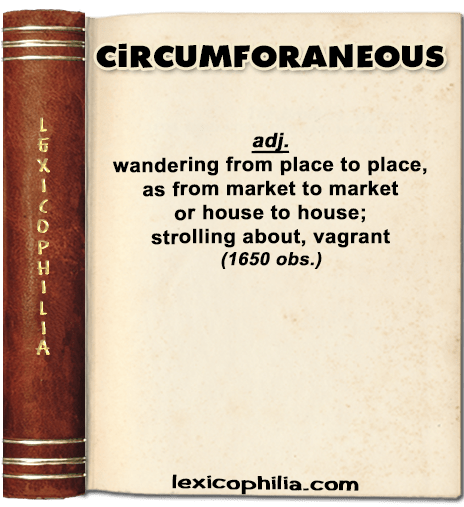
Word of the Day: CIRCUMFORANEOUS

ETYMOLOGY
from Latin circumforaneus (from circum + forum (market)) + -ous

EXAMPLE
“…  Water is good for any thing: It will part dogs, it will make Pottage, and howsoe’r and wheresoe’r the Barber found out this recipe for a dead sleep, it was no dry device, Veritatem è puteo hauriunt tantam, the truth of it is, the very Probatum for a Lethargy, and drawn out of a deep well cures a deep sleep. The Moon was alwaies beholding to the Pleiades, for waking of Endymion. I doe believe the Barber learned it of a Mountebanck, and ’twas first taught him to awaken drunken customers, who fell asleep in trimming-while, and with the sprinkling of this Frigida, were restor’d to their senses againe, and paid for the nap, as well as the snip. But the circumforaneous Emperick rais’d his Fame, in using this admirable Element upon any other disease. …”

From: Pleasant Notes upon Don Quixot
By Edmund Gayton, 1654

Word of the Day: CONTRADICTORIOUS

ETYMOLOGY
from Latin contradictorius (contradictory) + -ous

EXAMPLE (for adj. 1.)
“… after the grete clerk Plinius, libro quinto, capitulo decimo octavo, what distaunce is betwene cenit of oure hedde and a poynte contradictorious to hit in heuyn, soe moche distaunce is from the este in to the weste;…”

From: Polychronicon 
By Ranulf Higden
Translated by John Trevisa, a1475

Word of the Day: CRAB-STICK

ETYMOLOGY
from crab (the common name of the wild apple) + stick

EXAMPLE (for n. 2.)
“… Yes, I remember. I was remarking that sangaree and calipash, mangoes and guava jelly, dispose the heart to love, and so they do. I was not more than six weeks in Jamaica when I felt it myself. Now, it was a very dangerous symptom, if you had it strong in you, for this reason. Our colonel, the most cross-grained old
crabstick that ever breathed, happened himself to be taken in when young, and resolving, like the fox who lost his tail and said it was not the fashion to wear one, to pretend he did the thing for fun, determined to make every fellow marry upon the slightest provocation. …”

From: Charles O’Malley
The Irish Dragoon
By Charles Lever, 1840

Word of the Day: COEVOUS

ETYMOLOGY
from Latin coævus (of the same age),
from co- + ævum (age) + -ous

EXAMPLE
“… Finally, the Tetrad connects all Beings, of Elements, Numbers, Seasons of the Year, Coaevous Society; neither can we name any thing, which depends not on the Tetractys, as its Root and Principle: …”

From: The History of Philosophy: containing the lives, opinions, actions and discourses of the philosophers of every sect
By Thomas Stanley, 1660

Word of the Day: CHURLY

ETYMOLOGY
from churl -y

EXAMPLE
“… But all this while, the shop where Jonah sleeps,
Is tost, and torne, and batter’d on the deeps,
And well-nigh split upon the threatning Rock,
With many a boystrous brush, and
churley knock.
God help all desp’rate voyagers, and keepe
All such, as feele thy wonders on the deepe.
…”

From: Divine poems: containing the History of -Jonah. Ester. Job. Samson.; Sions – sonets. Elegies.
By Francis Quarles, 1638

Word of the Day: CLIBBY

ETYMOLOGY
formed from Old English clibbor (sticky, adhesive); 
related to Old English clifian (to cleave, adhere)

EXAMPLE
“… Which tother spying well, hotly pursues his poynt,
And each proffred resistance, chops off ioynt by ioynt,
Threatning, insisting, striking, wounding, reuelling,
Till meeke disarm’d stilnes proclaim’d his conquering:
Then 
clibbie ladder gainst his battered flanck hereares,
And vp it him, and he it vp, slow scaling beares.
…”

From: A Herrings Tayle
By Richard Carew, 1598

Word of the Day: COINQUINATE

ETYMOLOGY
from Latin coinquinat- participial stem of coinquinare (to defile all over),
from co- (together) + inquinare (to defile)

EXAMPLE
“... For the wele publyke
Of preesthode in this case
And alwayes to chase
Suche maner of sysmatykes
And halfe-heretykes
That wolde intoxicate
That wolde
conquinate
That wolde contemminate
And that wolde vyolate
And that wolde derogate
And that wolde abrogate
The churche hygh estates
…”

From: Colyn Cloute
By John Skelton, a1529

Word of the Day: CLODPATE

ETYMOLOGY
from clod (lump) + pate (head)

EXAMPLE
“… VVHat Clod-pates, Thenot, are our Brittish swains,
How lubber-like they loll upon the plains?
No life, no spirit in ’em; every Clown
Soone as he layes his Hook and Tarbox down,
That ought to take his Reed, and chant his layes,
Or nimbly run the winding of the Maze,
Now gets a bush to roam himselfe, and sleepe;
Tis hard to know the shepheard from the sheepe.
…”

From: By Thomas Randall/Randolph
in: Annalia Dubrensia, vpon the yeerely celebration of Mr. Robert Dovers Olimpick Games vpon Cotswold-Hills, 1636
Edited by Alexander Grosart, 1877

Word of the Day: COCKLEBELL

ETYMOLOGY
apparently originally from cock (an edible bivalve mollusc found on the coasts of Britain, probably a cockle, obs.) + bell

EXAMPLE (for n. 2)
“… My beard had sometimes yce on it as big as my little finger, my breath turning into many cock-bells as I walked…”

From: The Bargrave MS. Diary, 1645
in A Dictionary of the Kentish Dialect and Provincialisms in use in the County of Kent
By William Douglas Parish, & William Francis Shaw, 1887