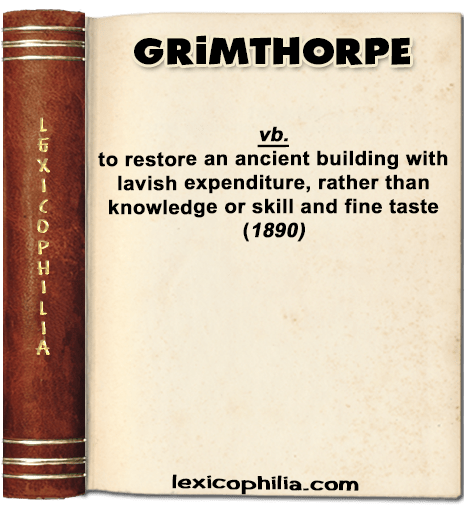
Word of the Day: GRIMTHORPE


ETYMOLOGY
from the name of Sir Edmund Beckett, first Lord Grimthorpe (1816–1905), whose restoration of St. Albans Cathedral, completed in 1904, aroused fierce criticism and controversy


EXAMPLE
“…Talking of Lord Grimthorpe reminds us of an honour that has recently been done unto his name. It shall not be the Antiquary’s fault if this honour is not perpetuated; so that, perchance, the dictionaries of the future may immortalize his titular name in the same way as they have already treated the family appellation of Boycott. Last November, a group of appreciative visitors were standing in the nave of the abbey church of Selby, discussing its probable reparation. “Ah!” remarked one, “if only the wealthy and generous man could be found, what a fine field for his labours!” To this a keen and well-known Yorkshire ecclesiologist replied: “Heaven forbid! the building might be grimthorped!…”

From: The Antiquary,
A Magazine Devoted to the Study of the Past, Vol. XXI, January – June, 1890
‘Notes of the Month’

Word of the Day: GYNOPHAGITE


ETYMOLOGY
from gyno– (combining form denoting female, woman) + Greek -ϕαγος (eating) + -ite


EXAMPLE
“…If our Ulysses, thus rejuvenated by his Minerva, has not fully made up his mind to make
a Penelope of Miss Jemima, all I can say is, that he is worse than Polyphemus, who was only an Anthropophagos; —
He preys upon the weaker sex, and is a Gynophagite
!…”

From: My Novel
By Edward Bulwer-Lytton, 1853

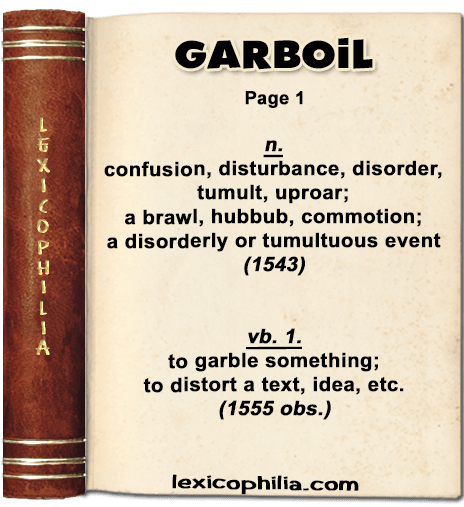
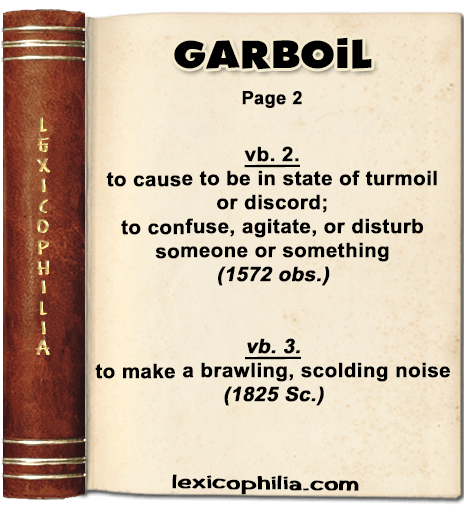
Word of the Day: GARBOIL


ETYMOLOGY
apparently from Old French garbouille (confused mess, confusion, disorder), of uncertain and disputed origin;
From the O.E.D.: “it is likely that this word and the related garboil v. have been associated with garble v. and garble n., and probably regarded as variants of these”


EXAMPLE
“…and after long and mature debating off the mattar, forasmuch as itt appeared the Mayor to have ben a great sturrer of this garboyle, and to be a man that att sondry tymes hadde deluded wyth delayes the sayde commissioners whereby the matter cowlde grow to none ende…”

From: Selections from the Records of the City of Oxford
Edited by Willilam H, Turner, 1880
1543, May 22. Decree of the Privy Councell in the matters of Difference between the University and City.

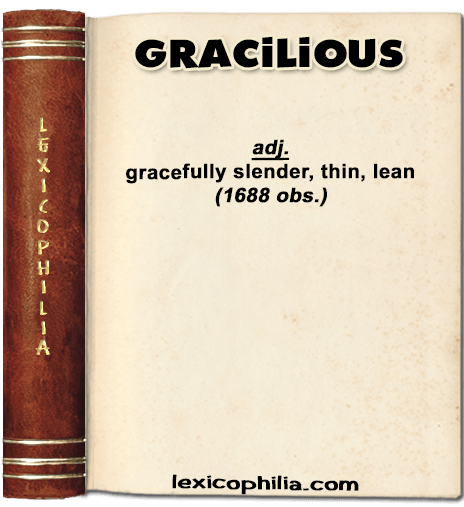
Word of the Day: GRACILENT


ETYMOLOGY
from Latin gracilentus (slender, thin),
from gracilis (gracile, gracefully slender) + -entus


EXAMPLE
“…his old  scratch-wig  awry,  and  his  garments  sadly  bespeaking wretchedness;  we  think  we  can  see  him, with  this  outward  repulsiveness  of  appearance,  sitting down  to  give  a  gracilent  opinion  of  the  canine species…”

From: The Ladies’ Repository
A Monthly Periodical Devoted to Literature and Religion, January, 1852
“Thoughts on a Canine Subject”
By James Pummill

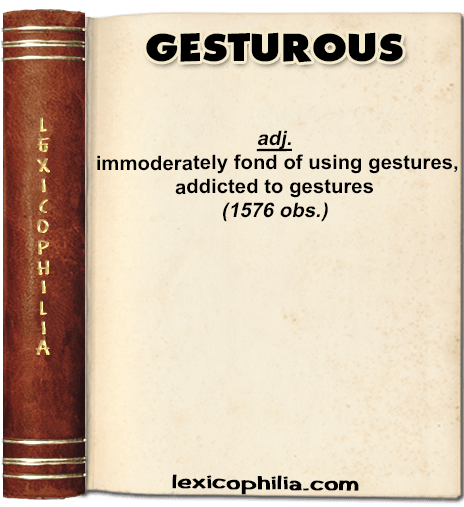
Word of the Day: GESTUROUS


ETYMOLOGY
from gesture + -ous


EXAMPLE
“…vvhich hath learned to spoyle & deuour folk to make vvidovves, destroy their houses, & make their Cities desert. Some be as foyinge, gesturous, and counterfeicting of any thing by ymitacion as Apes. Some Forlyke, are suttle, wylie, deceiptfull, and crafty to entrappe and catche the innocent at aduauntage…”

From: The Touchstone of Complexions
By Levinus Lemnius
Translated by Thomas Newton, 1576

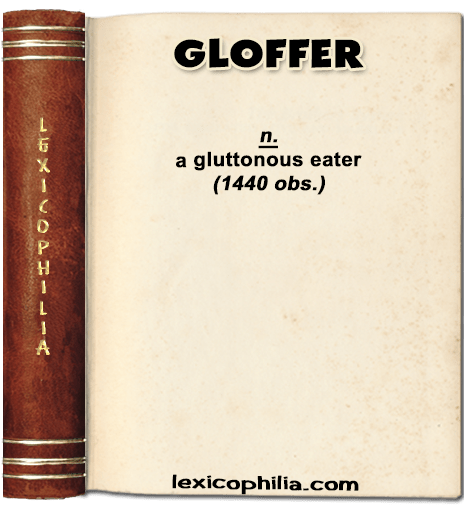
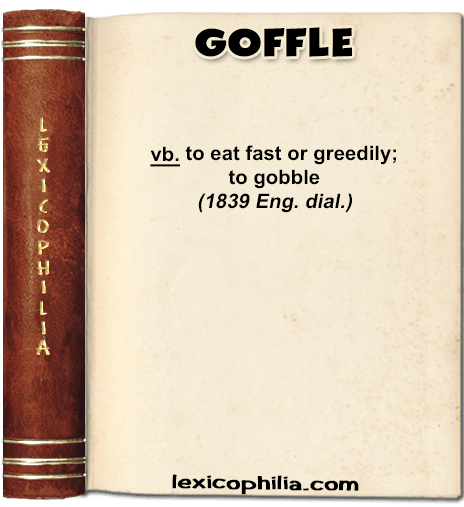
Word of the Day: GOFFLE


ETYMOLOGY
alteration of gobble


EXAMPLE
“…A dinner nice the oad folks have,”
At race-time, ollis ‘ood, –
That day, they had a toad-in-hole,
A dish that’s deadly gud

But when oad Styles to goffle it,
Bargun, he soon ded cry out: –
“Missus! I thinks as how, taa-day,
“Yow’ve put the meller’s eye out!…”

From: John Noakes & Mary Styles:
Or, “An Essex Calf’s” Visit to Tiptree Races
By Charles Clark, 1839

Word of the Day: GUMPLE-FOISTED


ETYMOLOGY
from Scots gumple (to be in a bad mood, to sulk, and as a noun, a fit of the sulks) + feist (found in other formations of similar meaning, e.g. bumple feist (the sulks), amplefeist (a sulky mood)) + -ed


EXAMPLE
“…Aweel, aweel,’ said Peter Peebles, totally unabashed by the repulse, ‘e’en as ye like, a wilful man maun hae his way; but,’ he added, stooping down and endeavouring to gather the spilled snuff from the polished floor, ‘I canna afford to lose my sneeshing for a’ that ye are gumple-foisted wi’ me‘….”

From: Redgauntlet: A Tale of the Eighteenth Century
By Sir Walter Scott, 1824