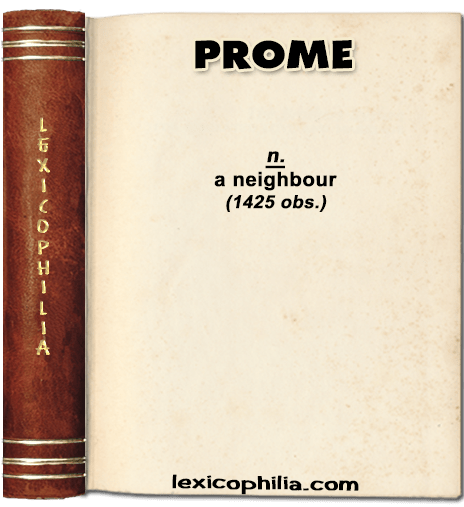
Word of the Day: PROME

ETYMOLOGY
from Old French promeproesme, and Middle French proisme (near), also as (n.) a neighbour, from Latin proximus (nearest)

EXAMPLE
“… First sal ye luue god wid al yure herte and wid al yure saul and wid al yure uertu, And ti prome als ti-self; sua ah ye at do …”

From: Three Middle-English versions of the Rule of St. Benet, a1425
By Saint Benedict, Abbot of Monte Cassino.
Edited by Ernst Albin Kock
Early English Text Society edition, 1902

Word of the Day: PROPUDIOUS

ETYMOLOGY
from Latin propudiosus (shameful, infamous), from propudium (a shameful action),
(from pro- pudere (to make ashamed) + -ium) + -osus (-ous)

EXAMPLE
“… Yea in the Cirque or Race-yard, (where was the greatest Concourse of People) they de-cryed Iulian; calling vpon Niger, the chiefest Officer of the sacred Empire, to vindicate the Roman State, and hasten to free them from that propudious Gouernour . ….”

From: Herodian of Alexandria His History of Twenty Roman Cæsars
Interpreted out of the original Greek by James Maxwell, 1629

Word of the Day: PREVIANT

ETYMOLOGY
from Latin praeviant-praevians, present participle of præviare (to go before), 
from præ-, (pre-) + viare to travel

EXAMPLE
“… Thirdly, and most especially, because that God oftentimes pardoning the ignorance, which men have of Himselfe and the creature, doth so enlighten the heart with His Holy Spirit, that it is suddenly framed without any previant knowledge, to faith and obedience. …”

From: A Treatise Concerning the Trinitie in Unitie
By Alexander Gil, 1601

Word of the Day: PHILOFELIST

ETYMOLOGY
from philo, combining form (loving, having an affection for) + Latin feles (cat) + -ist

EXAMPLE
“… An extract from the Register of Cat’s Eden has got abroad, whereby it appears that the Laureate, Dr. Southey, who is known to be a philofelist, and confers honours upon his Cats according to their services, has raised one to the highest rank in peerage, promoting him through all its degrees by the following titles, His Serene Highness the Arch-Duke Rumpelstilzchen, Marquis Macbum, Earl Tomlemagne, Baron Raticide, Waowlher and Skaratchi. …”

From: The Doctor, &c.
By Robert Southey, 1847

Word of the Day: PECKSNIFF

ETYMOLOGY
from the name of Mr. Pecksniff, a hypocritical character in Charles Dickens’s novel “The Life and Adventures of Martin Chuzzlewit

EXAMPLE
“… Should Welby Pugin ever favour us with a Supplement to his Contrasts, he will uo doubt bring forward as one most egregious instance of architectural bathos the unlucky structure commented upon in the preceding paragraph. He might also hold up for reprehension a good many Pecksniff specimens of Gothic and Tudor of very recent date – certainly more recent than would be imagined, for some of them seem to be almost twin-brothers to Strawberry Hill, or else to the front of Guildhall …”

From: The Civil Engineer and Architect’s Journal, Scientific and Railway Gazette
Volume 7, 1844

Word of the Day: PIGRITUDE

ETYMOLOGY
from Latin pigritudo (laziness); from Latin pigr-piger (lazy) + ‑itudo (itude)

EXAMPLE
“… But, with a little thoughtful frequenting, those deserted river-sides become contemplative and pleasant rambling-places, and, if some whim of fashion do not make the bank of the Hudson like the Marina of Smyrna, a fashionable resort, I have my Sunday afternoons provided for, during the pigritude of city durance. …”

From: Dashes at Life With a Free Pencil
By Nathaniel Parker Willis, 1845

Word of the Day: PLENIPOTENT

ETYMOLOGY
from Latin plenipotensplenipotent, from Latin pleni- (full) + potens (potent, powerful)

EXAMPLE (for adj.)
“… (being now grown by their rents and Lordly dignities, by their power over the Ministers and other liege’s, by their places in Parliament, Council, Session, Exchequer, and high Commission to a plenipotent dominion and greatness) they frame a book of Canons for ruling the Kirk and disposing upon religion at their pleasure. …”

From: The Remonstrance of the Nobility, Barrones, Burgesses, Ministers and Commons within the Kingdom of Scotland,
Church of Scotland. General Assembly, 1639

Word of the Day: PLISKY

ETYMOLOGY
of obscure origin

EXAMPLE (for n. 1.)
“… They ‘re fly’d at the heart, it’l be a black Bargain for poor Scotland: for the Engleses are owr auld farren for us, and there’s little Ground to think, they ‘ll gee
us a seen Vantage wee their will, they neer liked us sae well; and its naе forgotten yet, the foul
Plisk they play’d us about our Caledonia Business; …”

From: The Scottish Antiquary Or Northern Notes and Queries
Volume XII, January 1898
A Copy of a Letter from a Country Farmer To His Laird, a Member of Parliament, 1706

Word of the Day: PLURANIMOUS

ETYMOLOGY
from Latin plusplur- (more) + animous;
after unanimous (from Latin unanimisunanimus [from unus (one) + animus (mind)] + -ous)

EXAMPLE
“… Should I make a parallel of this present Basis with the former, & were I sure my Mare would not stumble, I could demonstrate it to be Heterogeneous, Heterodoxous, Incongrous, Omnigenous, Pluranimous, Versipellous, Centireligious, Nummiamorous; I thought I should hit it at length, but I take in Army and all, or else my Mare would soone stand on her head. …”

From: Discolliminium, or, A most obedient reply to a late book, called, Bounds & bonds, so farre as concerns the first demurrer and no further
By B. (Nathaniel Ward), 1650