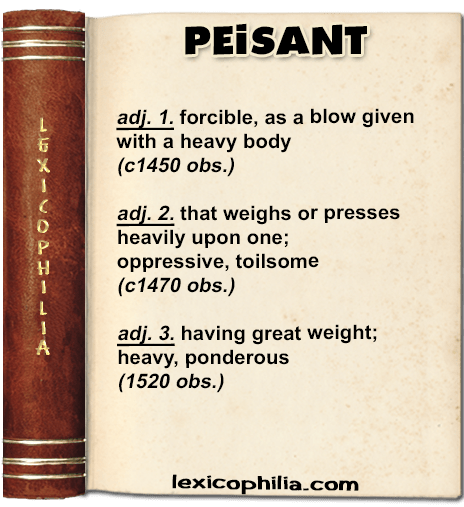
Word of the Day: PEISANT

ETYMOLOGY
from Anglo-Norman peisantpeisauntpesaunt, Anglo-Norman and Middle French pesant (of things – heavy, massive, oppressive, wearisome, difficult), (of the hand, a blow, etc. – forcible, coming down heavily), (of people – slow, sluggish), use as adjective of present participle of peiser , peser (to weigh)

EXAMPLE
“…But as for so poure a man as I, there would none aduocate pleden without wages paid byfore in honde; for pledours in worldly courtes hauen tonges lyke to t he languet of the balaunce that draweth hym alwey to the more peysaunt party, that better wyl rewarden…”

From: The Booke of the Pylgremage of the Sowle,
Translated from the French of Guillaume de Deguileville

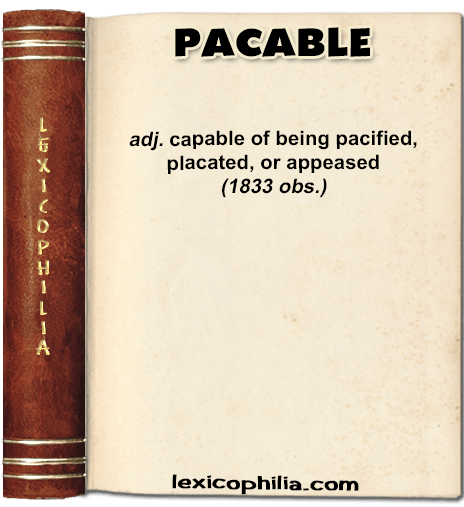
Word of the Day: PACABLE

ETYMOLOGY
from Latin pacabilis (placable),
from pacare (to appease, pacify) + -bilis (-ble)

EXAMPLE
“…Divil a worse, sir, yet not more now than ever. – Time immemorial, – wasn’t it always so? a house burned here, and a pacable tinant carded there; one villain murthering another, for teeking land over his head…”

From: Dramatic Scenes from Real Life
Manor Sackville
by Lady Sydney Morgan, 1833

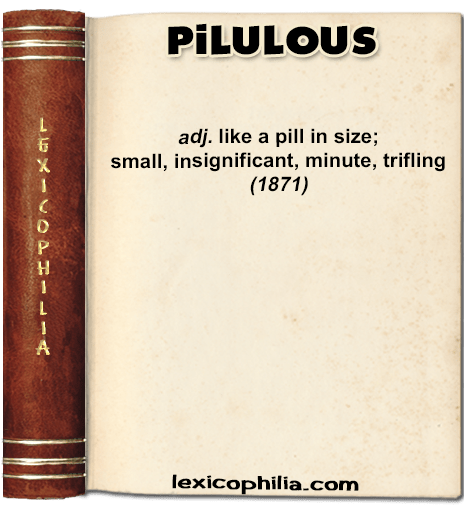
Word of the Day: PILULOUS

ETYMOLOGY
from Latin pilula (pill) + -ous

EXAMPLE
“…Dorothea’s inferences may seem large; but really life could never have gone on at any period but for this liberal allowance of conclusion, which has facilitated marriage under the difficulties of civilization. Has anyone ever pinched into its pilulous smallness the cobweb of pre-matrimonial acquaintanceship?…”

From: Middlemarch
– George Eliot, 1871

Word of the Day: PROSPICIENT

ETYMOLOGY
from Latin prōspicient-prōspiciēns (provident, cautious),
present participle of prōspicĕre (to look forward)

EXAMPLE
“…But for­tune prospicient to the Original of Rome, did provide a Woolf to give suck to the children, who having lost her whelps, and de­siring to emptie her teats, did offer her self as a Nurse to the Infants, and returning often to the children, as to her own young ones…”

From: The History of Ivstine:
taken out of the four and forty books of Trogus Pompeius… together with the Epitomie of the lives and manners of the Roman Emperors 
– Marcus Junianus Justinus
– translated by Robert Codrington, 1654

Word of the Day: PROSTIBULE

ETYMOLOGY
– from Latin prōstibulum (a prostitute, also a brothel),
from prōstāre (to stand forth publicly as for sale), + -bulum (suffix denoting instrument)

EXAMPLE
“…Jack Reacher: What I mean is, the cheapest woman tends to be the one you pay for.
– Sandy: I am not a prostibule!
– Jack Reacher: Well, a prostibule would get the joke
…”

From: The movie “Jack Reacher”
(the original word ‘hooker‘ has been replaced with ‘prostibule‘)

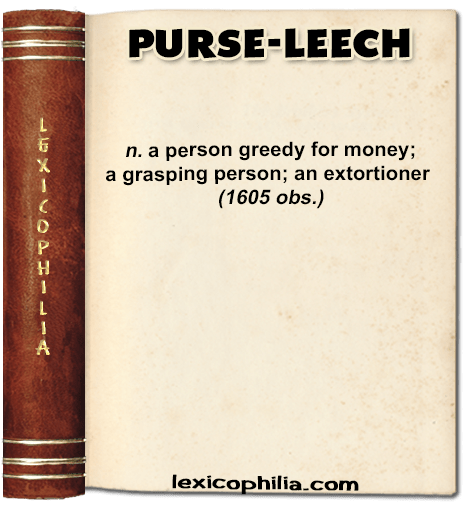
Word of the Day: PURSE-LEECH

ETYMOLOGY
– from purse (receptacle for money) + leech (a person who will ‘stick to’ another for the purpose of getting gain out of him)

EXAMPLE
“…False Counsellors (Concealers of the law),
Turn-coate Attornes, that with both hands draw,
Slie Peti-foggers, Wranglers at the barr,
Proud purse-leaches, Harpies of Westminster,
With fained chiding, and foul iarring noise
Breake not his braine, nor interrupt his ioyes
…”

From: Bartas his deuine weekes and workes
– Guillaume de Saluste Du Bartas 
Translated and dedicated to the Kings most excellent Maiestie By Iosuah Syluester 
(translated by Joshua Sylvester) 

Word of the Day: POWFAGGED

ETYMOLOGY
– from pow, variant of poll (the top of the head) + fagged (extremely tired)

EXAMPLE
“…Ther’s some sort o’ rumption gooin on ‘ith country, no deawt, an’ wi’st be gettin lurked, or lawmt, or powfagged some road, so let’s turn back while us booan are whul…”

From: Tales and Sketches of Lancashire Life
By Benjamin Brierley, 1862

Word of the Day: PERNEGATE

ETYMOLOGY
from ppl. stem of Latin pernegāre (to deny altogether),
from per- + negāre (to deny)

EXAMPLE
(the below example is for the noun pernegation – absolute denial)

“…I and my Friends shall be allowed the full benefit of all the variations, interpretations, reservations, postvariations, tergiversations, excusations, contemporations, pernegations, alterations, illaqueations, extrications, devotions, mentimutations, rementimutations, distinctions, evasions, possessions, plenipotentialities and fedifractions…”

From: Discolliminium;
Or, A most obedient reply to a late book
By Nathaniel War

Word of the Day: PAUCILOQUENT

ETYMOLOGY
– from Latin pauci- (comb. form. of Latin paucus few, little)
+ -loquent (speaking)

EXAMPLE
“…There was a sharp lawyer, one P-,
Whose thoughts never got through his still lips;
And all he would say was “ah!” “h’m!” “oh!” and “ay
This pauciloquent person named P-
…”

From: Ye Book of Copperheads
Checker-Boarders and Keystoners
Charles Godfrey Leland, 1863

Word of the Day: PHILOCALIST

ETYMOLOGY
– from ancient Greek ϕιλόκαλος (loving the beautiful);
from ϕιλο- (philo-) + καλός (beautiful) + –ist (suffix)

EXAMPLE
…This poor, vindictive, solitary, and powerful creature, was a philocalist: he had a singular love of flowers and of beautiful women.”

From: Horae Subsecivae
Locke and Sydenham, with other occasional papers
By John Brown · 1858