Word of the Day: PLENITUDINARY


ETYMOLOGY
from Latin plenitudinarius (full, complete, plenary),
from Latin plenitudin-plenitudo (abundance, fullness, fullness of shape, thickness, full amount, the whole) + -arius (-ary)


EXAMPLE
“…and a strange kind of Government must that needs be, wherein the Servants Throne is above his Masters, and a Subject shall have a plenitudinary power beyond that which his Lord and King had, or, as the times then were, was capable of …”

From: An Historical and Political Discourse of the Laws & Government of England from the First times to the End of the Reign of Queen Elizabeth
By Nathaniel Bacon, 1647
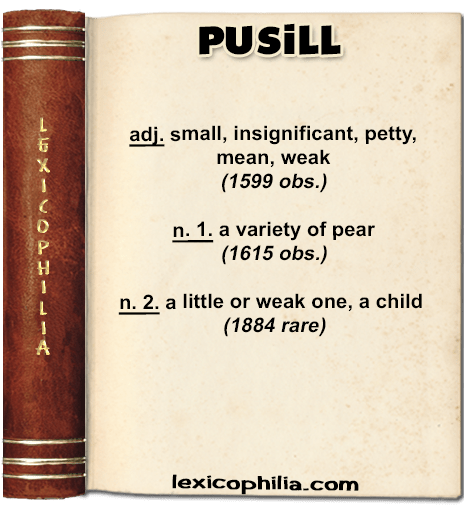
Word of the Day: PUSILL


ETYMOLOGY
from: a) Middle French pusillepuzilpusil (very small, weak),
b) Latin pusillus (very small, insignificant, petty) from pusus (boy) + -illus 


EXAMPLE
“…And to amase her weake, and pusill minde,
In creepe through crannies of imagination.
Deformd Idean formes, and phansies blinde.
Sent foorth by hir sicke sences, instigation.
Like staringe greisly fendes, threatninge invasion.
Presenting to her heart, the homely iarres.
And houshold cares, accurringe nuptiall warres…”

From: Eustathia, or the Constancie of Susanna
By Robert Roche, 1599

Word of the Day: PANICHTHYOPHAGOUS


ETYMOLOGY
from Greek πᾶν, pan, (“all”, “of everything”, “involving all members” of a group)
+ from Latin ichthyophagus,
from Greek ἴχθυοϕάγος  from Greek ἰχθυο- (fish-) + -ϕάγος (eating),
from ϕαγεῖν (to eat) + -ous


EXAMPLE
“…The caranx, trachurus, or bastard mackerel, probably corresponds with the individual so called by Oppian and Athenaeus. It abounds in the Mediterranean, and is a dry coarse fish, fit only for hungry boatmen and panichthyophagous puss…”

From: Fraser’s Magazine for Town and Country
Volume 47, March 1853
The Caranx

Word of the Day: PHILOXENY


ETYMOLOGY
from Latin philoxenia (love of strangers; eagerness to show hospitality);
or: from Greek ϕιλοξενίζειν from ϕιλόξενος (philoksenos) (loving hospitality or strangers), from ϕιλο- (philo-) + ξένος (xenos) (stranger) + -ia (-y)


EXAMPLE
“…for by this philoxeny, the virtue inclining and disposing the mind to the entertainment of strangers, is in the first place intended…”

From: An Exposition of the Epistle to the Hebrews
By John Owen, 1814

Word of the Day: PHOTOGENY

ETYMOLOGY
from photo- (comb. form; relating to light) + -geny (comb. form; general sense = mode of production)

EXAMPLE
“…IMPROVEMENTS IN THE DAGUERREOTYPE. — Numerous improvements have been lately made in the beautiful art of photogeny….”

From: Burton’s Gentleman’s Magazine
A Chapter on Science and Art
By Edgar Allen Poe
Volume VI, April, 1840

Word of the Day: PAPELARD

ETYMOLOGY
from French papelard, papelart
as per OED: further etymology uncertain and disputed

EXAMPLE
“…Þe zeuende boȝ of prede ys fol drede and fole ssame huane me let wel to done uor þe wordle þet me ne by yhyealde ypocrite ne papelard huer me dret more þe wordle: þanne god…”

(The seventh bough of pride is foolish dread and foolish shame, when one ceases to do well because of the world, that one be not held a hypocrite or a canter, where one dreads the world more than God)

From: Dan Michel’s Ayenbite of Inwyt : or, Remorse of Conscience, 1340
Translation from: The Ayenbite of Inwyt, A Translation of Parts into Modern English
By A.J. Wyatt

Word of the Day: PIPPIN-HEARTED

ETYMOLOGY
from pippin, from Anglo-Norman pepinpepinepopin and Middle French pepin (seed or pip of a fleshy fruit), possibly a derivative of a Romance base meaning ‘small’

EXAMPLE
“…and were put under the command of very valiant tailors and man-milliners, who, though on ordinary occasions the meekest, pippin-hearted little men in the world, were very devils at parades and court-martials, when they had cocked hats on their heads, and swords by their sides…”

From: A History of New York,
From the Beginning of the World to the end of the Dutch Dynasty
By Washington Irving, 1809