Word of the Day: PACIFICATE

ETYMOLOGY
from Latin pacificat-, past ppl. stem of pacificare (to make peace, to pacify)

EXAMPLE
“…It mitigateth anger, letificateth those that bee sad, pacificateth such as are at discord. It temperateth choler, and (to conclude all in a word) it expelleth all vagrant, wandring, and imagi­nary cogitations whatsoeuer…”

From: The Secrets of Nvmbers.
According to Theologicall, Arithmeti­call, Geometricall and Harmoni­call Computation
By William Ingpen, 1624

Word of the Day: POLITIZE

ETYMOLOGY
from polity (a particular form of government or political organization),
from obsolete French politie, from Latin polītīa (state, government) + –ize

EXAMPLE
“…Matters of state we vse to politize,
Procrastinating for aduantage great,
LOVE, lingring hates, and lothes to temporize,
Delaie’s too olde, for his orewarmed heate:
Ah, doe not driue me of thus (still) in vaine,
Still for to lose tis much, once let me gaine
…”

From: Alba The Months Minde of a Melancholy Louer
By Robert Tofte, 1598

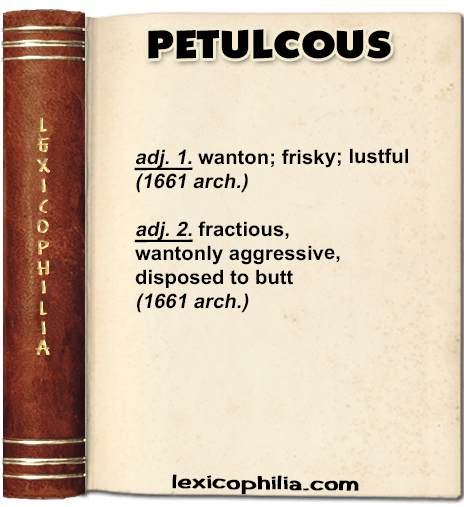
Word of the Day: PETULCOUS

ETYMOLOGY
from Latin petulcus (inclined to butt, butting, wanton, frisky);
(from petĕre – to aim at, assail + -ulcus (suffix forming adjectives) + -ous

EXAMPLE
“…But what does the Pape or Christian Pastour do in this case When the tumult is once raised and a disorder begun in any part of his flock by som proud turbulent spirit amongst them, the Pape first whistles him and his fellow petulcous rams into order by charitable admonition which still encreases lowder by degrees…”

From: Fiat Lux:
Or, A general Conduct to a right understanding and charity in the great Combustions and Broils about Religion here in England, Betwixt Papist and Protestant, Presbyterian and Independent
By John Baptist Vincent Canes

Word of the Day: PORNERASTIC

ETYMOLOGY
from Greek πορνo- (porno- comb. form) + ἐραστής (lover) + –ic

EXAMPLE
“…We hear nothing of those petit creve vices, those pornerastic habits in high places, those Diamond-necklace scandals, those unmentionable gambols of the Porphyro-geniti, which are too often thrust before our eyes in fiction, and indeed in fact…”

From: The Fortnightly Review
Edited by John Morley,
Vol. VII New Series, January to June, 1870
The Romance of the Peerage

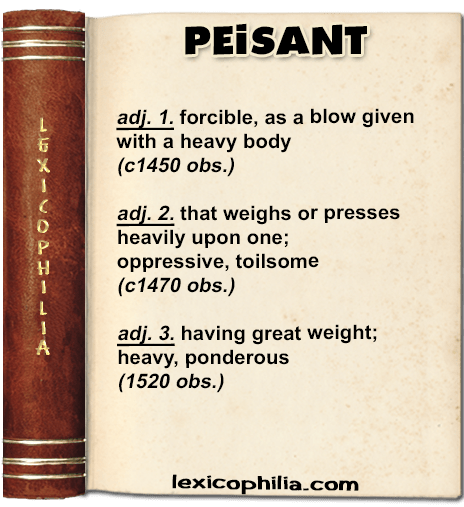
Word of the Day: PEISANT

ETYMOLOGY
from Anglo-Norman peisantpeisauntpesaunt, Anglo-Norman and Middle French pesant (of things – heavy, massive, oppressive, wearisome, difficult), (of the hand, a blow, etc. – forcible, coming down heavily), (of people – slow, sluggish), use as adjective of present participle of peiser , peser (to weigh)

EXAMPLE
“…But as for so poure a man as I, there would none aduocate pleden without wages paid byfore in honde; for pledours in worldly courtes hauen tonges lyke to t he languet of the balaunce that draweth hym alwey to the more peysaunt party, that better wyl rewarden…”

From: The Booke of the Pylgremage of the Sowle,
Translated from the French of Guillaume de Deguileville

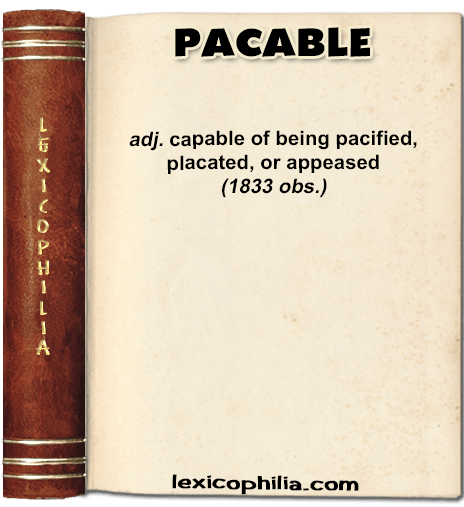
Word of the Day: PACABLE

ETYMOLOGY
from Latin pacabilis (placable),
from pacare (to appease, pacify) + -bilis (-ble)

EXAMPLE
“…Divil a worse, sir, yet not more now than ever. – Time immemorial, – wasn’t it always so? a house burned here, and a pacable tinant carded there; one villain murthering another, for teeking land over his head…”

From: Dramatic Scenes from Real Life
Manor Sackville
by Lady Sydney Morgan, 1833

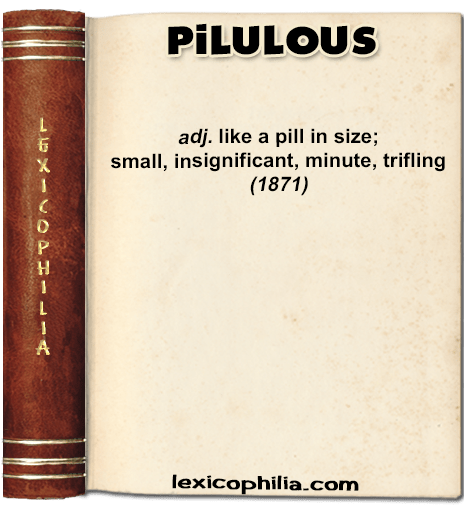
Word of the Day: PILULOUS

ETYMOLOGY
from Latin pilula (pill) + -ous

EXAMPLE
“…Dorothea’s inferences may seem large; but really life could never have gone on at any period but for this liberal allowance of conclusion, which has facilitated marriage under the difficulties of civilization. Has anyone ever pinched into its pilulous smallness the cobweb of pre-matrimonial acquaintanceship?…”

From: Middlemarch
– George Eliot, 1871

Word of the Day: PROSPICIENT

ETYMOLOGY
from Latin prōspicient-prōspiciēns (provident, cautious),
present participle of prōspicĕre (to look forward)

EXAMPLE
“…But for­tune prospicient to the Original of Rome, did provide a Woolf to give suck to the children, who having lost her whelps, and de­siring to emptie her teats, did offer her self as a Nurse to the Infants, and returning often to the children, as to her own young ones…”

From: The History of Ivstine:
taken out of the four and forty books of Trogus Pompeius… together with the Epitomie of the lives and manners of the Roman Emperors 
– Marcus Junianus Justinus
– translated by Robert Codrington, 1654

Word of the Day: PROSTIBULE

ETYMOLOGY
– from Latin prōstibulum (a prostitute, also a brothel),
from prōstāre (to stand forth publicly as for sale), + -bulum (suffix denoting instrument)

EXAMPLE
“…Jack Reacher: What I mean is, the cheapest woman tends to be the one you pay for.
– Sandy: I am not a prostibule!
– Jack Reacher: Well, a prostibule would get the joke
…”

From: The movie “Jack Reacher”
(the original word ‘hooker‘ has been replaced with ‘prostibule‘)