ETYMOLOGY
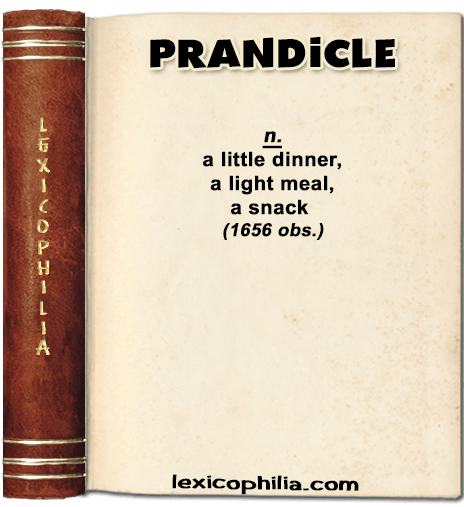
from Latin prandiculum (a light meal),
from prandium (luncheon) + -culum (-cule)
EXAMPLE
Most children cannot make it through to the evening meal without a prandicle.
ETYMOLOGY
from Latin prandiculum (a light meal),
from prandium (luncheon) + -culum (-cule)
EXAMPLE
Most children cannot make it through to the evening meal without a prandicle.

ETYMOLOGY
from Middle French preallable (preceding, preliminary);
from preal(l)er (to precede);
from pre- + aller (to go) + -able
EXAMPLE
“… And it was not to bee modelled or directed by the patterne of regular and remisse friendship, wherein so many precautions of a long and preallable conversation, are required. This hath no other Idea than of it selfe, and can have no reference but to it selfe. …”
From: The Essayes, or Morall, Politike, and Millitarie Discourses of Lord Michaell de Montaigne
Translated by John Florio, 1603
Of Friendship
ETYMOLOGY
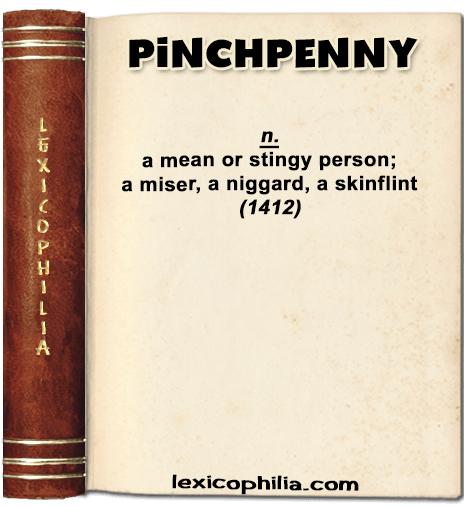
from pinch- (comb. form) + penny
EXAMPLE
“… A prince & kyng of al a regioun
Mot avarice thrist a-doune to grounde;
To hym þat lith in helle depe I-bounde,
The, auarice, by-take I to kepe;
Thow pynepeny, [pynchepeny] ther ay mot þou slepe! …”
From: Hoccleve’s Works,
Edited by Frederick J. Furnivall, 1892
De Regimine Principum
By Thomas Hoccleve, Composed c1412

ETYMOLOGY
reduplicated extension of prattle (to talk in a foolish, childish, or inconsequential way)
EXAMPLE (for vb.)
“… they are poore honest folkes, and haue here an honest company at their mariage, now they lacke wyne, I pray you helpe, She was not long in bibble bable, with saying she wist not what, but sayth at one word, helpe for it is nede. She doth not, as our Papistes do, whiche prittle prattle a whole day uppon their Beades, saying our Ladyes Psalter. But she only sayth, they haue no wyne; helpe. etc. …”
From: Frutefull Sermons
A Sermon Preached by Hugh Latymer, a1552
ETYMOLOGY
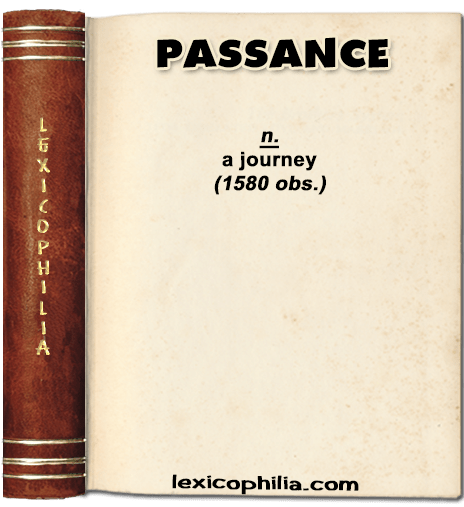
from passant (passing by or along, going, proceeding; travelling, journeying)
EXAMPLE
“… Thus passed they their passance, and wore out the wéerie way with these pleasant discourses, & prettie posies, where after their tedious toyle, they came to their Inne, where Phemocles coulde neither eate meate for ioy, nor sléepe in his bedde for the pleasure he cōceiued of his trauell. ..”
From: Narbonus The Laberynth of Libertie
By Austin Saker, 1580

ETYMOLOGY
from Latin pridianus (relating to the previous day),
from pridie (adv. on the day before),
from pri- before + dies a day + -anus (-an)
EXAMPLE
“… This Gann, I take it, has similar likings, for I hear him occasionally at midnight floundering up the stairs (his boots lie dirty in the passage)—floundering, I say, up the stairs, and cursing the candlestick, whence escape now and anon the snuffers and extinguisher, and with brazen rattle disturb the silence of the night. Thrice a−week, at least, does Gann breakfast in bed—sure sign of pridian intoxication; and thrice a−week, in the morning, I hear a hoarse voice roaring for ‘my soda−water.’ How long have the rogues drunk soda−water? …”
From: A Shabby Genteel Story,
And Other Tales.
By: William M. Thackeray, 1840
How Mrs. Gann received two lodgers.
ETYMOLOGY
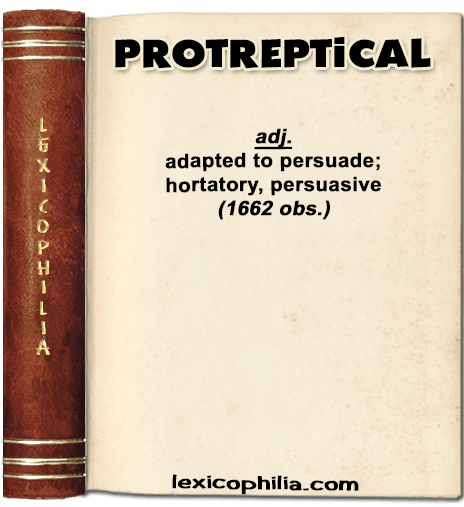
from Latin protrepticus or its etymon ancient Greek προτρεπτικός (hortatory, instructive) < προ- (pro-) + Greek τρεπτικός (causing change in),
from Greek τρεπτός (liable to be turned or changed)
(from τρέπειν (to turn, direct the course of) + ‑τός)) + ‑ικός (‑ic) + -al
EXAMPLE
“… For the matter, we find, that these words are joyned with the antecedent Doctrine concerning the Excellency of Christ both as Prophet and Priest; and so it’s the second part of the whole, which is, 1. Doctrinal. 2. Practical. For, the former part is didascalical, this latter protreptical and more practical. But if we consider the immediate Connexion, then it will appear, that it’s in a more special manner joyned with the Doctrine of Christ’s Priest-hood, …”
From: An exposition of the Epistle to the Hebrewes
By George Lawson, 1662

ETYMOLOGY
from past participial stem of Latin pertolerat- (to bear out, endure to the end)
EXAMPLE
It seems impossible that anyone could pertolerate such pain for so long.

ETYMOLOGY
from Latin pigritia (laziness, sluggishness, sloth) + -ous
EXAMPLE
“… Now if Stercus and Ʋrina can bee pickt out of the vanities of Cornelius Agrippa, it shal be thrown upon the purple robes of the Physician, by the ignorant or impudent. For Science hath no enemy but ignorance, nor is vilified among any except pigritious and impudent persons. Then let the ignorant prattle, still the Physitian shall be the instrument of all common good in a Republique, and if no valetudinarie man of any condition bee able to effect any solid good, either to his King, Countrie, or selfe, as he is not, and the power of restoring and healing him, bee given principally to the Phisician …”
From: The Tree of Humane Life, or, The Bloud of the Grape
By Tobias Whitaker, 1638

ETYMOLOGY
from Greek ποικίλος (poikilos) (many-coloured, variegated, various):
a formative element in scientific terms + Greek ὄνοµα (onoma), ὄνυµα (name)
EXAMPLE
“… Considering that the Parliament House (the “Sansad Bhavan”) and the seat of the President (the “Rashtrapati Bhavan”) are both situated in New Delhi – which is the capital of the country – the name of the city is frequently used as a poecilonym for the Government of India. …”
From: The Sovereign
Sprouts Of Good Governance
By Kislay Panday, 2022
PRONUNCIATION
PEE-suh-luh-nim
 Lexicophilia