Word of the Day: POECILONYM

ETYMOLOGY
from Greek ποικίλος (poikilos) (many-coloured, variegated, various):
a formative element in scientific terms + Greek ὄνοµα (onoma), ὄνυµα (name)

EXAMPLE
“… Considering that the Parliament House (the “Sansad Bhavan”) and the seat of the President (the “Rashtrapati Bhavan”) are both situated in New Delhi – which is the capital of the country – the name of the city is frequently used as a poecilonym for the Government of India. …”

From: The Sovereign
Sprouts Of Good Governance
By Kislay Panday, 2022

PRONUNCIATION
PEE-suh-luh-nim
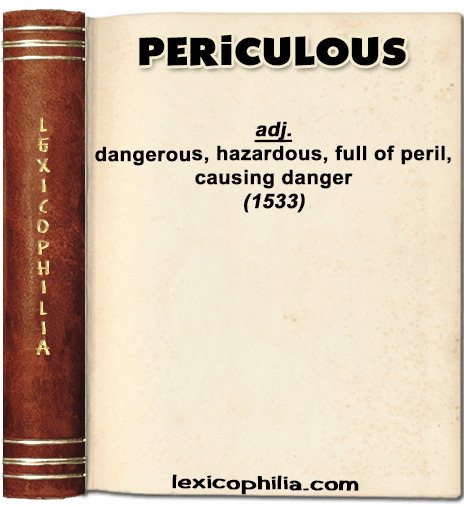
Word of the Day: PERICULOUS

ETYMOLOGY
from Latin periculosus (dangerous, full of danger), from periculum (danger, peril) + –osus (-ous)

EXAMPLE
“… That Saturn the enemy of life, comes almost every seventh year, unto the quadrate or malevolent place; that as the Moon about every seventh day arriveth unto a contrary sign, so Saturn, which remaineth about as many years, as the Moon doth daies in one sign, and holdeth the same consideration in years as the Moon in daies; doth cause these periculous periods. Which together with other Planets, and profection of the Horoscope, unto the seventh house, or opposite signs every seventh year; oppresseth living natures, and causeth observable mutations, in the state of sublunary things. …”

From: Pseudodoxia Epidemica, 
Or, Enquiries Into Very Many Received Tenents, and Commonly Presumed Truths.
By Thomas Brown, 1650
Chapter XII Of the great Climacterical year, that is, Sixty three.

PRONUNCIATION
puh-RICK-yuh-luhss

Word of the Day: PERCULSIVE

ETYMOLOGY
from Latin perculs-, past participial sterm of percellere (to upset, strike with consternation) + -ive

EXAMPLE
“… But grant that ONELY bee an alleuiating particle, yet it is so by comparison: and so is an OATH, a tryall of more ease, both to body and minde then are those other meanes by Rackes and tortures (vsuall in the Inquisition:) for as the peines are vnsufferable to flesh and blood, so haue they a very perculsiue force euen vpon the Soule, Nam & innocentes cogit mentiri door, saith the Stoicke, because in so many streights, of terrour, payne, hope, feare, nihil veritati loci relinquitur, as the Orator well obserued, (let Aelian speake of the Egyptians courage or insensiblenes what he will): men will say any thing (though most vnture) for ease and release from such pangs. …”

From: An Answer to a Catholike English-man
By William Barlow, 1609

Word of the Day: PERPOTATION

ETYMOLOGY
from Latin perpotation-perpotatio (continued drinking, drinking bout), 
from perpotat-, past participial stem of perpotare (to drink heavily),
from per- + potare (to drink) + ‑io (-ion) 

EXAMPLE
“… How could the inner man be capable of appreciating epic, when the outer man had been clogged with so much adventitious matter? Some of the guests seemed eminent professors of perpotation. My host was old, but still a literary enthusiast. His poetic fire had increased with his corporeal frigor. …”

From: The Mirror of Literature, Amusement, and Instruction
Containing Original Essays, Historical Narratives….
Volume VIII. 1826
“Epicism”

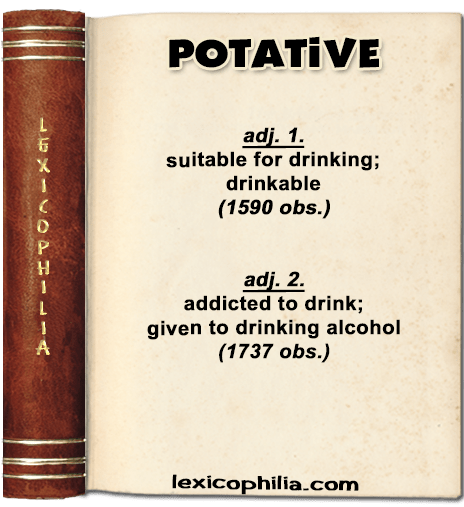
Word of the Day: POTATIVE

ETYMOLOGY
from Latin potat-, past participial stem of potare (to drink) + ‑ive

EXAMPLE
“… desireth to cure these or such like infectious diseases, must chiefly prepare and season the body with waters of cold and naturall hearbes, in the first and second degree, be­fore the disease be possessed: then foorthwith flux the body, by some gentle and potatiue electuarie, in equall and artificial de­gree, fauourably casting out the infected humours. …”

From: The Flower of Phisicke
VVherein is perfectlie comprehended a true introduction and method for mans assured health
By William Clever, 1590

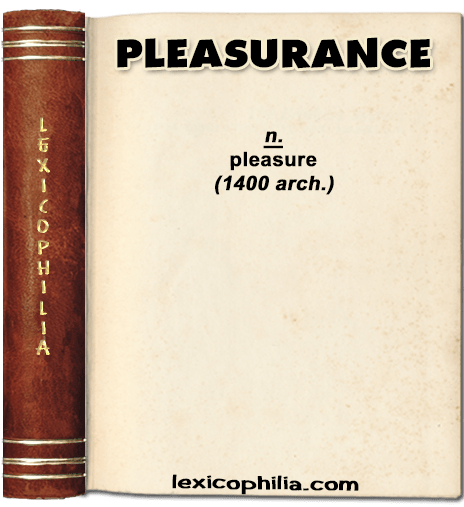
Word of the Day: PLEASURANCE

ETYMOLOGY
from pleasure (vb.) + -ance

EXAMPLE
“… With a mighty noise, noye for to here,
Playnond with pytie, no
pleasurance at all,
With sykyng & sorow said on this wise:—
“A! fonnet folke, why fare ye thus now,
With solas full sore, and sanges of myrthe,
At the weddyng of the weghes, þat shall to wo turne.
…”

From: The “Gest Hystoriale” of the Destruction of Troy
from Guido de Colonna’s “Hystoria troiana.”, a1400

PRONUNCIATION
PLEZH-uh-ruhns

Word of the Day: PUDIBUND

ETYMOLOGY
from Latin pudibundus (easily ashamed, bashful, modest, also shameful),
from pudere (to make or be ashamed) + -bundus 

EXAMPLE (for adj. 1)
“… If any man do vse to drynke water with wyne, let it be purely strayned, & than seth it and after it be cold let hī put it to his wyne, but better it is to drīke with wyne stylled waters, specyally ye water of strawberes or the water of buglos or the water of endyue, or the water of cycory, or ye water of southystel, & dandelyon. And yf any man be cobred with the stone or doth burne in the pudybunde places, vse to drynke with whyte wyne the water of hawes, & the water of mylke, voke for thys mater in a boke of my makynge named the breuyary of health …”

From: A Compendyous Regyment or a Dyetary of Healthe Made in Mountpyllyer,
By Andrewe Boorde, 1542

PRONUNCIATION
PYOO-duh-bund

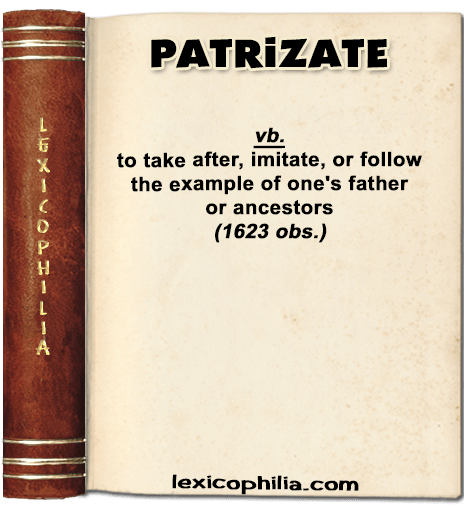
Word of the Day: PATRIZATE

ETYMOLOGY
from Latin patrissat- patrizat-, past participial stem of patrissare, patrizare (to act like or take after one’s father)

EXAMPLE
“…One was Walter Devereux Earl of Essex, who made him his bosome-friend, and the said Earl, lying on his death-bed, took his leave of him with many kisses, Oh my Ned (said he) farewell, thou art the faithfullest and friendliest Gentleman that ever I knew. In testimony of his true affection to the dead Father in his living Son, this Gentleman is thought to have penned that most judicious and elegant Epistle and presented it to the young Earl, conjuring him by the cogent arguments of example and rule, to patrizate. …”

From: The History of the Worthies of England
By Thomas Fuller, 1662