Word of the Day: POCOCURANTE

ETYMOLOGY
Italian, poco curante, (caring little), from poco (a little, rather) + curante (present participle of curare (to care)); from Latin curare (to cure, to heal), ? from the name of Seigneur Pococurante, a fictional apathetic Venetian senator in Voltaire’s Candide (1759)

EXAMPLE
…Leave we my mother – (truest of all the Poco-curante’s of her sex!) – careless about it, as about every thing else in the world which concerned her; – that is, – indifferent whether it was done this way or that, – provided it was but done at all …”

From: The Life and Opinions of Tristram Shandy, Gentleman
By Laurence Sterne, 1762

PRONUNCIATION
poh-koh-kyuh-RAN-tee
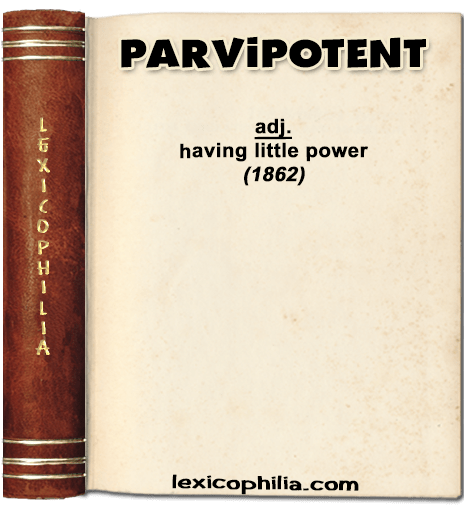
Word of the Day: PARVIPOTENT

ETYMOLOGY
from parvi- comb. form + potent (powerful, having great authority or influence)

EXAMPLE
“…It is called his causal body. Neither can do anything without one. The aggregate of the causal bodies of all souls, that is to say, distributive ignorances, make up I’s’wara’s causal body, which is illusion. Strange to say, the ignorance of a single soul renders that soul subject to misapprehension, and keeps it parviscient, parvipotent, &c; but the aggregation of these individual ignorances, or illusion, allows I’s’wara to be exempt from misapprehension, and communicate to him such attributes as omniscience and omnipotence …”

From: A Rational Refutation of the Hindu Philosophical Systems
By Nehemiah Nilakantha S’Astri’ Gore
Translation by Fitz-Edward Hall, 1862

Word of the Day: PAINTRIX

ETYMOLOGY
from paint + -trix 

EXAMPLE
“…
Quarters wages for Midsomer, anno Regni Regis Edwardi sexti Primo. [a.d. 1457.]…

On leaf 27, back, are
per Cade Item, to Anthony Totto, Painter … … … vj li v s
Item, to Barthilmewe Penne, Painter … … … vj li v s
Item, to Misteris levyn Terling, Paintrix … … xli
…”

In Thomas Vicary’s ‘The Anatomie of the Bodie of Man‘, 1547
Published by Early English Text Society, 1888

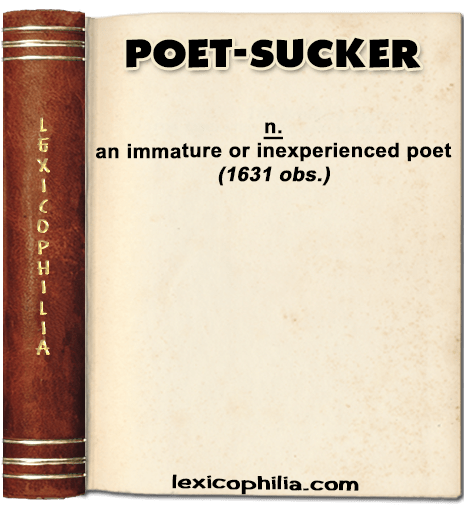
Word of the Day: POET-SUCKER

ETYMOLOGY
from poet + sucker (a greenhorn, a simpleton)

EXAMPLE
“…But gi’ me the man can start up a Justice of Wit out of six-shillings beer, and give the law to all the poets and poet-suckers i’ town. Because they are the players’ gossips? ‘Slid, other men have wives as fine as the players’, and as well dressed. Come hither, Win. …”

From: Bartholmew Fayre, A Comedie
By Ben Jonson, 1631

Word of the Day: PRICK-ME-DAINTY

ETYMOLOGY
from prick (to attire a person with clothes and ornaments fastened by pins, bodkins, etc.) + me + dainty

EXAMPLE
“… But, syr, among all
That sat in that hall,
There was a
pryckemedenty,
Sat lyke a seynty,
And began to paynty,
As thoughe she would faynty ;
She made it as koy
As a lege de moy ;
She was not halfe so wyse
As she was peuysshe nyse.
She sayde neuer a worde,
But rose from the borde,
And called for our dame,
Elynour by name.
…”

From: Here after foloweth Certayne Bokes
By John Skelton, ?1545
The Tunnyng of Elynour Rummyng, a1529

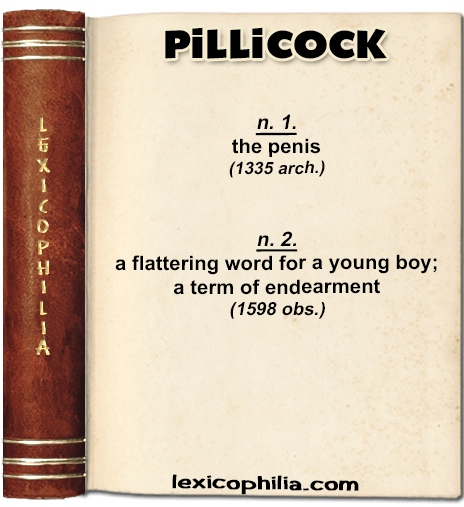
Word of the Day: PILLICOCK

ETYMOLOGY
from a first element of uncertain origin (see note below) + cock (mature male of the domestic chicken)

EXAMPLE (for n. 1.)
“…Lear.
Death traytor, nothing could haue subdued nature
To such a lownes, but his vnkind daughters,
Is it the fashion that discarded fathers,
Should haue thus little mercy on their flesh,
Iudicious punishment twas this flesh
Begot those Pelicane daughters.

Edg.
Pilicock sate on pelicocks hill, a lo lo lo.

Foole.
This cold night will turne vs all to fooles & madme
n. …”

From: True Chronicle Historie of the Life and Death of King Lear and his three daughters
By William Shakespeare, 1608

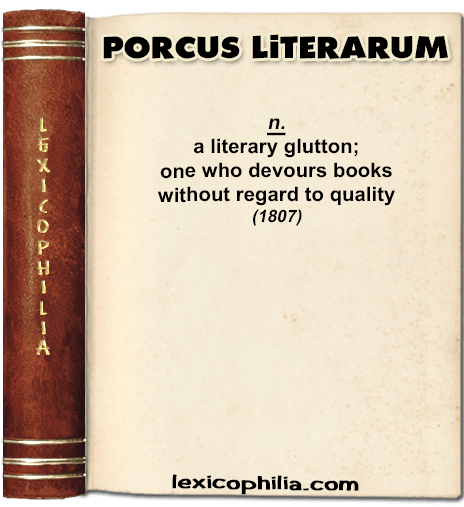
Word of the Day: PORCUS LITERARUM

ETYMOLOGY
from Latin porcus (a pig, hog) + literarum (letters, written knowledge, literature)

EXAMPLE
“…Epics he wrote and scores of rebusses,
All as neat as old Turnebus’s;
Eggs and altars, cyclopædias,
Grammars, prayer books – oh! ’twere tedious,
Did I but tell the half, to follow me,
Not the scribbling bard of Ptolemy,
No – nor the hoary Trismegistus,
(Whose writings all, thank heaven! have miss’d us,)
E’er fill’d with lumber such a ware-room
As this great “
porcus literarum!” …”

From: Epistles, Odes, and Other Poems
By Thomas Moore, 1807
“The Devil Among The Scholars”

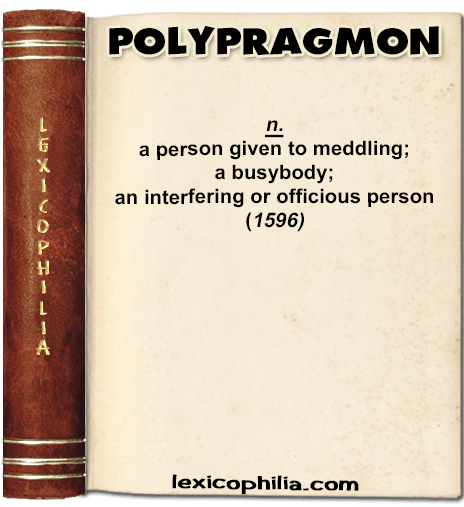
Word of the Day: POLYPRAGMON

ETYMOLOGY
from Greek πολυπράγµων )busy about many things, meddlesome, officious),
from  πολυ- (poly comb. form) + πρᾶγμα (thing done)

EXAMPLE
“… till this Polypragmon troubled us with his Blankes and matters of Estate
we lyved in Scot: peacably, administred the sacramentes, and
preached daly the trewe will and worde of oure savioure Jesus
…”

From: In Spanish influences in Scottish history, Appendix (1596)
By John Rawson Elder, 1920