Word of the Day: PAM-CHILD

ETYMOLOGY
from pam ( a card-game in which the knave of trumps was the highest trump card) + child


EXAMPLE
“…Yet rake I am, and abominably so, for a person that begins to wrinkle reverently. I have sat up twice this week till between two and three with the Duchess of Grafton, at loo, who, by the way, has got a pam-child this morning; and on Saturday night I supped with Prince Edward at my Lady Rochford’s, and we stayed till half an hour past three…”

From: The Letters of Horace Walpole
Volume 3, Letter 9 To George Montagu, Esq. Arlington Street, Jan. 14, 1760

Word of the Day: PEEPY


ETYMOLOGY
from peep + -y


EXAMPLE (for adj. 1)
“…An individual of the latter kind is distinguished in his earliest petticoats – even before he has well left the nursery. He is then a poor, peepy wretch, with blear eyes, and one everlasting dingy night-cap. constantly sitting by the fire, to the great annoyance of the nurse, who frequently declares him to be more of an infant than even his younger brother the baby…”

From: Chambers Edinburgh Journal
Conducted by William Chambers, and Robert Chambers,
Volume I No. 49, Saturday, January 5, 1833,
‘The Domestic Man’

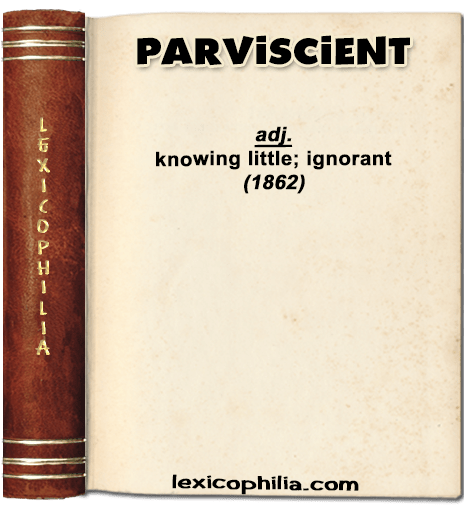
Word of the Day: PARVISCIENT


ETYMOLOGY
from parvi- comb. form of Latin parvus (small) + scient (knowledgeable, skilled);
probably after omniscient (having infinite knowledge)


EXAMPLE
“…It is called his causal body. Neither can do anything without one. The aggregate of the causal bodies of all souls, that is to say, distributive ignorances, make up I’s’wara’s causal body, which is illusion. Strange to say, the ignorance of a single soul renders that soul subject to misapprehension, and keeps it parviscient, parvipotent, &c; but the aggregation of these individual ignorances, or illusion, allows I’s’wara to be exempt from misapprehension, and communicate to him such attributes as omniscience and omnipotence…”

From: A Rational Refutation of the Hindu Philosophical Systems
By Nehemiah Nilakantha S’Astri’ Gore
Translation by Fitz-Edward Hall, 1862


PRONUNCIATION
par-VISS-ee-uhnt

Word of the Day: PULCHRITUDINOUS


ETYMOLOGY
from Latin pulchritudin-,  pulchritudo (beauty) + -ous


EXAMPLE
“…Returning to the pulchritudinous Fanny Newlove, she was reclining on a settee, listening with all her ears, to the ‘out pourings’ of a personage, whose appearance at once apprehended my attention, as indicative of anything except the clean potato …”

From: The Anglo-American Magazine
From July to December, 1854
Vol V, ‘The Purser’s Cabin’


PRONUNCIATION
pul-kruh-CHOO-duh-nuhss

Word of the Day: PINCHFART


ETYMOLOGY
formed by compounding pinch- (comb. form. a nip, a squeeze; to nip, to squeeze)


EXAMPLE
“…It were lamentable to tel what misery the Rattes and Mise endured in this hard world, how when all supply of vittualls failed them, they went a Boot-haling one night to Sinior Greedinesse bed-chamber, where finding nothing but emptines and vastitie, they encountred (after long inqusition) with a cod-peece, wel dunged and manured with greace (which my pinch-fart penie-father had retaind from his Bachelorship, vntill the eating of these presents).…”

From: Pierce Penilesse, His Supplication to the Divell
By Thomas Nashe, 1592

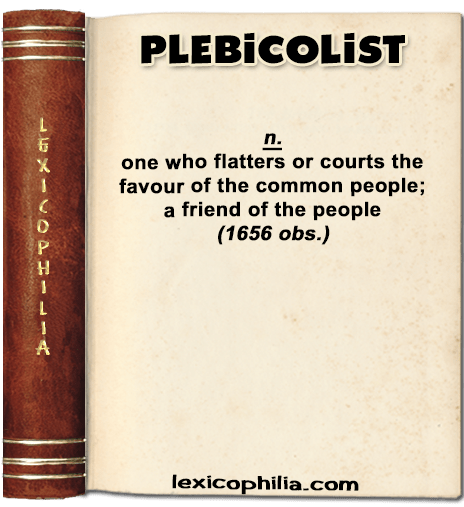
Word of the Day: PLEBICOLIST


ETYMOLOGY
from Latin plebicola one who courts the common people,
from plebs (the ordinary people) + –cola (cole) + -ist


EXAMPLE
“…Alva Adams, the plausible plebicolist who for so many years had prostituted Colorado to the lust of lucre and enslaved her to the corporations to serve his personal ends, was in his political death-struggle and fighting with the desperation of a dog-doomed rat…”

From: The Scarlet Shadow
A Story of the Great Colorado Conspiracy 
By Walter Hurt, 1907

Word of the Day: PANGUTS


ETYMOLOGY
apparently from pan- (all) + guts (the belly, stomach)


EXAMPLE
“…”Odzbodkins! You won’t spoil our sport,’ cried her husband. “Your crotchets are always coming in like a fox into a hen-roost.”
“I have work in hand that must be done,” replied his wife.
Panguts!” she exclaimed, raising her voice and her fist at the same time, “what do you do? lazying about here like a mud-turtle nine days after it’s killed
…”

From: Margaret: A Tale of the Real and Ideal, Blight and Bloom
By Sylvester Judd, 1845

Word of the Day: PERQUIRE


ETYMOLOGY
adj. & adv.: from French par cœur (by heart, by memory, perfectly, exactly)
vb.: from Latin perquirere (to make diligent search for), formed on  per-  + quærere (to seek)


EXAMPLE (for vb.)
“…Sweetly disposed soul (for so I hope)
Though most deluded by thy self, and Pope;
Perquire Zoographers, and none recite,
A Romane Pope turn’d willing Anchorite.
Now they so much abhor such doubtful ways,
They’ll not to Heaven go, without false ayes.
…”

From: Divine Glimpses of a Maiden Muse
By Christopher Clobery, 1659

Word of the Day: PERLEGATE


ETYMOLOGY
from Latin perlegere to read through, from per- + legere (to read) + ate


EXAMPLE
“…I am vouchsafede to perlegate vvith pleasure, & imploye a small of their time in the readinge, of my scriptsons, and vvritinges, I most courtiouslye desire thē, that they vvould more vvith good vvill, then vvith a spirite…”

From: The Frenche Chirurgerye, or all the Manualle Operations of Chirurgerye
By Jacques Guillemeau
Translated by A.M., 1598