Word of the Day: PODGER


ETYMOLOGY
for n. 1. – a variant of pottinger
for n. 2, 3, 4 – from podge (anything short or thick)  + ‑er 


EXAMPLE
“…He cannot deal the knock-me-down blows of Old Brough, and if you watch your opportunity you may give him a podger. I am seldom in a cause of any consequence before him without getting into some squabble with him…”

From: Life of John, Lord Campbell, 1881,
Letter dated 9 March, 1816
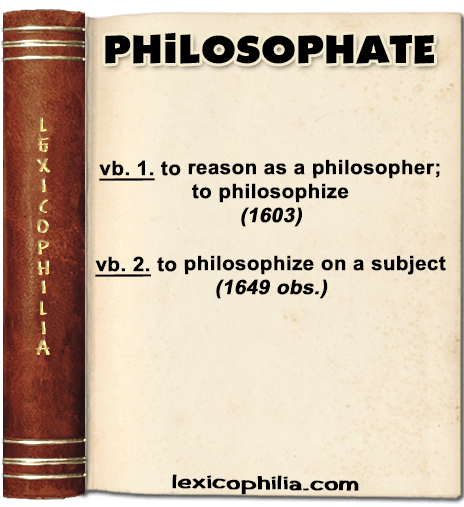
Word of the Day: PHILOSOPHATE


ETYMOLOGY
from Latin philosophāt-, ppl. stem of philosophārī (to do the philosopher, to philosophize), from philosophus (a philosopher)


EXAMPLE
“…If, as some say, to philosophate be to doubt; with much more reason to rave and fantastiquize, as I doe, must necessarily be to doubt: For, to enquire and debate belongeth to a scholler, and to resolve appertaines to a cathedrall master…”

From: The Essayes, or Morall, Politike, and Millitarie Discourses of Lord Michaell de Montaigne 
Translated by John Florio, 1603


PRONUNCIATION
fuh-LOSS-uh-fayt

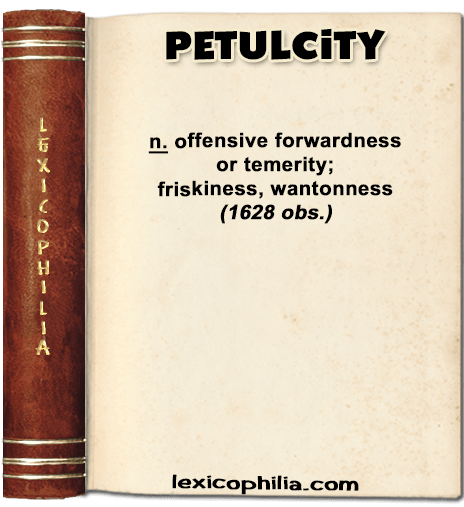
Word of the Day: PETULCITY


ETYMOLOGY
from Latin petulcus (butting, wanton, frisky)


EXAMPLE
“…I do therefore much blame the petulcity of whatsoever author that should dare to impute a popish affection to him, whom, besides his excellent writings and sermons, God’s visible, eminent, and resplendent graces of illumination, zeal, piety, and eloquence have made truly honourable and glorious in the Church of Christ…”

From: The Works of the Right Reverend Joseph Hall, 1837
Letter to Joseph Hall from Thomas Morton, 1628

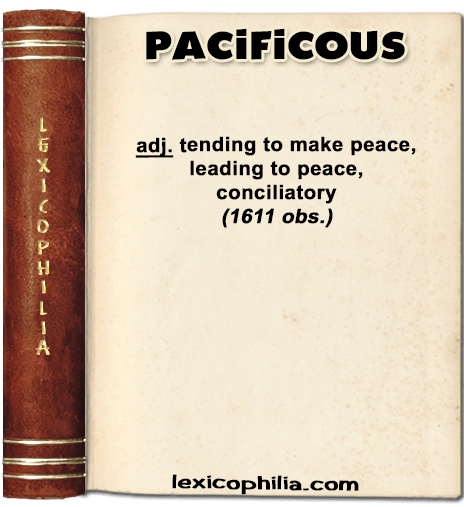
Word of the Day: PACIFICOUS


ETYMOLOGY
from Latin pacificus (peace-making, peaceful) + -ous,
from paxpacem (peace) + -ficus (-fic)


EXAMPLE
“…These, belike, were not acquainted with the Exploits of the Graecian Xenophon, the Roman Caesar, the English Sidney, Montjoy and Ra∣leigh, Gentlemen that were renowned both in Arms and Letters. Yet such as were transported with Warmth to be a sighting, prevail’d in Number, before the Pacificous…”

From: Scrinia Reserata A Memorial offer’d to the Great Deservings of John Williams
By John Hacket, 1693

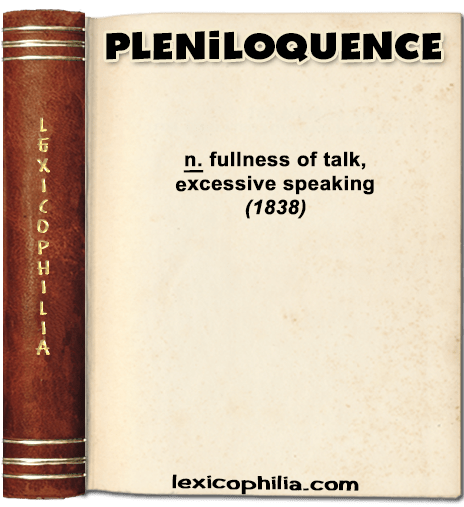
Word of the Day: PLENILOQUENCE


ETYMOLOGY
from Latin plenus (full) + loquentia (talking)


PRONUNCIATION
plen-I-luh-kwuhns


EXAMPLE
“…Mr. Emerson, writing to his friend Carlyle, August 6, 1838, thanking him for his “friendliest seeking of friends for the poor oration” (“The American Scholar”) says: I have written and read a kind of sermon to the Senior Class of our Cambridge Theological School a fortnight ago; and an address to the Literary Societies of Dartmouth College, for though I hate American pleniloquence, I cannot easily say No to young men who bid me speak also. … The first, I hear, is very offensive. I will now try to hold my tongue till next winter…”

From: The Complete Works of Ralph Waldo Emerson: Nature addresses and Lectures
Notes, 1838

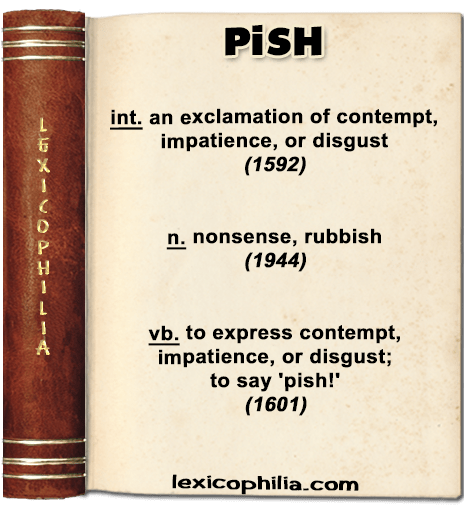
Word of the Day: PISH


ETYMOLOGY
an imitative or expressive formation


EXAMPLE
“…Hoe! God, be here! on their bald, burnt, parchment pates. Pish, pish! what talke you of olde age or balde pates? Men and women that haue gone vnder the south pole, must lay of theyr furre night-caps in spyght of their teeth, and become yeomen of the vineger bottle…”

From: Pierce Penilesse, His Supplication to the Diuell
By Thomas Nashe, 1592

Word of the Day: PEDESTRIAL


ETYMOLOGY
from Latin pedestr-pedester, also pedestris (going on foot), in prose, prosaic
(from pedes a person who goes on foot
(from ped-pēs (foot) + -es (after eques) + -ter + -al 


PRONUNCIATION
puh-DESS-tree-uhl


EXAMPLE
“…For, the formall esteemed causes (which are pedestriall, equestriall, or nauti∣call) stand either at the disposition of the efficient; or pretend perfection and vse from the finall…”

From: An Essay of the Meanes Hovv to Make our Trauailes, into Forraine Countries,
the More Profitable and Honourable
By Sir Thomas Palmer, 1606