Word of the Day: PHILOTHERIAN


ETYMOLOGY
from Greek ϕιλο-, ϕιλ-, combining form from root of ϕιλεῖν (to love), ϕίλ-ος (dear, friend)
+ θήρ (wild beast)


EXAMPLE
“…It is the reply of an old fisher-woman, when reproved by some Philotherian for skinning eels alive.
“Sir,” said she, “I have skinned them thusly for nearly fifty years; and they have got so used to it, they don’t mind it one bit.”…”

From: The Harvard Advocate
Vol. XI. Cambridge, Mass., February 28, 1871. No. I
Editorial

Word of the Day: POTHERY


ETYMOLOGY
from pother (disturbance, turmoil, bustle; noise, tumult) + -y


EXAMPLE
“…Meer Heat and Cold are very different things from that Pothery and Sultry, that Frosty and Congealing Weather, which alternately in Summer and Winter, at the Line and the Poles we usually now feel….”

From: A New Theory of the Earth
By William Whiston, 1696

Word of the Day: PLACIDIOUS


ETYMOLOGY
from Latin placidus (pleasing, favourable, gentle, mild, calm),
from root of placēre (to please)


EXAMPLE
“…There was never any thing more strange in the nature of Dogs, then that which happened at *Rhodes besieged by the Turk, for the Dogs did there discern betwixt Christians and Turks; for towards the Turks they were most eager, furious, and unappeaseable but towards Christians, although unknown, most easie, peaceable and placidious, which thing caused a certain Poet to write thus…”

From: The History of Four-footed Beasts, and Serpents
By Edward Topsell, 1607

Word of the Day: PERIPATICIAN


ETYMOLOGY
shortened from Middle French peripateticien, from peripateticus (a person who walks about, a traveller; also, moving about from place to place) + French -ien (-ian)


EXAMPLE
“…Yet certes Moecha is a Platonist,
To all, they say, but whoso do not list;
Because her husband, a far traffick’d man,
Is a profest Peripatecian…”

From: Virgidemiarum. The Three Last Bookes
By Joseph Hall, 1598

Word of the Day: PREHEND


ETYMOLOGY
from Latin prehendere (to grasp, seize, catch), variant of præhendere
from præ, (pre-) + a second element; sometimes perhaps aphetic from apprehend


EXAMPLE
“…but he lay not longe ther, but was delyveryd with-owt punyshment & styll Inioyed his beneffysis; they were greatly blamed that prehended hym and comitted hym…”

From: Political, Religious, and Love Poems
By John Stowe, a1605
Edited by Frederick James Furnivall, 1866

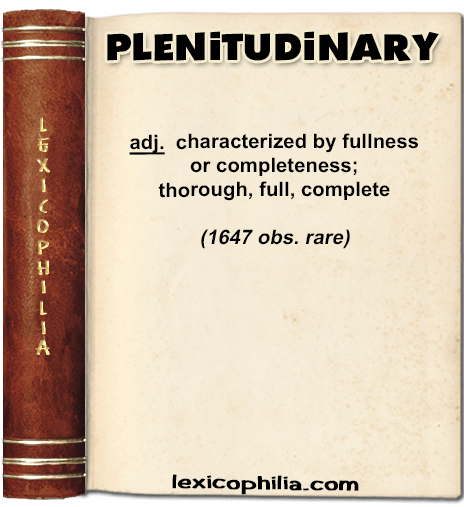
Word of the Day: PLENITUDINARY


ETYMOLOGY
from Latin plenitudinarius (full, complete, plenary),
from Latin plenitudin-plenitudo (abundance, fullness, fullness of shape, thickness, full amount, the whole) + -arius (-ary)


EXAMPLE
“…and a strange kind of Government must that needs be, wherein the Servants Throne is above his Masters, and a Subject shall have a plenitudinary power beyond that which his Lord and King had, or, as the times then were, was capable of …”

From: An Historical and Political Discourse of the Laws & Government of England from the First times to the End of the Reign of Queen Elizabeth
By Nathaniel Bacon, 1647

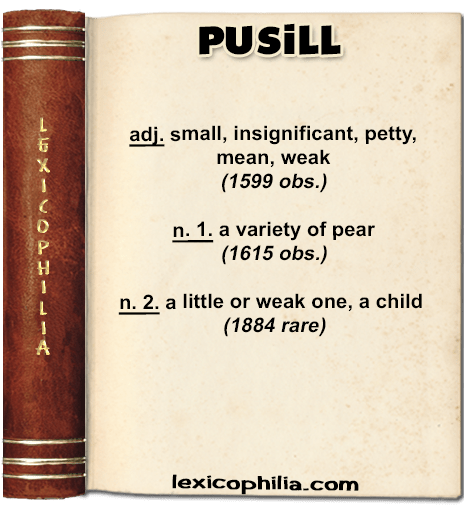
Word of the Day: PUSILL


ETYMOLOGY
from: a) Middle French pusillepuzilpusil (very small, weak),
b) Latin pusillus (very small, insignificant, petty) from pusus (boy) + -illus 


EXAMPLE
“…And to amase her weake, and pusill minde,
In creepe through crannies of imagination.
Deformd Idean formes, and phansies blinde.
Sent foorth by hir sicke sences, instigation.
Like staringe greisly fendes, threatninge invasion.
Presenting to her heart, the homely iarres.
And houshold cares, accurringe nuptiall warres…”

From: Eustathia, or the Constancie of Susanna
By Robert Roche, 1599

Word of the Day: PANICHTHYOPHAGOUS


ETYMOLOGY
from Greek πᾶν, pan, (“all”, “of everything”, “involving all members” of a group)
+ from Latin ichthyophagus,
from Greek ἴχθυοϕάγος  from Greek ἰχθυο- (fish-) + -ϕάγος (eating),
from ϕαγεῖν (to eat) + -ous


EXAMPLE
“…The caranx, trachurus, or bastard mackerel, probably corresponds with the individual so called by Oppian and Athenaeus. It abounds in the Mediterranean, and is a dry coarse fish, fit only for hungry boatmen and panichthyophagous puss…”

From: Fraser’s Magazine for Town and Country
Volume 47, March 1853
The Caranx

Word of the Day: PHILOXENY


ETYMOLOGY
from Latin philoxenia (love of strangers; eagerness to show hospitality);
or: from Greek ϕιλοξενίζειν from ϕιλόξενος (philoksenos) (loving hospitality or strangers), from ϕιλο- (philo-) + ξένος (xenos) (stranger) + -ia (-y)


EXAMPLE
“…for by this philoxeny, the virtue inclining and disposing the mind to the entertainment of strangers, is in the first place intended…”

From: An Exposition of the Epistle to the Hebrews
By John Owen, 1814