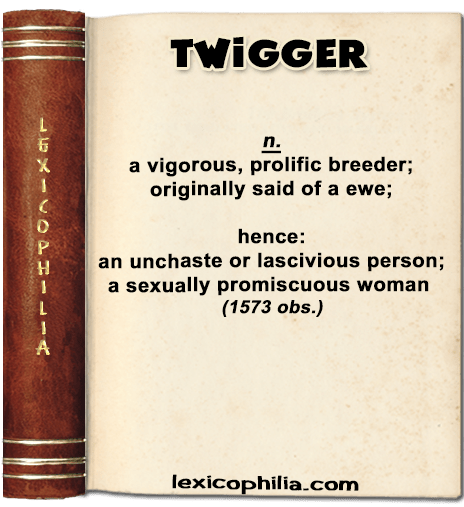
Word of the Day: TWIGGER

ETYMOLOGY
apparently from twig (to do anything strenuously or vigorously, obs.) + -er

EXAMPLE
“… Eaws yerely by twining, rich masters do make the lamb of such twynners, for breeders go take.
For twinlings be
twiggers, encrease for to bring:
though some for their twigging, peccantem may sing
Calues likely, yt come betwene Christmas & Lent,
take huswife to rere, or else after repent.
…”

From: Fiue Hundreth Points of Good Husbandry vnited to as many of good huswiferie first deuised,
By Thomas Tusser, 1573

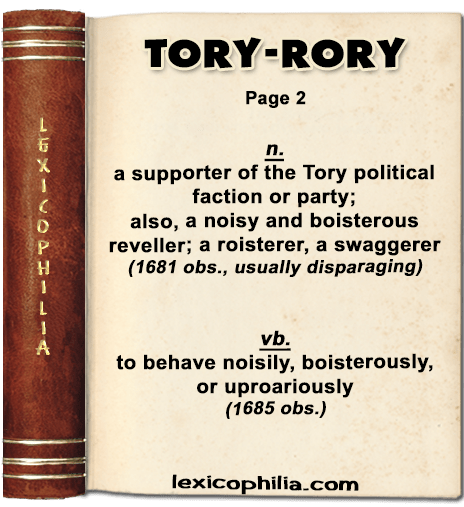
Word of the Day: TORY-RORY

ETYMOLOGY
Probably a reduplication (with consonant variation) of Tory (n.), perhaps after roary (loud, noisy, roaring)

EXAMPLE (for adj. 2.)
“… ‘Tis strange two of such different Tempers should so well agree: Methinks you look like two as roaring, ranting, tory rory Sparks as one would wish to meet withall. …”

From: Friendship in Fashion A Comedy
By Thomas Otway, 1678

Word of the Day: TIRELING

ETYMOLOGY
apparently from tire (to diminish, give out, come to an end, obs.) + -ling

EXAMPLE
“… So as they gazed after her a while,
Lo where a griesly Foster forth did rush,
Breathing out beastly lust her to defile:
His
tyreling iade he fiercely forth did push,
Through thicke and thin, both ouer banke and bush
In hope her to attaine by hooke or crooke,
That from his gorie sides the bloud did gush:
Large were his limbes, and terrible his looke,
And in his clownish hand a sharp bore speare he shooke.
…”

From: The Faerie Queene
By Edmund Spenser, 1590

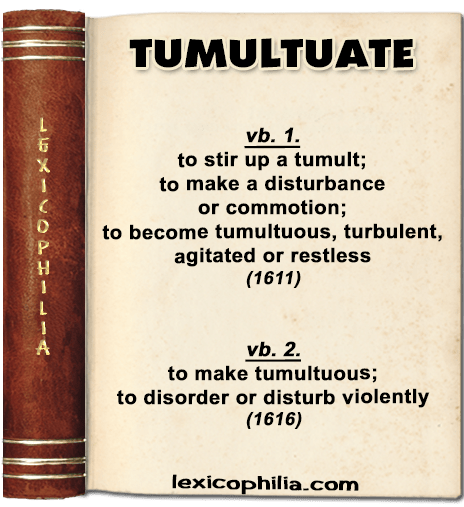
Word of the Day: TUMULTUATE

ETYMOLOGY
from participial stem of Latin tumultuari (to make a bustle or disturbance) + -ate

EXAMPLE
“… Secondly, beeing sued, and Iudgement passed against you, Acquiesce in the Iudgement, and doe not tumultuate against it; and take example from mee, whom you haue heard here protest, that when euer any Decree shall be giuen against me in my priuate right, betweene me and a Subiect, I will as humbly acquiesce as the meanest man in the Land. Imitate me in this, for in euery Plea there are two parties, and Iudgement can be but for one, and against the other; so one must alwayes be displeased. …”

From: James I of England
Speach Starre-chamber, 1616

Word of the Day: TROIL

ETYMOLOGY
vb.: from Old French troilliertruilliertreuiller, from Middle High German trüllen

EXAMPLE (for vb.)
“… Thus with treison and with trecherie · þow troiledest hem boþe,
And dudest hem breke [here] buxomnesse · þorw false by-heste;
Thus haddest þou hem oute · and hyder atte laste.
…”

(Thus with treason and with treachery · thou troiledest them both,
And diddest them break their buxomness · through false byhest;
Thus haddest thou them out · and hither at the last.
)

From: The Vision of William concerning Piers the Plowman
By William Langland, 1393

Word of the Day: THESMOPHILIST

ETYMOLOGY
from Greek θεσµός (thesmos – law); (from root θε– (to lay down)) + –ϕιλ-ος (-phil )-ist

EXAMPLE
“… To shut out any light that may be usefull in Gods house, is with the Jews to make it a denne: as they would do, that would shut out the Ceremonies out of the Church: for, take away Ceremonies out of the Church, and take away the light that is in it. Surely this is spoken in Ceremony, by way of complement to his Bishop, that great Thesmophilist: Have we no other candle in our candlestick but ceremony? …”

From: A Discourse of Proper Sacrifice
By Edward Dering, 1644

Word of the Day: TARDIGRADE

ETYMOLOGY
from French tardigrade (slow-paced) or from Latin tardigradus (walking slowly); from Latin tardus (slow) + -gradus (stepping, going)

EXAMPLE (for adj. 1)
“… Once more a cruelly long passage fell to my lot. The Deborah proved a marine hackney-coach of the most tardigrade order. But it could not be helped; so, like Diogenes, I resolved to be satisfied with my tub, and as for sunshine, I found it within and without! …”

From: Our Antipodes:
Or, Residence and Rambles in the Australasian Colonies.
By Lt. Colonel Godfrey Charles Mundy, 1852

Word of the Day: THINKATIVE

ETYMOLOGY
from think (vb.) + -ative, chiefly after talkative

EXAMPLE
“… They have not known I say, that the knowledge of Observation, doth not introduce an understanding into the essential thingliness of a thing, but erecteth only a thinkative knowledge: For otherwise, the understanding should perceive causes that are before in essence. Then also they have been deceived by the simplicity of the Water, which simpleness they have confounded with the unity of knowledge to us unknown. …”

From: Oriatrike or, Physick Refined
By Jean Baptiste van Helmont
Translated by J. Chandler, 1662