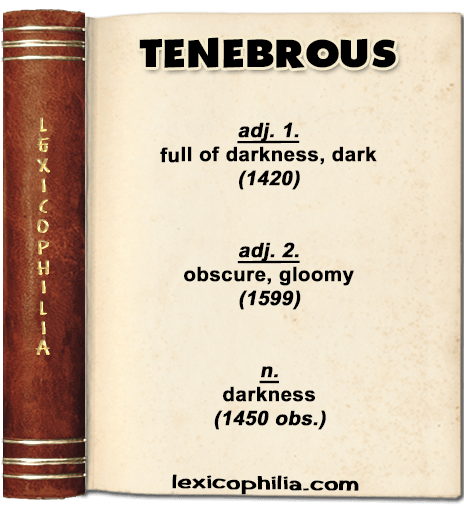
Word of the Day: TENEBROUS

ETYMOLOGY
from Old French tenebrus, modern French tenebreux, Provencal tenebros
Spanish, Italian tenebroso, from Latin tenebrosus (dark, gloomy)

EXAMPLE
“… The name of thys lady was callyd Prescience.
She neuer left Vyce, ne noon that wold hym folow,
Tyll they wer commyttyd by the diuine sentence
All to peyne perpetuell and infynyte sorow.
Ryghtwysnes went to see that no man shuld hem borow.
Thus all entretyd sharpely were they, tyll Cerberus
Had hem beshut withyn hys gates
tenebrus. …”

From: The Assembly of Gods:
or, The Accord of Reason and Sensuality in the Fear of Death
By John Lydgate, c1420

PRONUNCIATION
TEN-uh-bruhss

Word of the Day: TIB

ETYMOLOGY
perhaps the same as Tib, a shortened hypocoristic form of the female name Isabel; now rather rude or slighting (except playfully);
also with dim. -y or -ieTibbie, a common female name in the north

EXAMPLE
“… .Trupeny. Mary then prickmedaintie come toste me a fig,
Who shall then know our
Tib Talke apace trow ye?

An. Alyface. And why not Annot Alyface as fyne as she?

Trupeny. And what had Tom Trupeny, a father or none?

An. Alyface. Then our prety newe come man will looke to be one …”

From: Ralph Roister Doister 
By Nicholas Udall, a1556

Word of the Day: THRUMBLE

ETYMOLOGY
vb. 1: of uncertain origin
vb. 2, 3, 4: apparently from thrum (to press, to condense) + -le
vb. 5: apparently from thrum (to play on a stringed instrument) + -le

EXAMPLE (for vb.3)
“…PETER, quho was ever maist sudden, answers, and sayis: Thou art thrumbled and thrusted be the multitude, and ʒit thou speeris quha hes twitched thee, hee answers againe and he sayis, it is not that twitching that I speak of: It is ane vther kinde of twitching …”

From: Sermons vpon the Sacrament of the Lords Supper
By Robert Bruce, ?1591

Word of the Day: TERRIBLIZE

ETYMOLOGY
from terrible + -ize

EXAMPLE
“…Both Camps appoach, their bloudy rage doth rise,
And even the face of Cowards 
terriblize;
New Martial heat inflames their mindes with ire,
Their bloud is moov’d, their heart is all on fire.
Their cheerfull limbs (seeming to march too slowe).
Longing to meet, the fatall drums out-goe;
And even already in their gesture fight:
Th’ iron-footed coursers, lusty, fresh, and light,
…”

From: Du Bartas his Deuine Weekes and Workes translated
By Guillaume de Salluste Du Bartas
Translated by Josuah Sylvester, 1606

Word of the Day: TAKY

ETYMOLOGY
from take (to catch the fancy or affection of; to excite a liking in; to captivate, delight, charm) + -y

EXAMPLE
“…Speaking thus, Mr. Blyth now proceeded to perform by one great effort those two difficult and delicate operations in art, technically described as “putting in taky touches, and bringing out bits of effect.” These arduous final processes, are, as all painters know, only to be accomplished through the medium of certain mystic bodily evolutions, …”

From: Hide and Seek,
By Wilkie Collins, Vol. I. 1854

Word of the Day: TOMLING

ETYMOLOGY
from tom (a male cat) + -ling

EXAMPLE
“…We are promised to succeed him a Black Tomling, whom I have named Prester John – that hierarch being the most remarkable black potentate whom I could call to mind. Long live Prester John! and may he be more fortunate than his predecessors, Othello and Pulcheria. …”

From: Selections from the Letters of Robert Southey
Edited by John Wood Warter, Vol. III, 1856
Letter from R.S. to G.C.B., April 29, 1821

Word of the Day: TRAGEMATOPOLIST

ETYMOLOGY
from Latin tragematopola (sweet seller) or its etymon, Greek τραγηματοπώλης (seller of sweetmeats),
from τραγήματ-τραγήμα (dried fruits or sweetmeats eaten as dessert) + ‑ο‑ ‑πώλης (-pole) + ‑ist 

EXAMPLE
Abby promised her children a trip to the tragematopolist’s after they’d done their chores and homework.

Word of the Day: TEMPORANEOUS

ETYMOLOGY
from Latin temporaneus (timely, opportune), from tempustempor- (time) + -ous


EXAMPLE
“…For the further clearing of which there are these two things required 
1. To shew how the necessary Functions of life may be conserved and kept up while the Soul is 
separate from the Body 
2. To consider what those things are which may cause a Temporaneous disunion and disjunction of 
the Soul from the Body First then it will not seem at all strange that the principal Functions of life 
should be performed for some time without the presence of the Soul to them who will admit of the 
principles of the Cartesian Philosophy …”

From: Melampronoea,
or, A discourse of the polity and kingdom of darkness together with a solution of the chiefest objections brought against the being of witches
By Henry Hallywell, 1681

Word of the Day: TERRACULTURE


ETYMOLOGY
irregularly from Latin terra (earth) + culture


EXAMPLE
“…We venture at the outset to introduce a new term, and that for the only justifiable reason, viz: because there is no single word heretofore in use in our language expressive of the idea we wish to express. Agriculture is the culture of the field, and includes the operations of farming or the tillage of large portions of land. Horticulture is the culture of the garden, and has reference to the production of kitchen vegetables, fruits and flowers. We have often felt at a loss for a word to include all these, and as Terraculture, or the culture of the earth, exactly expresses the idea, and as it is derived from the Latin in a manner exactly similar to the other terms, we think there must result a decided advantage from its introduction. It comprehends all things which are produced from the earth, by the labor of man and beast, through the agency of vegetable life. Every thing that germinates and grows by receiving its nourishment from the soil, belongs to this department…”

From: The Franklin Farmer,
Devoted to Improvements in the Science of Agriculture, the Practice of Husbandry, and the Mind, Morals, and Interests, of the Cultivators of the Soil.
Vol. I., Edited by Tho. B. Stevenson, 1837-8

Word of the Day: TENTIGINOUS


ETYMOLOGY
from Latin tentigo, -inis, (a tension, lecherousness) + –ous


EXAMPLE
“…O wife, the rarest man! yet there’s another
To put you in mind o’ the last.
Such a brave man, wife!
Within, he has his projects, and do’s vent ‘hem,
The gallantest! where you tentiginous? ha?
Would you be acting of the Incubus?
Did her silkes rustling move you?
…”

From: The Divell is an Asse A Comedie
By Ben Jonson
First performed 1616
First published In Workes of Benjamin Jonson, 1631