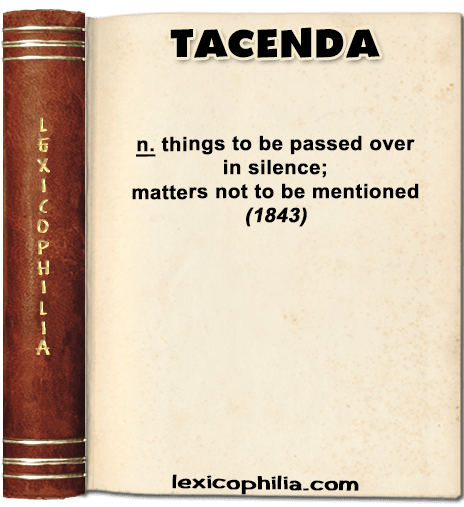
Word of the Day: TACENDA


ETYMOLOGY
Latin, gerundive neuter pl. of tacere (to be silent)


EXAMPLE
“…With due rigour, Willelmus Sacrista, and his bibations and tacenda are, at the earliest opportunity, softly, yet irrevocably put an end to. The bibations, namely, had to end; even the building where they used to be carried on was razed from the soil of St. Edmundsbury, and ‘on its place grow rows of beans:’ Willelmus himself, deposed from the Sacristry and all offices, retires into obscurity, into absolute taciturnity unbroken thenceforth to this hour…”

From: Past and Present
By Thomas Carlyle, 1843

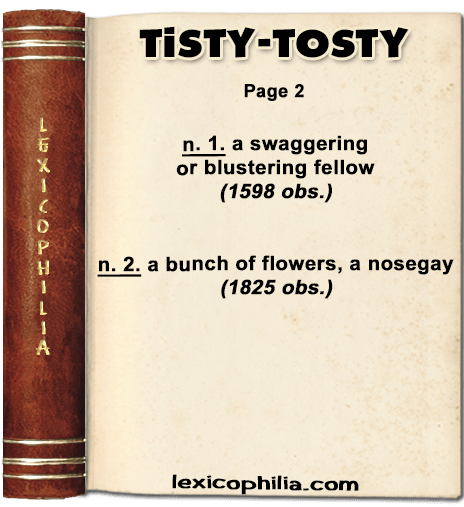
Word of the Day: TISTY-TOSTY


ETYMOLOGY
for int.: perhaps a mere ejaculation
for n. 2.: it has been compared with obsolete tyte tust(e) or obsolete tussemose (a nosegay)


EXAMPLE
“…And now I wil daunce, now wil I praunce,
For why I haue none other woork:
Snip snap Butter is no bone meat:
Knaues flesh is no Porke.
Hey tisty tosty an Ole is a bird,
Iack a napes hath an olde face:
You may beleeue me at one bare woord,
how like you this mery cace?
…”

From: A Pleasant Enterlude, Intituled, Like Will to Like Quoth the Deuill to the Collier
By Ulpian Fulwell, 1568

Word of the Day: TETTY


ETYMOLOGY
for adj.: of obscure origin
for n.1.: from teat () + -y 


EXAMPLE
“…but if they loose, though it be but a trifle, two or three games at tables, or a dealing at Cards for 2d a game, they are so cholericke and tetty that no man may speake with them, and breake many times into violent passions, oaths, imprecations, and vnbeseeming speeches, little differing from mad men for the time…”

From: The Anatomy of Melancholy
By Robert Burton, 1621

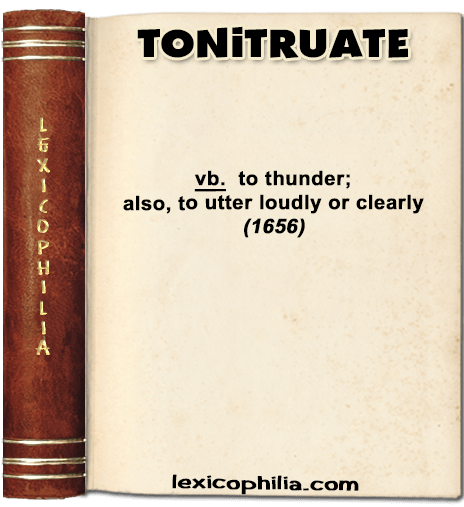
Word of the Day: TONITRUATE


ETYMOLOGY
from Latin tonitruare (to thunder)


EXAMPLE
“…I cannot fulminate or tonitruate words,
To puzzle intellects; my ninth lassaffords
No Lycophronian buskins, nor can strain
Garagantuan lines to gigantize thy vein;
Nor make a jusjurand, that thy great plays
Are tierra-del-fuegos or incognitas;
Thy Pegasus, in his admir’d career,
Curvets no caprioles of nonsense here
…”

From: Panegyric to James Shirley’s Grateful Servant, (preface verses)
By Thomas Randolph, 1630

Word of the Day: TARADIDDLE


ETYMOLOGY
the first element, tara, is of obscure origin;
+ diddle (n. a swindle, deception) (vb. to cheat, to swindle)


EXAMPLE
“…Bar. My dear Anna Matilda, I don’t know myself; so how can I tell you?
Mrs. B. There’s a bare-faced tarradiddle, Mr. Barbottle…”

From: The Duel:
Or, My Two Nephews 
A Farce, in Two Acts
By R. B. Peake, 1823

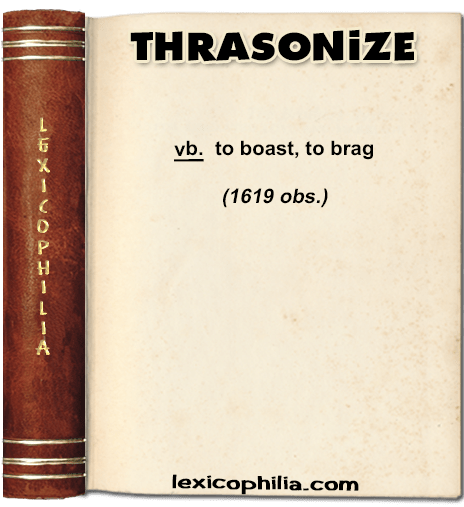
Word of the Day: THRASONIZE


ETYMOLOGY
from Latin Thrason-, Thraso Thraso, braggart soldier in the comedy Eunuchus by Terence


EXAMPLE
“…Warres austere God, with stout Achilles lance,
And wrinkled browes, doth Thrasonize it, rage:
Cornuted Phoebe, in her coach, doth prance:
Bacchus with grapes, doth stretch it on the stage:
Whiles this cup-saint, too lavish and profuse,
Embrews his temples in their liquid juice…”

From: ‘Ixions Wheele’ in Follie’s Anatomy,
By H. Hutton, 1619

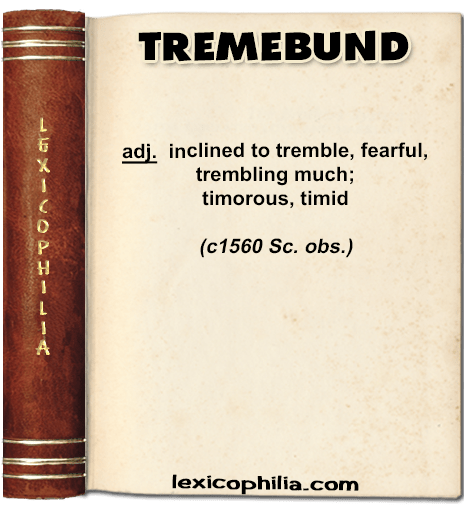
Word of the Day: TREMEBUND


ETYMOLOGY
from Latin tremebundus (trembling), from tremere (to tremble)


EXAMPLE
“…Thay tak delyt in martiall deidis,
And are of nature tremebund,
Thay wald men nurist all thair neidis,
Syne confortles lattis thame cnfound:
So find I thair affectioun
Contrair thair awin complexioun…”

From: Chronicle of Scottish Poetry,
From the Thirteen Century to the
By James Sibbald, 1802
Of Wemen-kind, By Alexander Scott, c1560

Word of the Day: THRENETIC


ETYMOLOGY
from Greek θρῆνος (funeral lament)


EXAMPLE
“…Threnetic odes are also ascribed to Sappho, among which a lament of Adonis is alluded to; but these poems are not classed under any separate head; and in an extant passage, she plainly intimates that his gloomier style of composition was little to her taste…”

From:  A Critical History of the Language and Literature of Ancient Greece
By William Mure, Volume III, 1850
Biography of Lyric Poets. Sappho, 600 B.C.

Word of the Day: TREPIDATE


ETYMOLOGY
adj.: from Latin trepidatus, past participle of trepidare
vb.: participial stem of trepidare (to hurry, bustle, be agitated or alarmed)


EXAMPLE
“…The celestiall spheres in continuall volubilitye..their diurnall or daylye course from the East to the West, their retrograde and vyolent motion from the West to the East, their trepidat motion from the South to the North…”

From: A Confutation of Atheisme
By John Dove, 1605