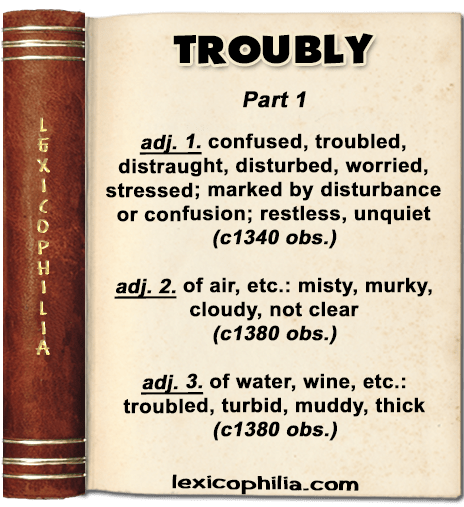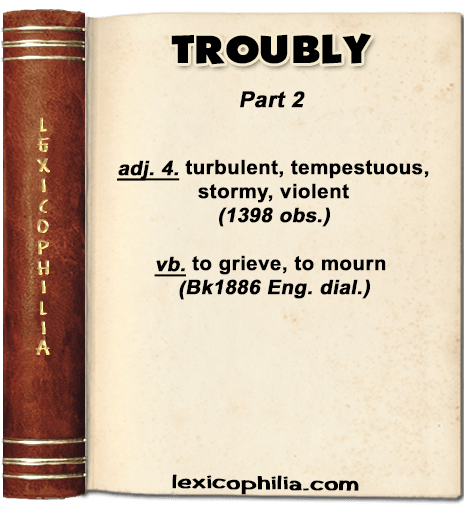
Word of the Day: TROUBLY

ETYMOLOGY
from trouble (n.) + -y or -ly 

EXAMPLE (for adj. 1.)
“…Mvsyng vpon the restles bisynesse
Which that this troubly world hath ay on honde,
That othir thyng than fruyt of byttirnesse
Ne yeldeth nought, as I can vndirstonde,
At Chestre ynnë, right fast be the stronde,
As I lay in my bed vp-on a nyght,
Thought me bereft of sleep with force and myght
…”

From: De Regimine Principum (The Governance of Kings and Princes)
By Thomas Hoccleve. c1412

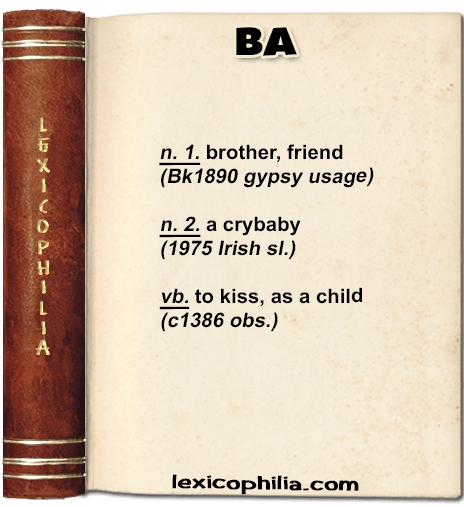
Word of the Day: BA

ETYMOLOGY
for the verb: probably a nursery or jocular word, imitating the action of the lips in an infant’s kiss; 
Old French has baerbeer (to open the mouth, to gape);
also, possibly a contracted form of basse (to kiss)

EXAMPLE (for verb)
“…Thanne wolde I seye, “Goode lief, taak keep
How meekly looketh Wilkyn, oure sheep!
Com neer, my spouse, let me ba thy cheke!
Ye sholde been al pacient and meeke
…”

From: The Wife of Bath’s Prologue
By Geoffrey Chaucer, c1386

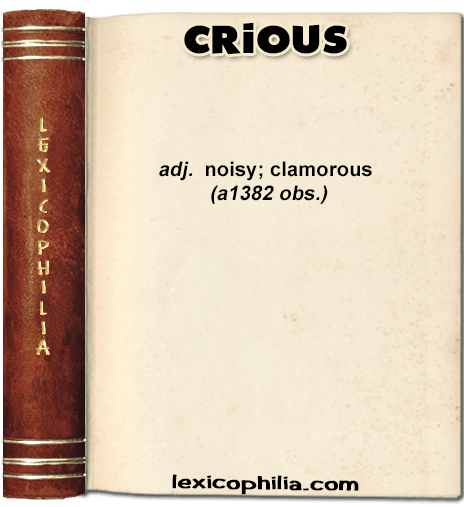
Word of the Day: CRIOUS

ETYMOLOGY
– from Anglo-Norman crious (also crieis, criois) clamorous,
from crier (vb. cry) + –ous

EXAMPLE
“… A fool womman, and crious sat in the ʒate doris of hir hous…”

From: The Holy Bible
Made from the Latin Vulgate by John Wycliffe and His Followers.
Edited by the Rev. Josiah Forshall and Sir Frederic Madden.
Volume III, 1850
Proverbs, Cap. IX

Word of the Day: HONISH


ETYMOLOGY
 from Anglo-Norman huniss-, Anglo-Norman and Old French honiss-, extended stem of Anglo-Norman hunir, Anglo-Norman and Old French honir (French honnir ) to shame, to humiliate, to ruin, to damage

FIRST DOCUMENTED USE
a1325 – see EXAMPLE below

EXAMPLE
“…Me sholde him [sc. Christ] hounschy & skorne boþe ffer & neye.….”

 From: The Southern Passion
A Middle English poem;
Edited by Beatrice Daw Brown, 1927