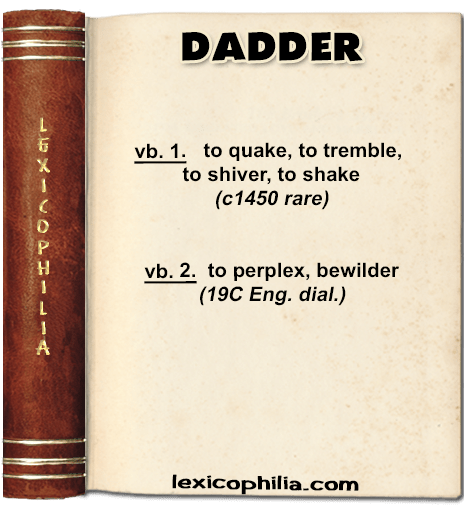
Word of the Day: DADDER


ETYMOLOGY
possibly imitative (perhaps of the chattering of teeth)


EXAMPLE
“…Full gayly was that grete lorde . girde in the myddis,
A brighte belte of ble, . broudirde with fewles,
With drakes and with dukkes, . daderande tham semede,
For ferdnes of fawcons fete, . less fawked thay were…”

From: Winnere and Wastoure 
(“Winner and Waster” is a Middle English poem written in alliterative verse around the middle of the 14th century)

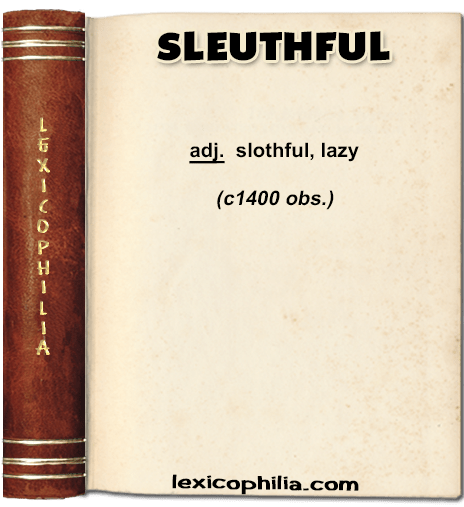
Word of the Day: SLEUTHFUL


ETYMOLOGY
from sleuth (sloth, laziness obs.) + -ful


EXAMPLE
“…And he þat hauys greet egℏen̛ ys enuyous & witℏ-outen shame, sleuthful, and vnobeyssant. He þat hauys lityƚƚ eghen̛, lyk to heuenly colour, or blake, ys of sharpe vnderstondynge, curteys, and leel…”

From: Secreta Secretorum,
(a treatise which purports to be a letter from Aristotle to his student Alexander the Great on an encyclopedic range of topics, including statecraft, ethics, physiognomy, astrology, alchemy, magic, and medicine)

Word of the Day: QUAINTRELLE


ETYMOLOGY
from Middle French (queint-cointerelle feminine of cointerel (beau, fop), from cointe (quaint)


EXAMPLE
“…It folweth nouht that thouh j be thus kembt and a litel make the queyntrelle that for swich cause j am fair I am foul old and slauery foule stinkinge and dungy…”

From: Pilgrimage of the Lyf of the Manhode,
from the French of G. de Guilleville, c1430

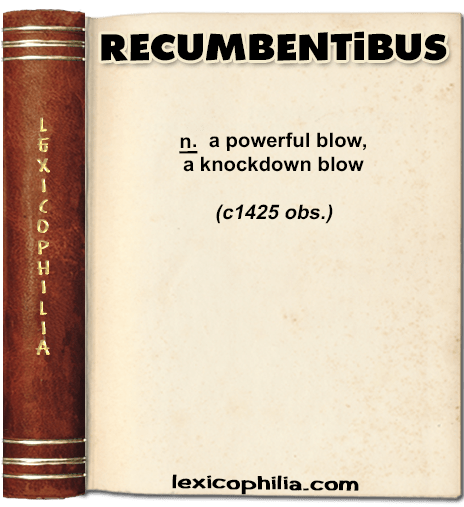
Word of the Day: RECUMBENTIBUS


ETYMOLOGY
a humorous use of Latin recumbentibus, ablative plural of recumbens, present participle of recumbere (recumb – to lean, recline, rest)


EXAMPLE
“…Ector sone to him gan take,
He thoght him venge of that wrake;
Ector bare his sword on hye,—
For he hadde no spere him bye,—
He ȝaff the kyng Episcropus
Suche a recumbentibus,
He smot In-two bothe helme & mayle,
Coleret and the ventayle…”

From: The Laud Troy Book;
an anonymous Middle English poem dealing with the background and events of the Trojan War, dating from around 1400

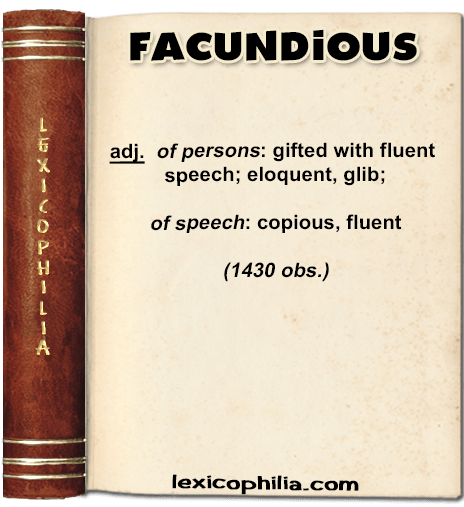
Word of the Day: FACUNDIOUS


ETYMOLOGY
from Latin fācundia (eloquence) + -ous


EXAMPLE
“…Discrete and hardy and wonder vertuous,
And of speche ryght facundious.
And coud him wel in euery thinge demene,
But Menelay of stature was but meane…”

From: The Auncient Historie and Onely Trewe and Syncere Cronicle of the Warres Betwixte the Grecians and the Troyans 
By John Lydgate, 1430

Word of the Day: WAKERLY


ETYMOLOGY
from waker (unsleeping, watchful, vigilant obs.) + -ly


EXAMPLE
“…Sothely he, as a good herde, was ful wakkerly and besy vppon the kepynge of that litell flok, his byloued disciples…”

From: The Mirror of the Blessed Life of Jesus Christ;
an adaptation/translation of Pseudo-Bonaventure’s Meditations on the Life of Christ into English
By Nicholas Love, c1400