Word of the Day: MALT-HORSE

ETYMOLOGY
from malt + horse

EXAMPLE
“…And bicause he passeth certain limites of a meane, that Reckelesness of his is curious, and not comly, and is a thing that commeth cleane contrarye to passe from the dryfte, (that is to wit) to cover arte. Therfore I judge it a no lesse vyce of curiositye to be in Reckelesness (which in it selfe is prayse worthye) in lettynge a mans clothes fal of his backe, then in Preciseness (whiche likewise of it self is praise worthy) to carie a mans head so like a malthorse for feare of ruffling his hear, or to keepe in the bottom of his cappe a looking glasse, and a comb in his sleeve, and to have alwayes at his heeles up and down the streetes a page with a spunge and a brushe: …”

From: The First Book of the Courtier
By Baldassare Castiglione
Translated by Thomas Hoby, 1561

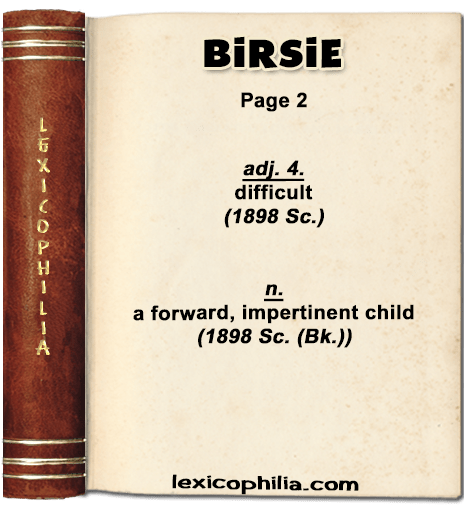
Word of the Day: BIRSIE

ETYMOLOGY
adj. 1. from birse (Sc. – a bristle, hair) + -y
n. from birse (Sc. – to push, to press, to squeeze) + -y

EXAMPLE
“…The mekill howke hym bair was Tryton callyt,
For in hir forstam was the monstre stallyt,
With watry trumpe fleyand the fludis gray;
Quhar as scho salyt, men mycht se hym ay
With  
byrsy body porturyt, and vissage
All rowgh of harys, semyng of cullage
In mannys form fra hys cost to hys crown,
…”

From: Virgil’s Aeneid translated into Scottish verse
By Gavin Douglas, a1522

Word of the Day: IMPERFECTIOUS

ETYMOLOGY
from Latin imperfectus (imperfect), after factious, etc.

EXAMPLE
“…Come hither thou Imperfecksious slaue in
Regard of thy beggery, holde thee theres
Twoshillings for thee? to pay for the
Healing of thy left legge which I meane
Furiously to inuade or to maime at the least.
…”

From: A Pleasant Conceited Historie, called The Taming of a Shrew, 1594

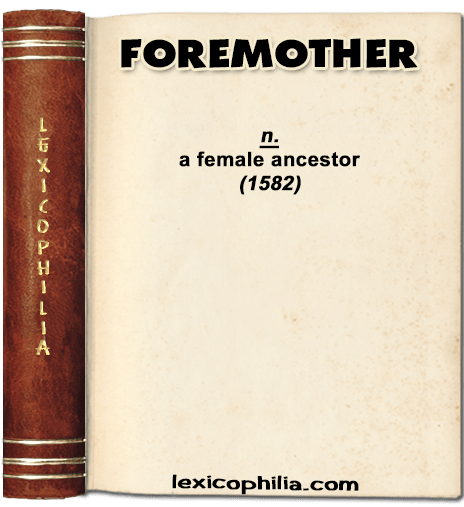
Word of the Day: FOREMOTHER

ETYMOLOGY
from fore- (prefix) + mother, after forefather

EXAMPLE
“…Finallie the admirable humilitie, and inuincible patience and constancie in all aduersities and persecution euen to the death and martyrdome, of Iepthas daughter, Susanna, the mother of the seuen brethren, and women of the Machabites, and manie other: that looking in this glasse of the holie liues of their foremothers, they may christianlie conforme and adorne themselues after their good examples, and become for their rare vertues verie beautifull spouses in the fight of their spirituall bridegroome Iesus Christ: to whom, as the kings daughters, they may appeere all glorious within, …”

From: The Monument of Matrones Conteining Seuen Seuerall Lamps of Virginitie, or Distinct Ttreatises
Compiled by Thomas Bentley, 1582

Word of the Day: AMPLECT

ETYMOLOGY
from Latin amplecti (to embrace, clasp), from amb- (about) + plectere (to plait, twine)

EXAMPLE
“...With what ioy Charles the people the amplect
Theyr ryght great ioyes done playnly testifye
Mixed with swete sownes of many a sect
Some sownyng trumpes and clarions wonders hye
Some other syngynge most melodiously
Some vpon lutes some vpon harpes play
The to reioyce in all that euer they may
….”

From: Anonymous translation of Latin verses by William Lily, 1522
“Of the tryumphe and the verses that Charles th’emperour and the most myghty redouted kyng of England Henry_the_.viii. were saluted with passyng through London”

Word of the Day: THRUMBLE

ETYMOLOGY
vb. 1: of uncertain origin
vb. 2, 3, 4: apparently from thrum (to press, to condense) + -le
vb. 5: apparently from thrum (to play on a stringed instrument) + -le

EXAMPLE (for vb.3)
“…PETER, quho was ever maist sudden, answers, and sayis: Thou art thrumbled and thrusted be the multitude, and ʒit thou speeris quha hes twitched thee, hee answers againe and he sayis, it is not that twitching that I speak of: It is ane vther kinde of twitching …”

From: Sermons vpon the Sacrament of the Lords Supper
By Robert Bruce, ?1591

Word of the Day: PAINTRIX

ETYMOLOGY
from paint + -trix 

EXAMPLE
“…
Quarters wages for Midsomer, anno Regni Regis Edwardi sexti Primo. [a.d. 1457.]…

On leaf 27, back, are
per Cade Item, to Anthony Totto, Painter … … … vj li v s
Item, to Barthilmewe Penne, Painter … … … vj li v s
Item, to Misteris levyn Terling, Paintrix … … xli
…”

In Thomas Vicary’s ‘The Anatomie of the Bodie of Man‘, 1547
Published by Early English Text Society, 1888

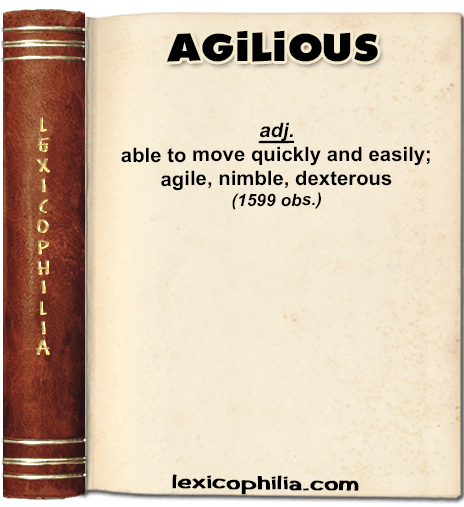
Word of the Day: AGILIOUS

ETYMOLOGY
from Latin agilis (agile) + -ous

EXAMPLE
“…What is become of all these iugling gambalds, Apish deuises, with all the rest of your squint-eyed trickes? when as through your deepe studies, long practises, & apt bodies, both strong & agilious, you haue attained to the height of all these things. …”

From: Paradoxes of Defence wherein is proued the true grounds of fight to be in the short auncient weapons, and that the short sword hath aduantage of the long sword or long rapier
By George Silver, 1599

Word of the Day: FOGGISH

ETYMOLOGY
adj. 1.: from fog (fat, bloated) + -ish
adj. 2.: from fog (cloud of small water droplets that is near ground level) + -ish

EXAMPLE (for adj. 1.)
“…He that lyueth after the rules of phisike lyueth wretchedly. As thoughe it were an happynes and felicitie, the body to be swolen and stretched out with surfettyng, to be brasted with the pleasure of the body, to waxe foggyshe with drinkyng of good ale, & to be sepulte and drowned in slepe …”

From: Declamatio in Laudem Nobilissimæ Artis Medicinæ.
= A declamacion in the prayse and co[m]me[n]dation of the most hygh and excellent science of phisyke
By Desiderius Erasmus
Translated out of Latin into English, ?1537