Word of the Day: VERECUND


ETYMOLOGY
from Latin verecundus, from vereri (to reverence, fear)


EXAMPLE 1
“…And sum of thame I sall now specifie,
Quhilk to ressoun salbe correspondent.
Than said Venus with vult verecund,
Say quhat ʒe will and keip ʒow within bound
Not pretendand to argune throw ʒour will:
Bot to ressoun that ʒour Sermone resound,
Or ellis the lak to ʒour self sall redound
…”

From: Ane treatise callit The Court of Venus deuidit into four buikis
By John Rolland, 1575


EXAMPLE 2
“…In my Father’s house,” says Christ, “are many mansions.” Verily, that appears to be also the case in some of His Scotch Evangelical servants’ houses here. And verecund Mr. McCosh, who will not venture to suggest any better arrangement of the heavens, – has he likewise no suggestion to offer as to the arrangement of No. 23, St. James’s Street?…”

From: Fors Clavigera: Letters to the Workmen and Labourers of Great Britain,
By John Ruskin, 1873
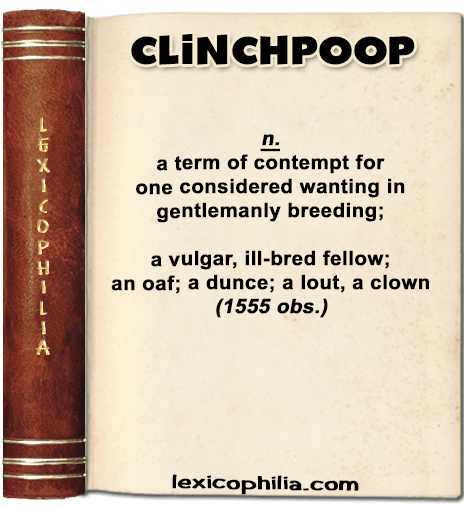
Word of the Day: CLINCHPOOP


ETYMOLOGY
of uncertain origin;
perhaps from one who clinches or clenches the poops of vessels,
a clincher (a workman who clinched the bolts in shipbuilding)


EXAMPLE 1.
“…Yf a Gentlemanne haue in hym anye humble behauour, then Roysters doo cal suche one by the name of a Loute, a Clynchepope, or one that knoweth no facyons…”

From: The Institucion of a Gentleman
By Humfrey Braham, 1555


EXAMPLE 2.
“…Cléante
Ma chere, ma chere, c’est vrai, c’est vrai,
But my rival is a juggins –

Angélique
A muggins –

Cléante
A noodle and a looby –

Angélique
A lopdoodle, a dunderhead, a pigsconce and a booby

Cléante
A Clinchpoop, a gobemouche, a snollygoster, a gongoozler

Angélique
A lickspiggot, a fuzzdutty, a jobbernowl, an ass –

Thomas
It’s highly amusing.

Cléante
Who’s in love with the sound of his own braying …”

From: The Hypochondriac
Roger McGough’s translation of Molière’s Le Malade Imaginaire, 2009

Word of the Day: BAWTIE


ETYMOLOGY
from Old Sc. bawtébawtie (a dog’s name), extended to dogs;
bawd is a Sc. term for a hare


EXAMPLE
“…I rew the race that Geordie Steill
Brocht Bawte to the kingis presence.
I pray God lat hym neuer do weill,
Sen syne I gat na audience.
For Bawte now gettis sic credence,
That he lyis on the Kingis nycht goun.
Quhare I perforce for my offence,
Man in the clois ly lyke ane loun
….”

From: The Warkis of the Famous and Vorthie Knicht Schir Dauid Lyndesay of the Mont, alias, Lyoun King of Armes
By David Lindsay, 1568
‘The Complaint and Publiet Confessioun of the Kingis Auld Hound, callit Bagsche, directit to Bawte, the Kingis best belouit dog, and his Companʒeonis’


PRONUNCIATION
BAW-tee

Word of the Day: MALIGNIOUS


ETYMOLOGY
from malign (adj.), from Latin malignus (evil-disposed),
from malus (evil) + -gnus, from base of gignere (to beget, produce, devise)


EXAMPLE
“… for as by the bad is the good knowen, so by the sower is the sweete the better discerned, and by the darkenesse of the night may a man iudge the brightnesse of the day, in so much that I wholy perswade with my selfe that lightly your Honour will pardon my attempt, and fond presumption, in being bold vnder your honours patronage to shield me with defence against such carping, blustering, and malignious tongues, which not onely doo perillously shake at, yea, and indeuour mainely to beat downe, and confute not onely all kind of blossomes, and young budded fruites…”

From: Florio His Firste Fruites which yeelde Familiar Speech, Merie Prouerbes, Wittie Sentences, and Golden Sayings
By John Florio, 1578

Word of the Day: PINCHFART


ETYMOLOGY
formed by compounding pinch- (comb. form. a nip, a squeeze; to nip, to squeeze)


EXAMPLE
“…It were lamentable to tel what misery the Rattes and Mise endured in this hard world, how when all supply of vittualls failed them, they went a Boot-haling one night to Sinior Greedinesse bed-chamber, where finding nothing but emptines and vastitie, they encountred (after long inqusition) with a cod-peece, wel dunged and manured with greace (which my pinch-fart penie-father had retaind from his Bachelorship, vntill the eating of these presents).…”

From: Pierce Penilesse, His Supplication to the Divell
By Thomas Nashe, 1592

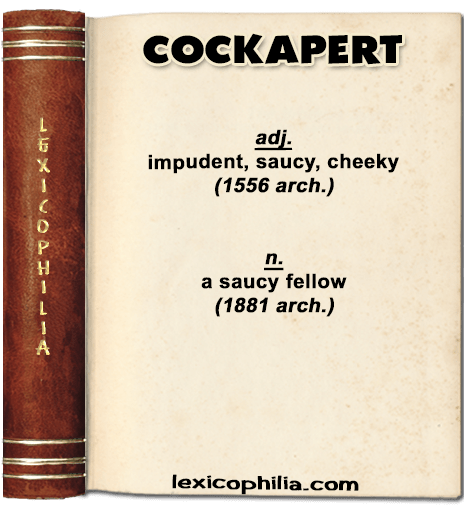
Word of the Day: COCKAPERT


ETYMOLOGY
seemingly an alteration of malapert (adj.) after cock (a mature male of the domestic chicken)


EXAMPLE
for adj.

“…Which is terbox to your side: for out of dout,
Your cockapert pride: and your couetous harts.
Haue brought: more than three parts of our ils about.
Your rude rebelins disobedient parts:
Much vnto our (and much more to your own) smarts:
Kicking and wincing at euery good order,
Hath distroide good order in euery border…”

From: The Spider and the Flie
By John Heywood, 1556


for n.

“… I could tell he was cross about something. I didn’t think the blisters were enough to account for it; he’d suffered them for days without complaint. We got under the quilt and I pulled the coverlet over our heads. In the dark I could watch him but he couldn’t see me. There was a strong scent of sweet balm from the foot salve. I said, “I heard about Sire … Lackadaisy, or or Lapscallion – the cockapert who insulted you. Are you still hungry at him?…”

From: Wildfire: A Novel
By Sarah Wicklem, 2009

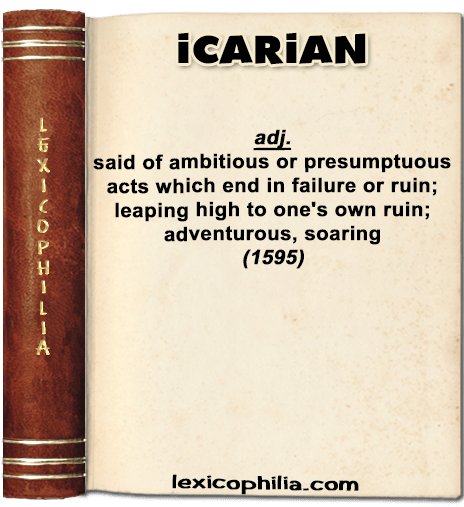
Word of the Day: ICARIAN


ETYMOLOGY
from Latin Icarius = Greek Ἰκάριος, from Icarus, Ἴκαρος the son of Daedalus, in Greek Mythology + -an 


EXAMPLE
“…And yet ’tis a bitter pang under any circumstances to find another preferred to yourself. It is about the same blow as one would probably feel if falling from a balloon. Your Icarian flight melts into a very grovelling existence, scarcely superior to that of a sponge or a coral, or redeemed only from utter insensibility by your very frank detestation of your rival…”

From: Coningsby: Or, The New Generation
By Benjamin Disraeli, 1844

Word of the Day: SPECTIBLE


ETYMOLOGY
from Latin spect-, ppl. stem of specere (to look)


EXAMPLE
“…Furthermore to make him more carefull to regard vertue, he planted into him very deepe rootes and prickes of conscience, hee added moreouer Statutes and Lawes, not onely emprinted within euery ones hart, but engrauen also outwardly in spectible Tables…”

From: Against Ierome Osorius Byshopp of Siluane in Portingall and against his slaunderous inuectiues An aunswere apologeticall.
By Walter Haddon and John Foxe
Translation by James Bell, 1581

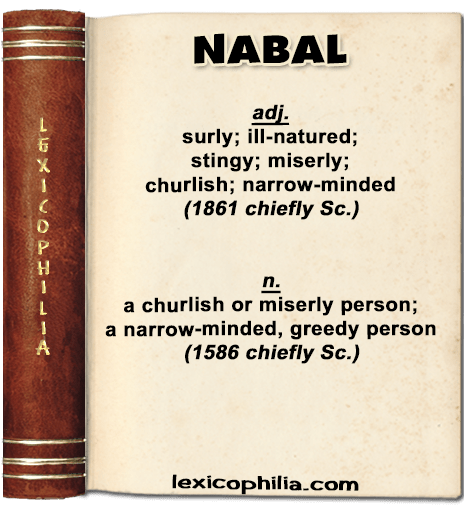
Word of the Day: NABAL


ETYMOLOGY
from the Hebrew proper name Nabal (a wealthy sheep owner who refused to pay tribute to King David for protecting his flocks),
from nabal (a disgraceful, impious, or villainous person)
from nabal (to be foolish, act foolishly)


EXAMPLE
“…As for those men that resemble the rigorous iudge, that neither feare God, nor good man, that neuer thinke of the saluation of their sinful seduced soules, that either be Athiestes or Libertines or Machiuelians or Spend-thriftes or couetous Nabals or great Gamsters or Luxurious and Riotous persons or seditious and traiterous papists, are no fitte men to bee such a husband as I propose …”

From: A sermon preached at Trafford in Lancashire
By William Massie, 1586


PRONUNCIATION
NAY-buhl

Word of the Day: NICELING


ETYMOLOGY
from nice (adj.) + -ling


EXAMPLES
(for n.1.)
“…Whether a man loue God purely, the pleasures of this worlde dooe trye, but muche more doeth the hurly burly of affliccions. And it is in vs, that being furnyshed with the helping ayde of God, we maye nether become tendre nycelynges through vayne pleasures, ne moued with terrible turmoylinges …”

From: The seconde tome or volume of the Paraphrase of Erasmus vpon the Newe Testament
Desiderius Erasmus
Translation by Miles Coverdale et al, 1549


(for n. 2.)
“…Why, I was showing you what nicelings and delicates my father was bringing, and what I had thought to say was this: that he may have this for one, and that for the other, and many a one proud to be remembered (as I shall be if he thinks of me), but this that I know he is bringing for little Bess Hall is something worth all of these, for it is nothing less than the whole love of his heart…”

From: Judith Shakespeare: Her love affairs and Other Adventures
By William Black, 1884