Word of the Day: STRATAGEMATIC


ETYMOLOGY
from obsolete French strategematique,
or from Latin strategematicus, from strategēmat-strategema (stratagem) + -icus (-ic)


EXAMPLE
“…Wherefore such persons as be illuminated with the brightest irradiations of knowledge and of the veritie and due proportion of things, they are called by the learned men not phantastici but euphantasioti, and of this sorte of phantasie are all good Poets, notable Captaines stratagematique, all cunning artificers and enginers, all Legislators, Polititiens, & Counsellours of estate, in whose exercises the inuentiue part is most employed, and is to the sound and true iudgement of man most needful…”

From: The Arte of English Poesie
By George Puttenham, 1589

Word of the Day: DULCARNON


ETYMOLOGY
from Latin dulcarnon Pythagoras’ theorem
from Arabic ḏu’l-qarnayn (two-horned, lit. ‘possessor of the two horns’)
from ḏu (lord, possessor) + al (the) + qarnayn, dual of qarn (horn)


EXAMPLES
“…Criseyde answerde, :As wisly God at reste
My soule bringe, as me is for hym wo!
If that ich hadde grace to do so.
And eem, y-wis, fayn wolde I doon the beste,
But whether that ye dwelle or for him go,
I am, til God me bettre mynde sende,
At dulcarnoun, right at my wittes ende
…”

From: Letter from Mrs. M. Roper in Thomas More’s Works, 1441


“…Siva holds the drums of creation in one hand and the fires of destruction in the other—an either/or dulcarnon from which there seems no escape…”

From: A Wake Newslitter
December, 1974

Word of the Day: BEBLUBBERED


ETYMOLOGY
from be- + blubber (to weep effusively) + -ed


EXAMPLE
“…Thee seas, thee regions and eeche place worldlye beholding,
On Lybye land lastly fixt his celestial eyesight.
And thus as he mused, with tears Venus heauye beblubberd
Prest foorth in presence, and whimpring framed her errand
…”

From: The First Booke of Virgil His Aeneis
Translated by Richard Stanyhurst, 1582

Word of the Day: HIRPLE


ETYMOLOGY
of unknown origin;
the coincidence in sound and sense with Greek ἕρπειν from ἕρπω (hérpō) (to move slowly),
is noticeable.


EXAMPLE
“…The bull: the beir: the bugill: and the bair:
The wodwys: vildcat: and the wild wolfyne:
The hardbakkit hurcheoun: and the hirpland hair:
Baith otter and aip: and pennit porcupyne.
The gukit gait: the selie scheip the swyne:
The bauer bakon and the balterand brok:
The fowmart, with the fyber furth can flok
…”

From: The Morall Fabillis of Esope the Phrygian
“The taill of the sone & air of the forsaid foxe”
Robert Henryson, a1500

Word of the Day: GARBOIL


ETYMOLOGY
apparently from Old French garbouille (confused mess, confusion, disorder), of uncertain and disputed origin;
From the O.E.D.: “it is likely that this word and the related garboil v. have been associated with garble v. and garble n., and probably regarded as variants of these”


EXAMPLE
“…and after long and mature debating off the mattar, forasmuch as itt appeared the Mayor to have ben a great sturrer of this garboyle, and to be a man that att sondry tymes hadde deluded wyth delayes the sayde commissioners whereby the matter cowlde grow to none ende…”

From: Selections from the Records of the City of Oxford
Edited by Willilam H, Turner, 1880
1543, May 22. Decree of the Privy Councell in the matters of Difference between the University and City.

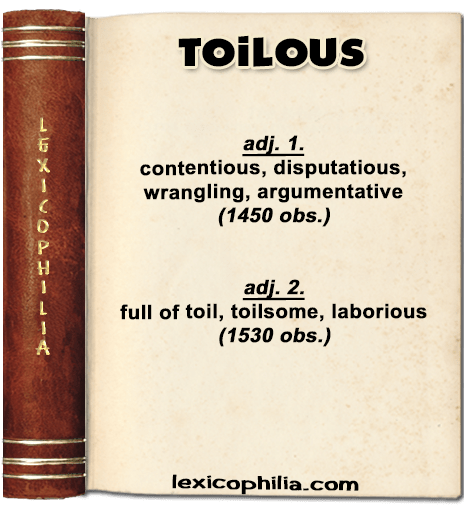
Word of the Day: TOILOUS


ETYMOLOGY
from toil (strife, turmoil, dispute) + -ous


EXAMPLE
“….R
to riotus, to reueling, ne rage not to rudeli.
S
to straunge, ne to stirynge, ne straungeli to stare.
T
to toilose, ne to talewijs, for temperaunce is beest.
V
to venemose, ne to veniable, & voide al vilonye.
W
to wielde, ne to wraþful, neiþer waaste, ne waade not to depe
..”

From: Aristotle’s A B C
in The Babees Book,
Lambeth Manuscript. a1430

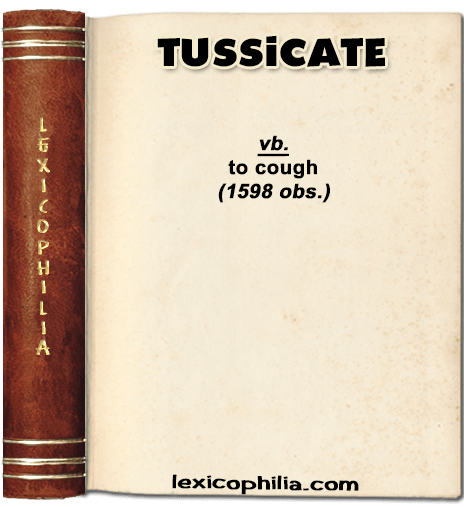
Word of the Day: TUSSICATE


ETYMOLOGY
from Latin tussicus (afflicted with tussis a cough)


EXAMPLE
“…Phisition Mirus talkes of saliuation,
Of Tophes and Pustules, and Febricitation;
Who doth ingurgitate, who tussicate,
And who an vlcer hath inueterate.
Thus while his Inkehorne termes he doth apply,
Euacuated is his ingenie.
..”

From: Chrestoleros. Seuen Bookes of Epigrames
By Thomas Bastard, 1598

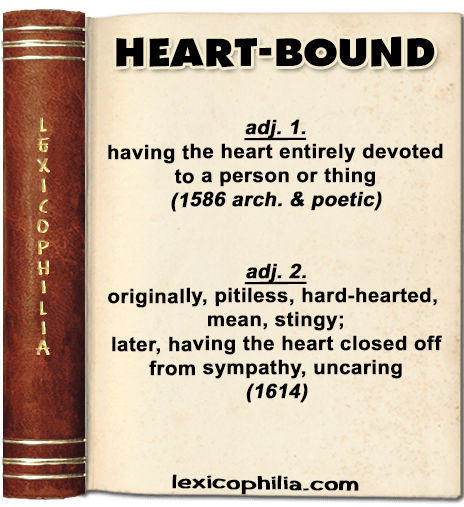
Word of the Day: HEART-BOUND


ETYMOLOGY
from heart + bound


EXAMPLE
“…When Strephon cursing his owne backwardnes
Came to hir back, and so with double warde
Emprison hir, who both them did possesse
As heart-bound slaues: and happy then embrace
Vertues proofe, fortunes victor, beauties place
…”

From: The Countesse of Pembrokes Arcadia.
By Sir Philip Sidney. a1586