ETYMOLOGY
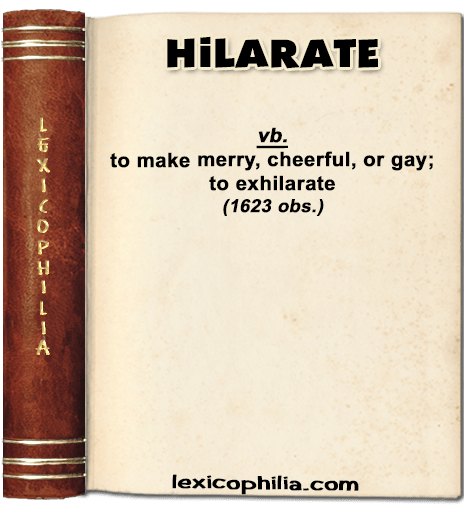
from Latin hilarat- participial stem of hilarare, from hilarus, hilaris, (cheerful, gay)
EXAMPLE
They drank enough wine to hilarate, not intoxicate.
ETYMOLOGY
from Latin hilarat- participial stem of hilarare, from hilarus, hilaris, (cheerful, gay)
EXAMPLE
They drank enough wine to hilarate, not intoxicate.

ETYMOLOGY
earlier form of smuggle (vb.)
EXAMPLE
“… Which computation is sufficiently justified by the Customs of the Three Kingdoms, whose intrinsick value are thought to be near a Million per annum, viz. Six hundred thousand pounds, payable to the King; 100 thousand Pounds, for the charges of Collecting, &c. Two hundred thousand pounds smuckled by the Merchants, and one Hundred thousand pounds gained by the Farmers; according to common Opinion, and Mens Sayings: And this agrees also with that proportion, or part of the whole Trade of the World, which I have estimated the Subjects of the King of England to be possessed of; viz, of about Ten of Forty Five Millions. …”
From: Political Arithmetick
By Sir William Petty, 1691

ETYMOLOGY
from fuddle one’s cap or nose (to get drunk);
from fuddle (to tipple, to booze)
EXAMPLE
“… The Fuddlecap, whose God’s the Vyne,
Lacks not the Sun if he have Wine;
By th’ Sun he only finds a way
To some cool Spring, to spend the day.
Shrill Flutes and Trumpets Souldiers love,
And scorn those fears that Women move. …”
From: The Poems of Horace consisting of Odes, Satyres, and Epistles
Rendred in English verse by several persons
‘A Paraphrase upon the first Ode by S. W. Esq To MECOENAS‘
ETYMOLOGY
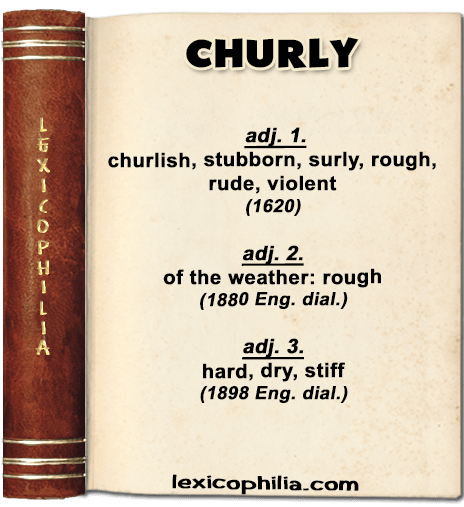
from churl + -y
EXAMPLE
“… But all this while, the shop where Jonah sleeps,
Is tost, and torne, and batter’d on the deeps,
And well-nigh split upon the threatning Rock,
With many a boystrous brush, and churley knock.
God help all desp’rate voyagers, and keepe
All such, as feele thy wonders on the deepe. …”
From: Divine poems: containing the History of -Jonah. Ester. Job. Samson.; Sions – sonets. Elegies.
By Francis Quarles, 1638

ETYMOLOGY
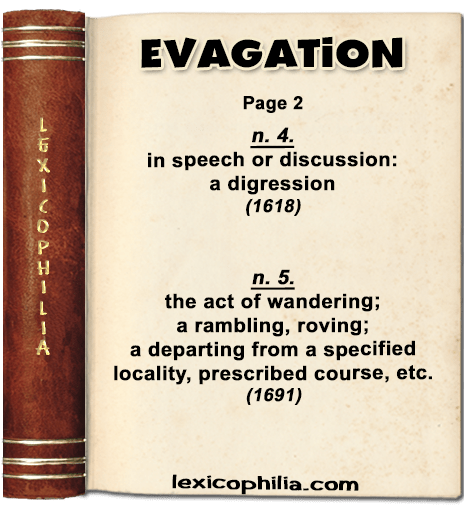
First introduced in the fig. n.1; from French evagation, Latin evagationem, noun of action from evagari, from e (out) + vagari (to wander)
EXAMPLE (for noun 1)
“… Clarefie me with fy clernesse of euerlastinge lijt, and bringe oute of fe liabitacle of myn herte aH maner of derkenes. Restreyne all euel evagacions & all miȝty temptacions. …”
From: The earliest English translation of the first three books of the De imitatione Christi
By Thomas à Kempis, c1425

ETYMOLOGY
from Latin rident-, ridens, present participle of ridere (to laugh), of uncertain origin
EXAMPLE
“…Bo. Hold up; so, sir, now away. Oh Mistris, your scantling, most sweete mistriss, most derydent starre.
Acut. Then most rydent starre, faire fall ye.
Grac. Nay tis the Moone her self, for there’s her man and her Dogge before. …”
From: Everie Woman in her Humor
‘Printed by E.A. for Thomas Archer, and are to be solde at his shop in the Popes-head-Pallace, neere the Royall Exchange’ ,1609

ETYMOLOGY
from Latin irruentem, present participle of irruere (to rush in or upon)
EXAMPLE
“… Under such an irresistible impulsion, mind and soul both were now following hand in hand a new path of progressive and irruent development. …”
From: Music: A Monthly Magazine
Devoted to the Art, Science, Technic, and Literature of Music
W. S. B. Mathews, Editor
Volume IV. May, 1893 to October 1893
The Old Lyric Stage and the New One
ETYMOLOGY
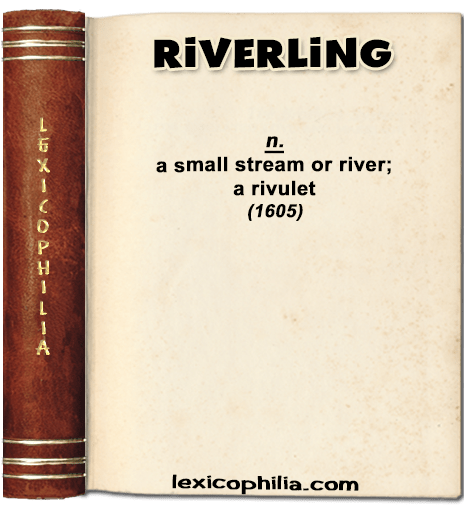
from river + -ling
EXAMPLE
“… Of him she also holds her silver Springs.
And all her hidden Crystall Riverlings:
And after (greatly) in two sorts repayes
Th humour she borrows by two sundry wayes. …”
From: Bartas His Deuine Weekes and Workes
By Guillaume de Saluste Du Bartas
Translated by Joshua Sylvester, 1605
The third Day of the first Week.
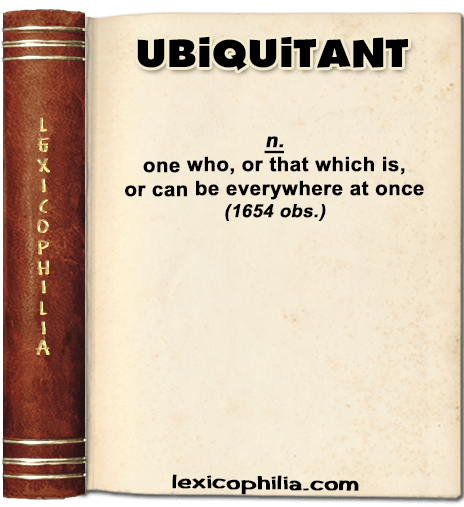
ETYMOLOGY
from ubiquit- (in ubiquitair (adj.), ubiquitarian (n.), ubiquitism (n.), ubiquity (n.), etc.) + ‑ant
EXAMPLE
“… as neither is pure Air. Hence divers Divines aver Angels to be corporeal, becaus finit and limited to place; being bounded, as it were, with a superficies, that they cannot be ubiquitants every wher or elswher at once: Much more then Mens Souls, which liv in Bodies. …”
From: Theoremata Theologica: Theological Treatises.
Octo theses theologicæ: Eight theses of divinity
By Robert Vilvain, 1654

ETYMOLOGY
from Greek ζῴδιον diminutive of ζῷον (animal) + γράϕειν (to write)
EXAMPLE
“… Notwithstanding upon enquiry we find no mention hereof in Ancient Zodiographers, and such as have particularly discoursed upon Animals,
as Aristotle, Elian, Pliny, Solinus and many more; who seldom forget proprieties of such a nature, and have been very punctual in less considerable Records. …”
From: Pseudodoxia Epidemica
By Sir Thomas Browne, 1650
Of the Picture of the Pelecan
 Lexicophilia