Word of the Day: PROTREPTICAL

ETYMOLOGY
from Latin protrepticus or its etymon ancient Greek προτρεπτικός (hortatory, instructive) < προ- (pro-) + Greek τρεπτικός (causing change in),
from Greek τρεπτός (liable to be turned or changed)
(from τρέπειν (to turn, direct the course of) + ‑τός)) + ‑ικός (‑ic) + -al

EXAMPLE
“… For the matter, we find, that these words are joyned with the antecedent Doctrine concerning the Excellency of Christ both as Prophet and Priest; and so it’s the second part of the whole, which is, 1. Doctrinal. 2. Practical. For, the former part is didascalical, this latter protreptical and more practical. But if we consider the immediate Connexion, then it will appear, that it’s in a more special manner joyned with the Doctrine of Christ’s Priest-hood, …”

From: An exposition of the Epistle to the Hebrewes 
By George Lawson, 1662

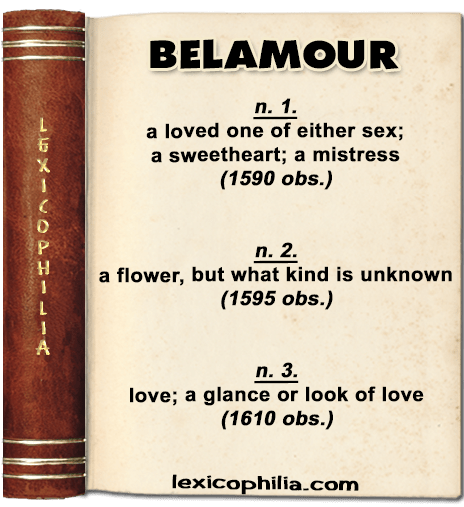
Word of the Day: BELAMOUR

ETYMOLOGY
from French bel (fair) + amour (love)

EXAMPLE (for n. 1)
“… Loe loe how braue she decks her bounteous boure,
  With silken curtens and gold couerlets,
  Therein to shrowd her sumptuous
Belamoure,
  Yet neither spinnes nor cardes, ne cares nor frets,
But to her mother Nature all her care she lets.
…”

From: The Faerie Queene
By Edmund Spenser, 1590

Word of the Day: HARE-HEARTED

ETYMOLOGY
from hare + hearted

EXAMPLE
“… Two right Hare-harted coward Fooles,
Would end their wrath with Cutlers tooles,
And two moft fhifting Knaues intends,
To make thofe Cowards louing friends:
One goes to th’one, and tell’s him tother,
Vowes he doth loue him as his Brother;
And would a Supper on him fpend :
That Cuppes of Sacke their ftrife might end, …”

From: A Fooles Bolt is Soone Shot
By Samuel Rowlands, 1614

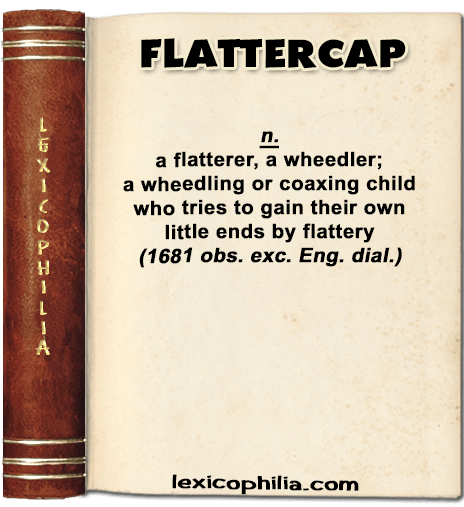
Word of the Day: FLATTERCAP

ETYMOLOGY
from flatter (vb.) + cap

EXAMPLE
“… He’s struggling to learn a lot of new things, but I also think he’s trying to do whatever he can to get on with the men.
I’ve seen him behaving like a 
flattercap, all yes sir, no sir, with a seaman named Brian Blount. …”

From: Trouble on the Voyage : The Strange and Dangerous Voyage of the Henrietta Maria
By Bob Barton, 2010

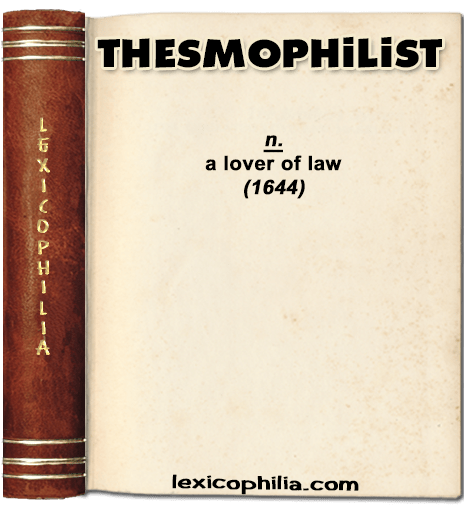
Word of the Day: THESMOPHILIST

ETYMOLOGY
from Greek θεσµός (thesmos – law); (from root θε– (to lay down)) + –ϕιλ-ος (-phil )-ist

EXAMPLE
“… To shut out any light that may be usefull in Gods house, is with the Jews to make it a denne: as they would do, that would shut out the Ceremonies out of the Church: for, take away Ceremonies out of the Church, and take away the light that is in it. Surely this is spoken in Ceremony, by way of complement to his Bishop, that great Thesmophilist: Have we no other candle in our candlestick but ceremony? …”

From: A Discourse of Proper Sacrifice
By Edward Dering, 1644

Word of the Day: QUINOMBROM

ETYMOLOGY
of unknown origin

EXAMPLE
“… When you have cast an eye upon this Letter which goeth stuff’d with all Proverbs, old Motts, and Adages, whereof some were used in the time of high bonnets, when men used to wipe their noses on their sleeves, for want of a napkin, you will judge perhaps, that the Author hath some strange freaks, or quinombroms in his noddle, that he hath quicksands, or Mercury, or rather one quarter of the Moon in his pericranium; But you Sir, that have a head so well timbred, will, I presume, passe another judgement. …”

From: Paroimiographia Proverbs, or, Old sayed savves & adages in English (or the Saxon toung), Italian, French, and Spanish
By James Howell, 1659

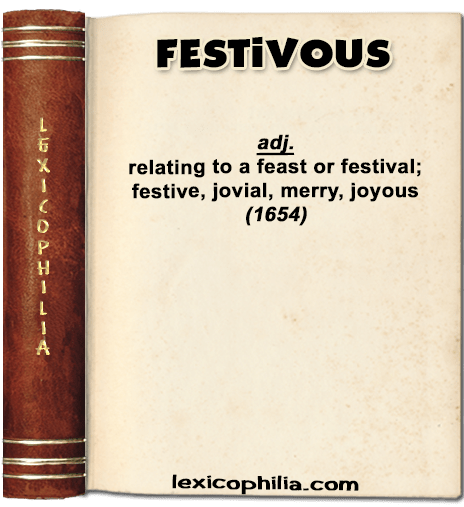
Word of the Day: FESTIVOUS

ETYMOLOGY
from Latin festivus (festive), from festum (a feast) + -ous

EXAMPLE
“… But goe on boldly, Frestons charmes must end,
See here, a Disinchanter is thy friend;
Who innocent black Art, hath round thee writ
A magick circle of Festivous Wit;
Which will secure thy Fame against that Prime,
And lasting monster, all devouring Time. …”

From: John Speed in Edmund Gayton’s Pleasant Notes Upon Don Quixot, 1654