Word of the Day: GULIST

ETYMOLOGY
from Latin gula (gullet, appetite, gluttony) + -ist

EXAMPLE
“… He that sell’s himselfe to the custome of disloyalty to his Creator, become’s ignorant of his offence; and, instead of correction, prove’s unskilfull in the knowledge of his sinne. The gluttonous satiety of our swelling Gulists, argue’s their necessity of offending by forgetfulnes: and their own abundance barr’s them frō the just weighing of the poverty of the distressed. The common drunkard cannot be taken with a due thanks-giving for that superfluity which he corrupt’s, from whence many thirstie soules might sucke a reasonable supply for necessity. …”

From: The Honor of Chastity
By John Featley, 1632
Word of the Day: LEGIFEROUS

ETYMOLOGY
from Latin legifer (law-giving); (from legi-lex (law) + -fer (bearing, bringing)) + -ous

EXAMPLE
“… When both joynd issue to Entertaine the King
(Your Royall Grandfather of blessed memory)
Then did the issues of the Schollars braine
Put Ignoramus on’s 
Legiferous straine …”

From: Ignoramus. Or, The Academical Lawyer
By Ferdinando Parkhurst, 1662
in The Prologues and Epilogues of the Restoration 1660-1700
By Pierre Danchin, 1981

Word of the Day: TARDIGRADE

ETYMOLOGY
from French tardigrade (slow-paced) or from Latin tardigradus (walking slowly); from Latin tardus (slow) + -gradus (stepping, going)

EXAMPLE (for adj. 1)
“… Once more a cruelly long passage fell to my lot. The Deborah proved a marine hackney-coach of the most tardigrade order. But it could not be helped; so, like Diogenes, I resolved to be satisfied with my tub, and as for sunshine, I found it within and without! …”

From: Our Antipodes:
Or, Residence and Rambles in the Australasian Colonies.
By Lt. Colonel Godfrey Charles Mundy, 1852

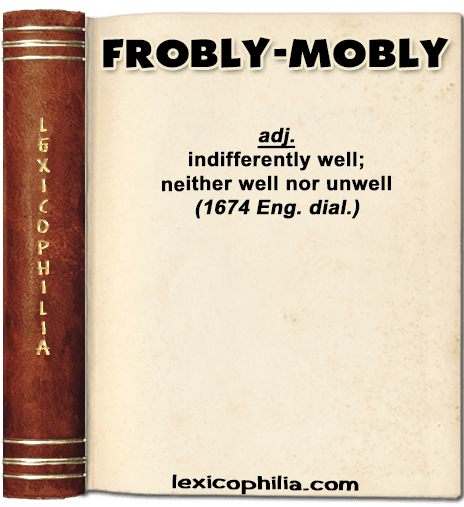
Word of the Day: FROBLY-MOBLY

ETYMOLOGY
of unknown origin

EXAMPLE
“… If people felt but indifferently well, they said they were frobly-mobly; if they had swollen faces, they spoke of boun muns; if they were ready to faint, they said coath. …”

From: All The Year Round:
A Weekly Journal
Conducted by Charles Dickens, Jun.
Volume IV. From June 4, to November 26, 1870
‘In the Provinces ‘

Word of the Day: THINKATIVE

ETYMOLOGY
from think (vb.) + -ative, chiefly after talkative

EXAMPLE
“… They have not known I say, that the knowledge of Observation, doth not introduce an understanding into the essential thingliness of a thing, but erecteth only a thinkative knowledge: For otherwise, the understanding should perceive causes that are before in essence. Then also they have been deceived by the simplicity of the Water, which simpleness they have confounded with the unity of knowledge to us unknown. …”

From: Oriatrike or, Physick Refined
By Jean Baptiste van Helmont
Translated by J. Chandler, 1662

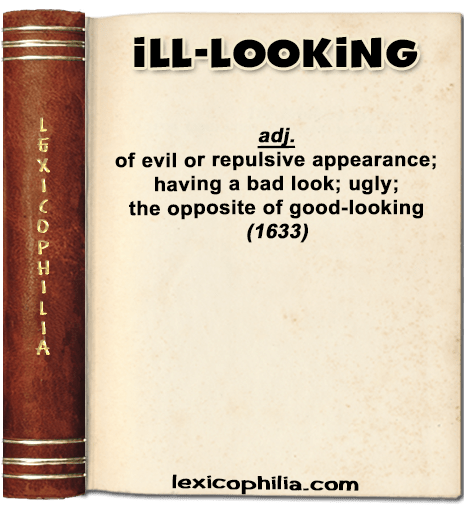
Word of the Day: ILL-LOOKING

ETYMOLOGY
from ill (adj.) or (adv.) + looking, present participle of look (vb.)

EXAMPLE
“… That gawdy eare-wrig, or my lord your patron,
Whose pensioner you are. — I ‘le teare thy throat out,
Sonme of a cat,
ill-looking hounds-head, rip up
Thy ulcerous maw, if I but scent a paper,
A scroll, but halfe as big as what can cover
A wart upon thy nose, a spot, a pimple,
Directed to my lady: it may prove
A mysticall preparative to lewdnesse.
…”

From: The Broken Heart
By John Ford, 1633

Word of the Day: DUPLE

Note: the obsolete adjective definition is a general sense.
In mathematics, it is applied to the proportion of two quantities one of which is double of the other; 
in music, it is applied to ‘time’ or rhythm having two beats in the bar.

ETYMOLOGY
Adj. and n.:  from Latin duplus (double), from duo (two) + -plus, from root ple- (to fill);
Vb.:  from Latin duplare (to double), from dupl-us (duple)

EXAMPLE (for vb.)
“… She mixd of Quick-silver a deadly weight,
That dupled force his murder hasten might.
Then while those baneful pots betwixt them strov,
The helpful swaying the hurtfuls bane out drov. …”

From: Enchiridium epigrammatum Latino-Anglicum:
An epitome of essais,
Englished out of Latin by Robert Vilvain, 1654

Word of the Day: VIRIPOTENT

ETYMOLOGY
adj. 1: from Latin viripotent-viripotens, from vir (man, husband) + potens (able)
adj. 2: from Latin viripotent-viripotens, from vires (strength)

EXAMPLE
“… The king thus hauing vanquished and ouercome the Welshmen, placed garisons in sundrie townes & castels, where he thought most necessarie, and then returned to London with great triumph. Thither shortlie after came ambassadours from the emperour, requiring the kings daughter affianced (as before you haue heard) vnto him, and (being now viripotent or mariable) desired that she might be deliuered vnto them. …”

From: The first and second volumes of Chronicles. [vol. 3 (i.e. The Third Volume of Chronicles)] comprising 1 The description and historie of England, 2 The description and historie of Ireland, 3 The description and historie of Scotland:
First collected and published by Raphaell Holinshed, William Harrison, and others: now newlie augmented and continued (with manifold matters of singular note and worthie memorie) to the yeare 1586. by Iohn Hooker aliàs Vowell Gent and others.
Henrie the first, yoongest sonne to William the Conquerour. (Book Henry I)

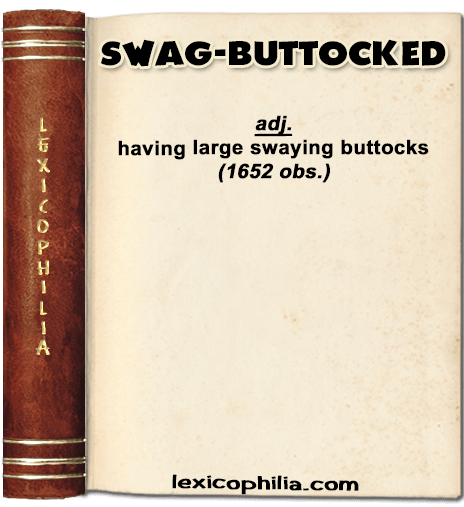
Word of the Day: SWAG-BUTTOCKED

ETYMOLOGY
from swag (to move heavily from side to side or up and down) + buttock

EXAMPLE
“… Mag. Look you heare then.
Fra. O see, see — dat is de gross english Douck, for
de
swagbuttock’d-wife of de Pesant.
Mag. How like you this then? There’s a Reverence
I warrant you.
…”

From: Five new playes, (viz.) The Madd Couple Well matcht. Novella. Court begger. City witt. Damoiselle
The Damoiselle, Or The New Ordinary
By Richard Brome, 1653

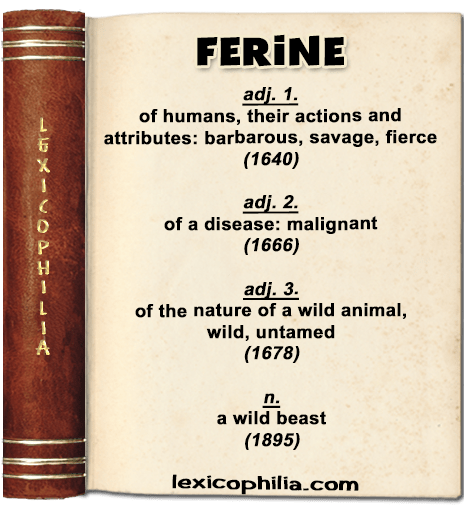
Word of the Day: FERINE

ETYMOLOGY
from Latin ferinus, from fera (wild beast)

EXAMPLE (for adj. 1)
“… Secondly there are brutish and unnaturall Desires, which the Philosopher calleth 
ferine and inhumane, instancing in those barbarous Countries, where they use to eat mens flesh and raw meat; and in the Woman who ripped up Women with childe that shee might eat their young ones: …”

From: A Treatise of the Passions and Faculties of the Soule of Man
By Edward Reynolds, 1640