Word of the Day: EMPTITIOUS

ETYMOLOGY
from Latin empticius (obtained by purchase), from empt- ppl. stem of emere (to buy) + ‑icius (‑itious)

EXAMPLE
“… but, diverted twixt fear of detection and zeal of working more good (upon the Presbyter) for the Catholike cause, we wheel’d about and got us to Newcastle; where we found the Gentleman that ran away from Oxford playing at Stowball with his Sodalitia, his guid chapmen; who (as emptitious as he was) though they valued him not, because sese inscendi passus est, he suffered himself to be fool ridden, yet knew well enough how to overvalue him. …”

From: Mutatus Polemo. The horrible strategems of the Jesuits, lately practised in England, during the Civil-Wars, and now discovered by a reclaimed Romanist.
By A.B., 1650
Word of the Day: SHROWARDLY

ETYMOLOGY
perhaps from shrow (shrew, a wicked or malignant person), after frowardly

EXAMPLE
“… Now have I most unmanfully fallen foul upon some
Woman, I’le warrant you, and wounded her
Reputation
shrowardly: Oh drink, drink! thou
Art a vile enemy to the civillest sort of curteous
Ladies.
…”

From: The Comical Revenge, or, Love in a Tub
By George Etherege, 1664

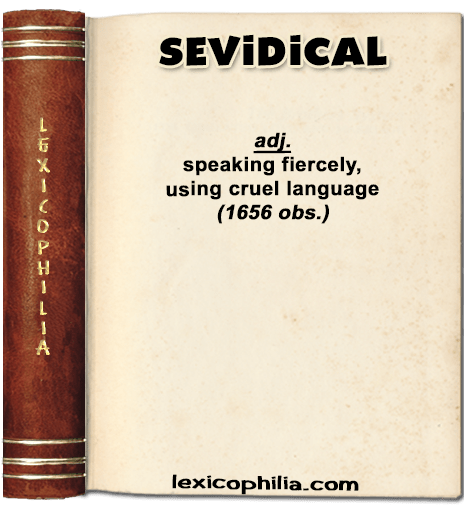
Word of the Day: SEVIDICAL

ETYMOLOGY
from Latin sævidicus; from sævus (fierce, furious) + dic- stem of dicere (to say, speak) + -al

EXAMPLE
“… Carolyn smiled and gave a crafty wink, “It means a filthy, slobbering person. That’s the way you left him wasn’t it? And I think we can assume he was quite sevidical in his comments about you, don’t you think? …”

From: Something to Crowe About
By E. W. Nickerson, 2013

Word of the Day: NESTCOCK

also NESCOCK, NESCOOK (Eng. dial.)

ETYMOLOGY
from nest + cock

EXAMPLE
“… As for Rafe – despite his love for the theater and his determination to travel the Circuit, he was essentially a homebody, a confirmed nestcock eagerly anticipating marriage to Crisiant and a settled home with a dozen rambunctious children. …”

From: Touchstone
By Melanie Rawn, 2012

Word of the Day: COMITATE

ETYMOLOGY
from Latin comitat- ppl. stem of comitari (accompany, attend, follow)

EXAMPLE
“… Thus to his guest Aeneas lodgings went
This Heroë brave, mindfull of’s high intent
And of his promis’d aid. With no lesse care
Aeneas in the morning doth prepare.
With Pallas young the king associated,
Achates kinde Aeneas comitated.
Met, they shake hands, and down together sit,
And having time for talk, and leisure fit,
The king thus first began; Great prince of Troy,
I ne’re shall think (whiles thou dost life enjoy)
Troyes crowns and comforts to be brought to thrall …”

From: The XII Aeneids of Virgil, the Most Renowned Laureat-Prince of Latine-Poets
Translated by John Vicars, 1632

Word of the Day: BROW-SICK

ETYMOLOGY
from brow + sick

EXAMPLE
“… Besides though, I confess, Parnassus hardly,
Yet Helicon this Summer-time is dry:
Our wits were at an ebbe or very low,
And, to say troth, I think they cannot flow.
But yet a gracious influence from you
May alter Nature in our  
Browsick crew.
Have patience then, we pray, and sit a while;
And, if a laugh be too much, lend a smile
. …”

From: The Last Remains of Sr John Suckling
A Prologue of the Author’s to a Masque at Witten, 1659

Word of the Day: CUFFER

ETYMOLOGY
for. n. 1. & n. 2. from cuff (to strike with the fist or open hand, to buffet) + -er
for n. 4. from cuff (to discuss, to talk over) + -er

EXAMPLE (for n. 1.)
“… LET US LEARN THE LAWS OF FASTING, that we run not uncertainly, nor beat the air, nor be as such cuffers who fight as it were with their shadow. Fasting is a medicine; but physick, although it be never so good, that is prescribed, oftimes becomes unprofitable, by reason of the imprudence of him that useth it. …”

From: The Paschal or Lent-Fast, Apostolical & Perpetual at first deliver’d in a sermon preached before His Majesty in Lent and since enlarged
By Peter Gunning, 1662

Word of the Day: MULLIGRUBS

also MA-LE-GRUBBLES, MOULDY-GRUBS, MULLEYGRUBS, 
MULLIEGRUMS, MULLIGRUMPHS (Sc.), MULLYGRUBS

ETYMOLOGY
alteration (probably influenced by grub) of earlier mulliegrums, perhaps alteration (perhaps influenced by obsolete English mully (dusty, mouldy), from English mull + -y) of megrims (low spirits) 

EXAMPLE (for n. 1.)
“… Hee was as good as his word, and had no sooner spoke the worde, but he did as he spoke. with a heauy heart to the pallace the yeoman of the mouth departed, and rehearsed this second il successe, wherwith Peters successour was so in his mulliegrums that he had thought to haue buffeted him, & cursed him with bell, book, & cndle ; but he ruled his reaso[n], & bad him, thgh it cost a million, to let him haue that third that rested behind, and hie him expeditely thither, lest some other snatched it vp, and as fast from thence againe, for hee swore by his triple crowne, no crumme of refection woulde he gnaw vpon, till he had sweetened his lippes with it. …”

From: Lenten Stuffe
By Thomas Nashe, 1599
“The Praise of the Red Herring”