Word of the Day: INODIATE

ETYMOLOGY
from Latin type inodiare, from in- + odium (hate)

EXAMPLE
“… And if I should appeal from Philip asleep, to Philip awake, I presume the Apologists themselves will acquit me of any odium toward Ministry; I wish some of them were not more culpable for inodiating Ministers, and censorious vilifying their persons and pains, that themselves may attract more esteem and dependencies, who (like the men of China) though they may think the Presbyterians to have one eye (as the Chinois say of the Europeans,) yet they conclude all the World beside to be blind. …”

From: Coena quasi koinē
The New-Inclosures broken down, and the Lords Supper Laid forth in common for all Church-members, having a Dogmatical Faith, and not being Scandalous
By William Morice, 1657

Word of the Day: MAKE-SPORT

ETYMOLOGY
from make (to produce by action, bring about) + sport (activity involving physical exertion and skill)

EXAMPLE (for adj.)
“… Graunt that this present Tyrian with Troian asemblye
May breede good fortune to our freends and kynred heer after.
Let
make sport Bacchus, with good ladye Iuno, be present.
And ye, my freend Tyrians, thee Troian coompanye frollick
Thus sayd, with sipping in vessel nycelye she dipped.
…”

From: Thee first foure bookes of Virgil his Aeneis
Translated by Richard Stanyhurst, 1582

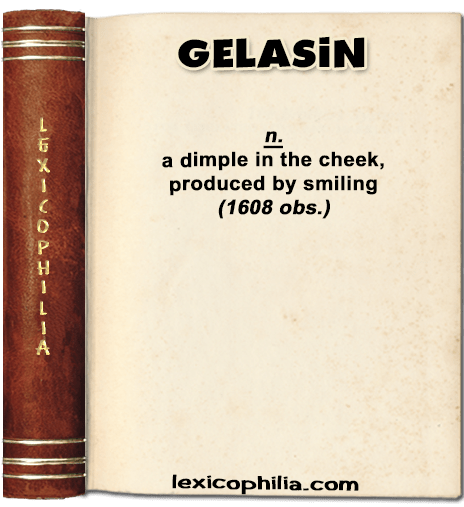
Word of the Day: GELASIN

also GELAZIN

ETYMOLOGY
from French gelasin, from Greek γελασῖνος (gelasinus), from γελᾶν (to laugh)

EXAMPLE
“… The beauty of the face consisteth in a large, square, well extended and cleere front, eye-browes well ranged, thin and subtile, the eye well diuided, cheerefull, sparkling: as for the colour I leaue it doubtfull, the nose leane, the mouth little, the lips coraline, the chinne short and dimpled, the cheekes somewhat rising and in the middle the pleasant gelasin, the eares round and well compact, the whole countenance with a liuely tincture white and vermilion. …”

From: Of Wisdome, three bookes written in French by Peter Charron
Translated by Samson Lennard ?1608

Word of the Day: REPANDOUS

ETYMOLOGY
from Latin repandus (bent backwards, turned up), from re- + pandus (bent)

EXAMPLE
“… And as indeed is deducible from pictures themselves; for though they be drawn repandous, or convexedly crooked in one piece, yet the Dolphin that carrieth Arion is concavously inverted, and hath its spine depressed in another. …”

From: Pseudodoxia Epidemica: 
Or Enquiries Into Very Many Received Tenents and Commonly Presumed Truths
By Thomas Browne, 1646

Word of the Day: INDULCATE

also INDULCIATE

ETYMOLOGY
from ppl. stem of Latin indulcare (to sweeten), from in- + dulcare (to sweeten), dulcis (sweet)

EXAMPLE
“… as guilt imbitters our comforts, it is like drinking out of a wormwood cup; so assurance would indulciate and sweeten all. …”

From: A Body of Practical Divinity
By Thomas Watson, 1759
Of Assurance.

Word of the Day: TIB

ETYMOLOGY
perhaps the same as Tib, a shortened hypocoristic form of the female name Isabel; now rather rude or slighting (except playfully);
also with dim. -y or -ieTibbie, a common female name in the north

EXAMPLE
“… .Trupeny. Mary then prickmedaintie come toste me a fig,
Who shall then know our
Tib Talke apace trow ye?

An. Alyface. And why not Annot Alyface as fyne as she?

Trupeny. And what had Tom Trupeny, a father or none?

An. Alyface. Then our prety newe come man will looke to be one …”

From: Ralph Roister Doister 
By Nicholas Udall, a1556

Word of the Day: FULGUROUS

also FULGROUS

ETYMOLOGY
from Latin fulgur (lightning, a flash of lightning) + -ous

EXAMPLE
“… and, iust at thinstant, all the canons plaien
frome towne to Campe, from Camp to towne againe,
in suche ann horrid noise, and flaminge light,
as if noone daie weare wedded to midd night:
or as if th’ pitchie clowdes of
fulgrous heavn
had taen their In vp, neath the spheres seaven.
…”

From: John Lane’s Continuation of Chaucer’s ‘Squire’s Tale’
By John Lane, 1616

PRONUNCIATION
FUL-gyuh-ruhss

Word of the Day: UNPLAUSIVE

ETYMOLOGY
from un- + plausive (expressive of approval or praise),
from Latin plaus-, ppl. stem of plaudere (to applaud) + -ive

EXAMPLE
“… Achilles stands i’th entrance of his Tent;
Please it our Generall to passe strangely by him,
As if he were forgot: and Princes all,
Lay negligent and loose regard vpon him;
I will come last,’tis like heele question me,
Why such vnplausiue eyes are bent? why turn’d on him?
If so, I haue derision medicinable,
To vse betweene your strangenesse and his pride,
Which his owne will shall haue desire to drinke;
It may doe good, pride hath no other glasse
To show it selfe, but pride: for supple knees,
Feede arrogance, and are the proud mans fees. …”

From: The Tragedy of Troylus and Cressida
By William Shakespeare, 1609

Word of the Day: VETERASCENT

ETYMOLOGY
from Latin veterascent-veterascens (present participle of veterascere to grow old),
from veter-vetus (old) + ‑ascere

EXAMPLE
“… This Vestis animae (as Tertullian calls it,) our body, the clothing of our soules, is daily veterascent and mouldring away; notwithstanding all the art wee use to patch up our obsolete faces and withered carkasses. O let our minds, that inward man, as the Eagle, be renewed daily …”

From: Three Sermons preached upon severall publike occasions by John Gauden, 1642

PRONUNCIATION
vet-uh-RASS-uhnt