ETYMOLOGY
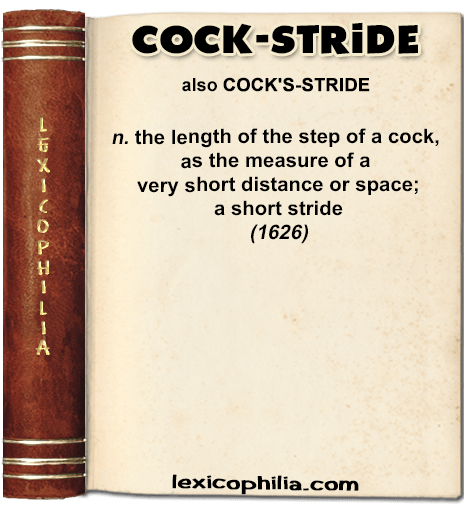
from cock + stride
EXAMPLE
“…It is now February and the Sun has gotten up a cocke-stride of his climbing, the vallies now are painted while, and the brooks are full of water…”
From: Fantasticks
– Nicholas Breton, 1626
ETYMOLOGY
from cock + stride
EXAMPLE
“…It is now February and the Sun has gotten up a cocke-stride of his climbing, the vallies now are painted while, and the brooks are full of water…”
From: Fantasticks
– Nicholas Breton, 1626

ETYMOLOGY
from slip + skin
EXAMPLE
“…A pretty slip-skin conveyance to sift Masse into no Masse, and Popish into not Popish; yet saving this passing fine sophistical boulting hatch, so long as she symbolises in form, and pranks herself in the weeds of Popish Mass…”
From: Animadversions upon the Remonstrants Defence against Smectymnuus
by John Milton, 1641
ETYMOLOGY
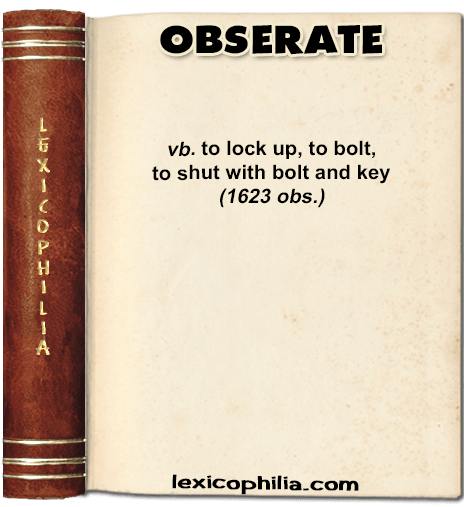
from. Latin obserat-, past participial stem of obserare (to bolt),
from ob- + sera (bolt)
EXAMPLE
“…he commenced to supparasite the juratory bevy relative to their noetical habilitation to sarse Fritz’s maleficence, and adjudicate to ablegate him to a lobspound, and have him there immured and securely obserated…”
From: Frontier Experience
Or Epistolary Sesquipedalian Lexiphanicism from the Occident
by J.E.L. Seneker, 1906

ETYMOLOGY
from Latin crēbrum (frequent) + -ous
EXAMPLE
“…Now at the lengthe not onlie harde necessitie, but also most principallie the crebrous phame of your clemencie, and the right worshipfull and Godlie reporte of your bountefull humanitie and gentlenes vnto all men…”
From: Original Letters of Eminent Literary Men of the Sixteenth, Seventeenth, and Eighteenth Centuries
– J. Leach. c1600
Edited by Henry Ellis

ETYMOLOGY
? alteration of twilight after twitter (vb. to move tremulously, shake, quiver) + light
EXAMPLE
“…You can steale secretly hether, you misticall queane you, at twylight, twitterlights,
You haue a priuiledge from your hat forsooth,
To walke without a man, and suspition,”
But we poore gentlewomen that goe in Tires
Haue no such liberty, we cannot do thus…”
From: Your fiue gallants
As it hath beene often in action at the Black-friers
By Thomas Middleton, 1608
ETYMOLOGY
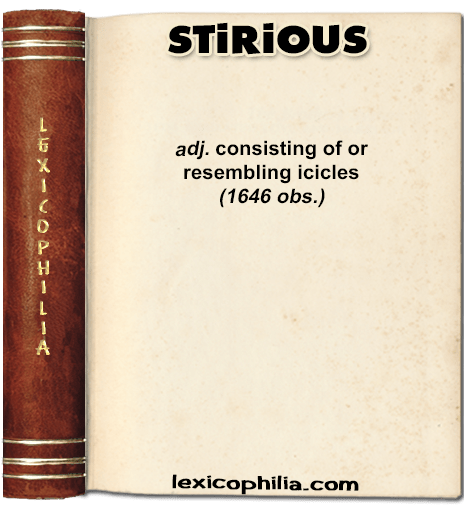
from stiria (an icicle) + -ous
EXAMPLE
“…The ground of this opinion might be, first the conclusions of some men from experience, for as much as Crystall is found sometimes in rockes, and in some places not much unlike the stirious or stillicidious dependencies of Ice; which notwithstanding may happen either in places which havee been forsaken or left bare by the earth, or may be petrifications, or Minerall indurations, like other gemmes proceeding from percolations of the earth disposed unto such concretions…”
From: Pseudodoxia Epidemica,
or, Enquiries into very many received tenents and commonly presumed truths
By Thomas Browne

ETYMOLOGY
from Latin prōspicient-, prōspiciēns (provident, cautious),
present participle of prōspicĕre (to look forward)
EXAMPLE
“…But fortune prospicient to the Original of Rome, did provide a Woolf to give suck to the children, who having lost her whelps, and desiring to emptie her teats, did offer her self as a Nurse to the Infants, and returning often to the children, as to her own young ones…”
From: The History of Ivstine:
taken out of the four and forty books of Trogus Pompeius… together with the Epitomie of the lives and manners of the Roman Emperors
– Marcus Junianus Justinus
– translated by Robert Codrington, 1654

ETYMOLOGY
from Latin scrībĕre (to write) + -acious
EXAMPLE
“…We have some Letters of Popes, (though not many; for Popes were then not very scribacious, or not so pragmatical; whence to supply that defect, lest Popes should seem not able to write, or to have slept almost 400 years, they have forged divers for them, and those so wise ones, that we who love the memory of those good Popes, disdain to acknowledge them Authours of such idle stuff; we have yet some Letters)…”
From: A Treatise of the Pope’s Supremacy:
to which is added a Discourse Concerning the Unity of the Church
– Isaac Barrow, a1677
ETYMOLOGY
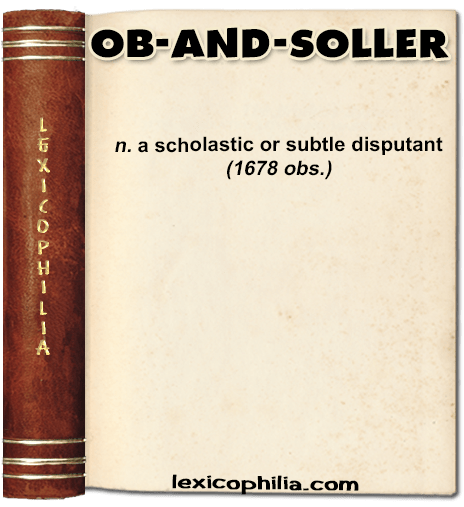
– from ob and sol (scholastic disputation, subtle debate – shortened from objection) + -er
EXAMPLE
“…Where Hinderson, and th’ other Masses,
Were sent to cap Texts, and put Cases:
To pass for Deep and Learned Scholars;
Although but Paltry, Ob-and-Sollers:
As if th’ unseasonable Fools
Had been a Cursing in the Schools…”
From: Hudibras. The third and last part,
By Samuel Butler, 1678

ETYMOLOGY
from Latin rēiectānea (things which, while not absolutely bad, fall beneath the level of indifference),
from rejicĕre (to reject) + -āneus + -ous
EXAMPLE
“…Let them looke carefully about them, and let them be assured of this, that God will haue his glory upon them either in their conversion, if they belong to the number of his chosen servants, or in their confusion, if they be rejectaneous and castawaies.…”
From: Romphaiopheros = the Sword-Bearer.
Or, The Byshop of Chichester’s armes emblazoned in a sermon preached at a synod by T.V. B. of D. sometimes fellow of Queenes Colledge in Oxford,
and now pastor of the church at Cockfield in Southsex.
by Thomas Vicars, 1627
 Lexicophilia