ETYMOLOGY
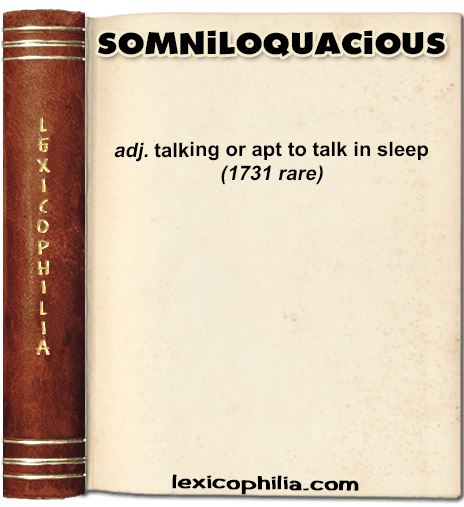
from somni- (combining form of Latin somnus sleep), + loquacious
EXAMPLE
My somniloquacious sister kept me awake so many nights that I finally wore earplugs.
ETYMOLOGY
from somni- (combining form of Latin somnus sleep), + loquacious
EXAMPLE
My somniloquacious sister kept me awake so many nights that I finally wore earplugs.

ETYMOLOGY
from Latin laniāt-, participial stem of laniare (to tear)
EXAMPLE
“…Wail for the little partridges on porringer and plate;
Cry for the ruin of the fries and stews well marinate:
Keen as I keen for loved, lost daughters of the Kata-grouse,
And omelette round the fair enbrowned fowls agglomerate:
O fire in heart of me for fish, those deux poissons I saw,
Bedded on new made scones and cakes in piles to laniate.
For thee, O vermicelli! aches my very maw! I hold
Without thee every taste and joy are clean annihilate
Those eggs have rolled their yellow eyes in torturing pains of fire
Ere served with hash and fritters hot, that delicatest cate….”
From: Arabian Nights’ Entertainments
– translated by Richard Francis Burton, 1885

ETYMOLOGY
from hen (a woman, a wife) + house
EXAMPLE
“…That was another one. She’s got two daughters. Hold me, big boy,; I’m heading for the hen-house…”
From: Sanctuary
By William Faulkner, 1931

also Scottish and dialect form ROW-DE-DOW
ETYMOLOGY
– originally a variant of row dow dow ( a series of sounds as produced by beating a drum)
– later possibly influenced by rowdy dowdy (characterized by noisy roughness)
EXAMPLE
“…There has been a terrible rowdydow in the operatic green-room…”
From: Dashes at Life with a Free Pencil
By Nathaniel Parker Willis, 1845
ETYMOLOGY
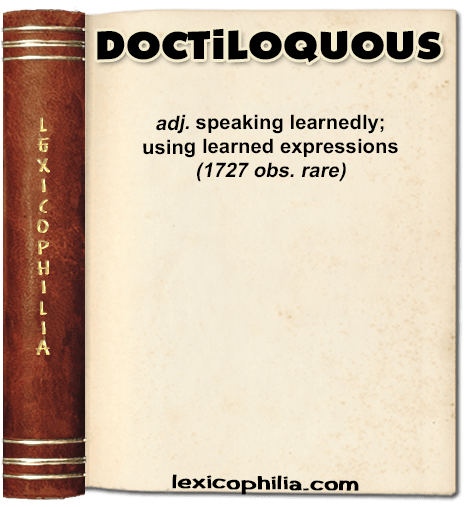
– from Latin doctiloquus (learnedly-speaking)
EXAMPLE
“…Most prudent,
Most grave,
Most scientific Jordan,
the most religious admirer of,
Sir,
Your very high Doctiloquous Sapience…”
From: Posthumous Works of Frederic II, King of Prussia, Vol. IX,
Correspondence. Letters Between Frederic II and M. Jordan
Translated From the French By Thomas Holcroft, 1789
Letter LIV, From the King, The Camp of Molwitz, May 13, 1741

ETYMOLOGY
– dialect form of snivel-nose (a snotty nose)
EXAMPLE
“…How Dem! a Trub? – go, ye rearing, snapping, tedious, cutted Snibblenose!…”
From: An Exmoor Scolding
By Peter Lock, 1782

ETYMOLOGY
from Latin marītātus pa. pple. of marītāre (to marry) + -ed
EXAMPLE
“…I am still an agamist, although nubile for several annuary epochs. I have had multitudinous allectations to enter into a maritated condition, but have as yet evitated all morsure at the proffers coming from your genus…”
From: Letters to Squire Pedant In the East,
By Lorenzo Altisonant, an Emigrant to the West.
By Samuel Klinefelter Hoshour, 1870
Amenityville, Occident, (Letter written July 4, 1844)
To Seignior Lorenzo Altisonant

ETYMOLOGY
– from the French abaisser (to depress)
EXAMPLE – see below

From: The Poetical Works of Sir Thomas Chatterton,
With an Essay on the Rowley Poems by The Rev. Walter D. Skeat,
Vol II, 1891
Rowley Poems

DEFINITIONS (cont’d)
n. 1. 1768 UK sl. – a term of address to a man
n. 2. 1823 – anything abnormally large of its kind; a big lie; a heavy blow
n. 3. 1827 Amer. dial. – a driver of animals; a drover; an ox or mule driver
n. 4. 1861 Eng. dial. – a shake; a shiver
n. 5. Bk1942 Amer. sl. – something excellent
n. 6. 1960s Aust. sl. – a fool
n. 7. 1980s US sl. – a masturbator
n. 8. 20C US sl. – a gadget, a thing
n. 9. 20C US sl. – the penis
vb. 1703 Eng. dial. – to tremble, to shake with cold, fear, etc.
ETYMOLOGY
from whack (vb.) + -er
EXAMPLE (for n.3)
“…A noisy train of long-horned, thin-bodied oxen, dragging trailed wagons piled high with freight from the railway terminus, comes round the corner, and stops to listen before unyoking for the night, the whacker’s long whip cracking like pistol-shots as he lashes his unwieldy beasts into position…”
From: Harper’s New Monthly Magazine
No. CCCLIX – April, 1880 – Vol. I.X.
La Villa Real De Santa Fe

ETYMOLOGY
from Latin famēlicōsus, from fames (hunger)
EXAMPLE
“…We arrived there by 10:30 p.m. and were super hungry despite eating all the stuffed pranthas all the way. I guess all Punjabis are famelicose because no matter how much we eat, we can still manage to eat more if given something that is delicious…”
From: Unanswered Questions
Love is Lost When the Answers are Assumed,
Katie Khanna, 2016
 Lexicophilia