
ETYMOLOGY
possibly a variant of prickle (vb.)
EXAMPLE
“…I’ll gar your Daup dirle. Footnote: prinkle, smart. …”
From: A complete Collection of Scottish Proverbs
By James Kelly, 1721
ETYMOLOGY
possibly a variant of prickle (vb.)
EXAMPLE
“…I’ll gar your Daup dirle. Footnote: prinkle, smart. …”
From: A complete Collection of Scottish Proverbs
By James Kelly, 1721
ETYMOLOGY
from Latin nemorivagus (that wanders in the woods) + -ous
EXAMPLE
She had enough problems living so close to the forest and keeping track of her nemorivagous child.

ETYMOLOGY
from pam ( a card-game in which the knave of trumps was the highest trump card) + child
EXAMPLE
“…Yet rake I am, and abominably so, for a person that begins to wrinkle reverently. I have sat up twice this week till between two and three with the Duchess of Grafton, at loo, who, by the way, has got a pam-child this morning; and on Saturday night I supped with Prince Edward at my Lady Rochford’s, and we stayed till half an hour past three…”
From: The Letters of Horace Walpole
Volume 3, Letter 9 To George Montagu, Esq. Arlington Street, Jan. 14, 1760
ETYMOLOGY
possible alteration of ‘fernticle’ or the synonymous dialectal ‘fan freckle‘
EXAMPLE
“…John Hewitt, a Bricklayer .. straight Hair, and Form-Speckles on his hands and Face …”
From: The London Gazette, 1666, Feb.

ETYMOLOGY
the element dod is evidently the same as in dodman (a shell-snail);
hoddy-dod, hoddy-doddy, & hodman-dod, are perhaps from nursery reduplications;
but the element hoddy- appears itself to have come to be associated to mean ‘snail’ (or ? horned);
for n. 2. (a cuckold) – with reference to the ‘horns’ of a cuckold
EXAMPLE (for n. 1.)
“…My living lieth here and there, of God’s grace,
Sometime with this good man, sometime in that place;
Sometime Lewis Loiterer biddeth me come near;
Somewhiles Watkin Waster maketh us good cheer;
Sometime Davy Diceplayer, when he hath well cast,
Keepeth revel-rout, as long as it will last;
Sometime Tom Titivile keepeth us a feast;
Sometime with Sir Hugh Pie I am a bidden guest;
Sometime at Nichol Neverthrive’s I get a sop;
Sometime I am feasted with Bryan Blinkinsop;
Sometime I hang on Hankyn Hoddydoddy’s sleeve;
But this day on Ralph Roister Doister’s, by his leave…”
From: Ralph Roister Doister,
By Nicholas Udall, a1556

ETYMOLOGY
from mimp (prim, precise, affected; also, n. a prim or affectedly modest woman)
EXAMPLE
“…It is not many people indeed I should praise so warmly; but as to all squeamish prudery in not speaking what one thinks, I’ve no notion of it, though I am so teased and so lectured by the old folks that I sit mimpetty mimp before them merely for peace sake; but I don’t see why one may not admire an handsome man as well as an handsome stature, or an handsome animal, or any thing else that is beautiful…”
From: The Young Philosopher:
A Novel in Four Volumes
By Charlotte Smith, 1798
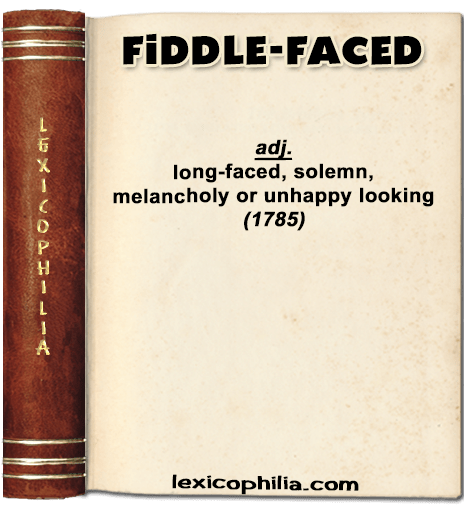
ETYMOLOGY
from fiddle (n.) + faced (adj.)
EXAMPLE
“…And would any but such like, sick-brained, corky-noddled, flea-lugg’d piper framed, fiddle faced, wagtailed fellows, saucy, and idle, lazy, lubbert, leeped, nasty, foul clacking, and a meer outside, a pinned up bacon, a stitched together stand-bra, can scarce put on her own cloaths, and can do nothing else but stand like a statue, with her gogling eyes, and black patches, and when they are off is ashamed to be seen in public, for fear they prove a scare crow…”
From: John Thompson’s Man
Or. A short survey of the difficulties and disturbances That may attend a married Life, c1785

ETYMOLOGY
from way (a track, a road, a path) + worn
EXAMPLE
“…Say then, if England’s youth in earlier days
On Glory’s field with well train’d armies vy’d,
Why shall they now renounce that gen’rous praise?
Why dread the foreign mercenary’s pride?
Tho’ Valois brav’d young Edward’s gentle hand,
And Albret rush’d on Henry’s way-worn band,
With Europe’s chosen sons in arms renown’d,
Yet not on Vere’s bold archers long they look’d,
Nor Audley’s squires nor Mowbray’s yeomen brook’d;
They saw their standard fall, and left their monarch bound….”
From: Ode to the Country Gentlemen of England.
By Mark Akenside, 1758
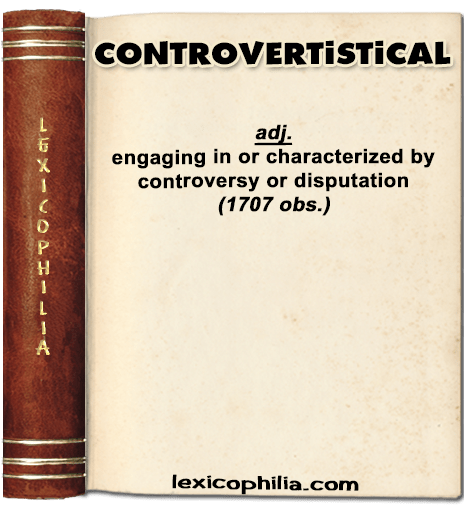
ETYMOLOGY
from controvertist (a person who engages in argument or controversy) [from controvertere (in logic, to invert; to argue, to dispute, to oppose)] + ‑ical
EXAMPLE
“…The Company began to Smile at this odd Rodomontade, but Eudoxus told him, in controvertistical Debates, there was no Appeal from Reason to the Sword; that it was more prudent to confess Errors, than to defend ’em; to cancel past Crimes, than to commit new ones …”
From: A Gentleman Instructed in the True Principles of Religion
By William Darrell. 1707

ETYMOLOGY
from bran (the husk of a cereal after grinding) + -faced
EXAMPLE
“…And for the rest, if any fuddling, bolus-brained, bran-faced, turnip-tongued, hippopotamus-headed moon-calf doubts my word, let him remember that there are pistols for two – and coffee for one, in Belgium, and let him tremble…”
From: Punch, Or The London Charivari
Vol. 98, 1890
In The Know (By Mr. Punch’s Own Prophet)
 Lexicophilia