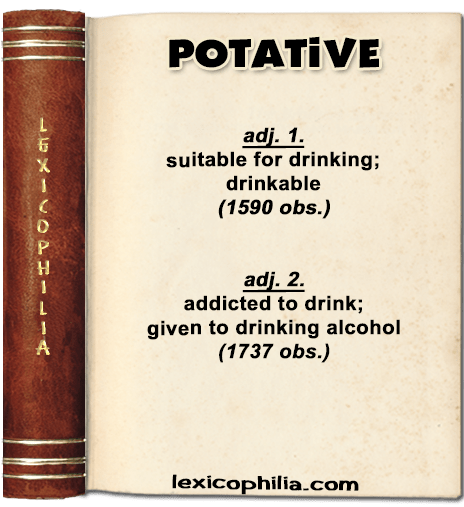
Word of the Day: POTATIVE

ETYMOLOGY
from Latin potat-, past participial stem of potare (to drink) + ‑ive

EXAMPLE
“… desireth to cure these or such like infectious diseases, must chiefly prepare and season the body with waters of cold and naturall hearbes, in the first and second degree, be­fore the disease be possessed: then foorthwith flux the body, by some gentle and potatiue electuarie, in equall and artificial de­gree, fauourably casting out the infected humours. …”

From: The Flower of Phisicke
VVherein is perfectlie comprehended a true introduction and method for mans assured health
By William Clever, 1590
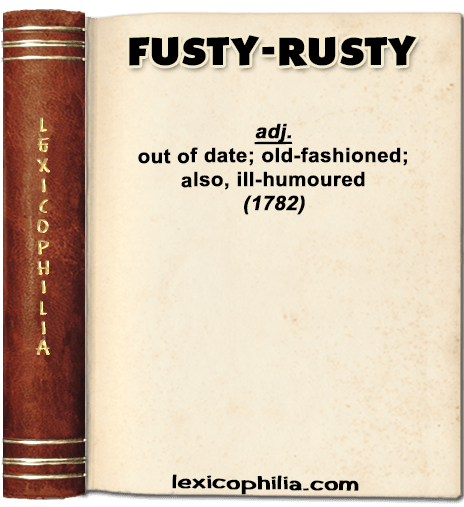
Word of the Day: FUSTY-RUSTY

ETYMOLOGY
from fusty (adj.)

EXAMPLE
“…There is a fashion in these things, which the Doctor seems to have forgot. But what shall we say of his fusty-rusty remarks upon Henry and Emma? I agree with him, that morally considered both the knight and his lady, are bad characters, and that each exhibits an example which ought not to be followed. …”

From: The Life and Posthumous Writings of William Cowper
By William Hayley, Volume III, 1804
Letter XLVII. To the Rev. William Unwin, January, 5, 1782

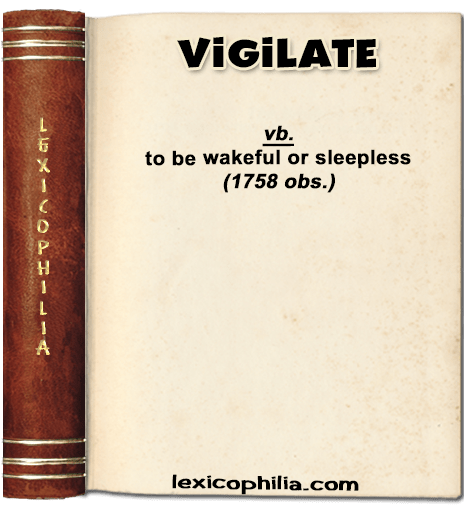
Word of the Day: VIGILATE

ETYMOLOGY
from Latin vigilat-, ppl. stem of vigilare (to remain awake)

EXAMPLE
“… Mountain Hawkweed with long slender stalks and small flowers. The flowers are in their expanded or vigilating state from five or six in the morning till about ten. …”

From: Philosophical Transactions
Volume L. Part II. For the Year 1758
Printed 1759
“Some Observations upon the Sleep of Plants”

Word of the Day: POCOCURANTE

ETYMOLOGY
Italian, poco curante, (caring little), from poco (a little, rather) + curante (present participle of curare (to care)); from Latin curare (to cure, to heal), ? from the name of Seigneur Pococurante, a fictional apathetic Venetian senator in Voltaire’s Candide (1759)

EXAMPLE
…Leave we my mother – (truest of all the Poco-curante’s of her sex!) – careless about it, as about every thing else in the world which concerned her; – that is, – indifferent whether it was done this way or that, – provided it was but done at all …”

From: The Life and Opinions of Tristram Shandy, Gentleman
By Laurence Sterne, 1762

PRONUNCIATION
poh-koh-kyuh-RAN-tee

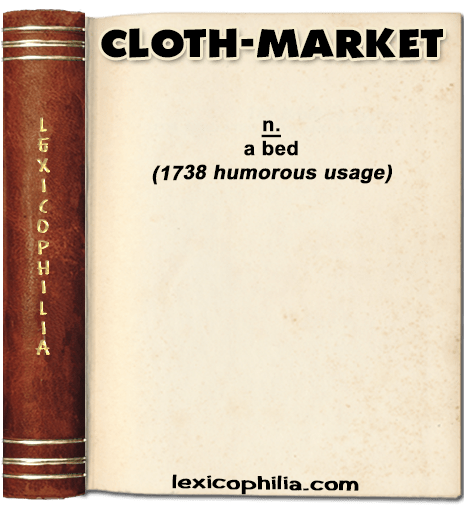
Word of the Day: CLOTH-MARKET

ETYMOLOGY
from cloth + market

EXAMPLE
“…Neverout. Miss, your Slave: I hope your early Rising will do you no Harm. I hear you are but just come out of the Cloth-Market.
Miss. I always rise at Eleven, whether it be Day or no.
Col. Miss, I hope you are up for all Day?
Miss. Yes, if I don’t get a Fall before Night
…”

From: A complete collection of genteel and ingenious conversation, according to the most polite mode and method now used at court, and in the best companies of England,
By Jonathan Swift, 1738

Word of the Day: VILIORATE

ETYMOLOGY
from Latin vilior, comparative of vilis (vile) + -ate; after meliorate

EXAMPLE
“…Secondly, that there is a medium in the watery temperature of the earth, either extream of
which
viliorates the juice, where there is not an equal heat of the sun or fatness in the earth to correct the juices of the superluxuriant grass. …”

From: Observations in Husbandry
By Edward Lisle, a1722

Word of the Day: LENNO

ETYMOLOGY
from Gaelic leanabh (baby, infant, child)

EXAMPLE
“…Ye’s neir pe pidden work a turn
At ony kind o’ spin, mattam,
But shug your
lenno in a scull,
And tidel highland sing, mattam;
Had awa’, had awa’,
Had awa’ frae me, Donald;
Your jogging sculls and highland sang
Will sound but harsh wi’ me, Donald.
…”

From: Scotish Song
By Joseph Ritson, 1714
Song XI.  Had Awa’ Frae Me, Donald

Word of the Day: RAMFEEZLED

ETYMOLOGY
apparently from Scots ram- (used with intensive force before words which generally imply something forcible, vigorous or disorderly) + the second element is obscure;
but perhaps feeze (to beat, to ‘do for’ – Eng dial.) + ‑le ‑ed 

EXAMPLE
“…The tappetless, ramfeezl’d hizzie,
She’s saft at best, an’ something lazy:
Quo’ she, ‘Ye ken we’ve been sae busy
‘This month an’ mair,
That trouth, my head is grown right dizzie,
An’ something sair.’ …”

From: Poems,
By Robert Burns, 1786
Epistle to J. L*****K,
An Old Scottish Bard.
April 21, 1785

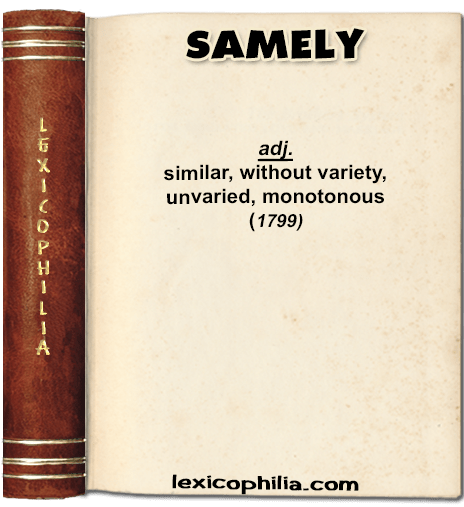
Word of the Day: SAMELY

ETYMOLOGY
from same (adj.) + -ly

EXAMPLE
“…and by making judicious openings, so as to break straight lines, and separate parts that were in some places too heavy and samely: so that the same extent of land has now not only a much larger appearance, but exhibits a much greater variety of ground …”

From: Transactions of the Society of instituted at London for the Encouragement of Arts, Manufactures, and Commerce;
with Premiums offered in the Year 1799. Vol. XVII.