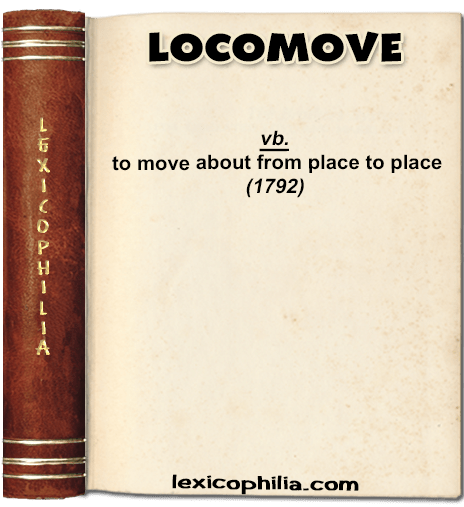
Word of the Day: LOCOMOVE


ETYMOLOGY
from Latin loco, ablative of locus (the place in which something is situated or occurs) + move


EXAMPLE
“…A Journey in a Postchaise
To his Brother
Passenham, July 16, 1792

Dear Brother, – It is high time you should know something about us and our locomotions. To-morrow morning, at six of the clock, we begin to loco-move towards Bitteswell
…”

From: Recreations and Studies of a Country Clergyman of the Eighteenth Century
By Thomas Twining (letter)
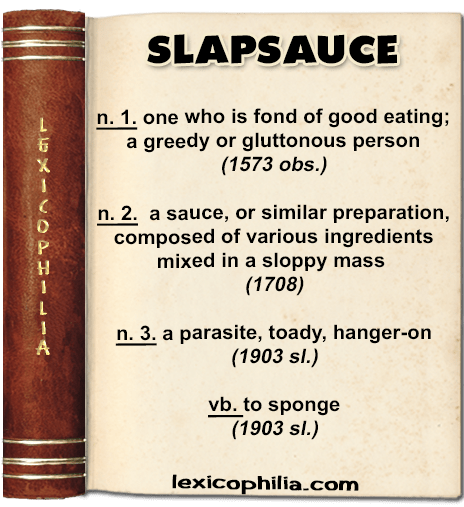
Word of the Day: SLAPSAUCE


ETYMOLOGY
from slap (to lap → Eng. dial.) + sauce


EXAMPLE
“…At dinner and supper the table doth craue
good fellowly neighbour good manner to haue.
Aduise thee well therefore, ere tongue be too free,
or slapsauce be noted too saucie to bee…”

From: Points of Huswifrie
In Fiue Hundreth Points of Good Husbandry
By Thomas Tusser, 1573

Word of the Day: EBRIETATING


ETYMOLOGY
from ebriety (a being intoxicated, drunkenness) + ‑ate 


EXAMPLE
“…But what we suppose conduces most to this seeming Magnanimity, is some things their Priests give them before, of an ebrietating Quality, which intoxicates their Spirits, and renders them insensible of what they are going to endure…”

From: The British Apollo, or, Curious Amusements for the Ingenious
May, 1711

Word of the Day: PODGER


ETYMOLOGY
for n. 1. – a variant of pottinger
for n. 2, 3, 4 – from podge (anything short or thick)  + ‑er 


EXAMPLE
“…He cannot deal the knock-me-down blows of Old Brough, and if you watch your opportunity you may give him a podger. I am seldom in a cause of any consequence before him without getting into some squabble with him…”

From: Life of John, Lord Campbell, 1881,
Letter dated 9 March, 1816

Word of the Day: MICACIOUS


ETYMOLOGY
from Latin micare (to shine, sparkle, dart, move swiftly) + -acious 


PRONUNCIATION
migh-KAY-shuhss


EXAMPLE
“…Others little inferior in splendour followed in procession; and what added much to their gorgeous appearance was, that as the oars were lifted, the water was perfectly micacious, and they appeared to glide over a sea of liquid gold…”

From: Constantinople Ancient and Modern:
With Excursions to the Shores and Islands of the Archipelago and to the Troad
By James Dallaway, 1797

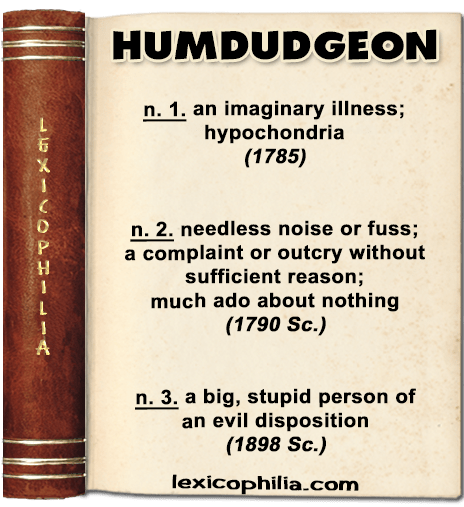
Word of the Day: HUMDUDGEON


ETYMOLOGY
from hum (a piece of humbug, an imposition, a hoax) + dudgeon (a feeling of anger, resentment, offense)


EXAMPLE (for n. 1)
“…”Hout tout, man – I would never be making a hum-dudgeon about a scart on the pow – but we’ll be in Scotland in five minutes now, and ye maun gang up to Charlies-hope wi’ me, that’s a clear case…”

From: Guy Mannering
By Walter Scott, 1815

Word of the Day: RURICOLIST


ETYMOLOGY
from Latin ruricola (a person who tills the land, husbandman, country dweller, rustic)
(from ruri-, combining form of rur-rus (country) + -cola) + -ist


EXAMPLE
“…His hood was half blue and half green, and, over his left ear, was set off with an artificial rose. His appearance did not bespeak the ruricolist, and Dick, who at once detected this, set him down for a burgess of London…”

From: The Life and Times of Dick Whittington
An Historical Romance.
By Richard Whittington, 1841