Word of the Day: TARDIGRADE

ETYMOLOGY
from French tardigrade (slow-paced) or from Latin tardigradus (walking slowly); from Latin tardus (slow) + -gradus (stepping, going)

EXAMPLE (for adj. 1)
“… Once more a cruelly long passage fell to my lot. The Deborah proved a marine hackney-coach of the most tardigrade order. But it could not be helped; so, like Diogenes, I resolved to be satisfied with my tub, and as for sunshine, I found it within and without! …”

From: Our Antipodes:
Or, Residence and Rambles in the Australasian Colonies.
By Lt. Colonel Godfrey Charles Mundy, 1852

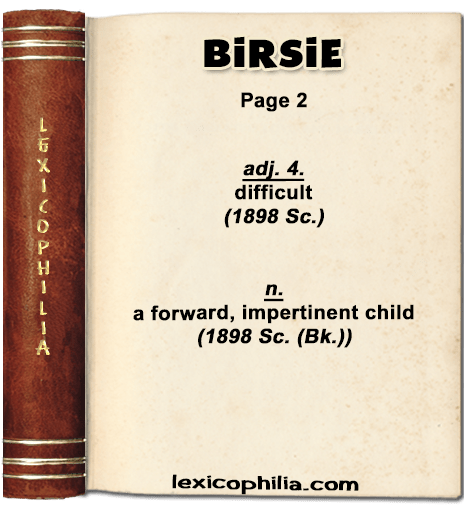
Word of the Day: BIRSIE

ETYMOLOGY
adj. 1. from birse (Sc. – a bristle, hair) + -y
n. from birse (Sc. – to push, to press, to squeeze) + -y

EXAMPLE
“…The mekill howke hym bair was Tryton callyt,
For in hir forstam was the monstre stallyt,
With watry trumpe fleyand the fludis gray;
Quhar as scho salyt, men mycht se hym ay
With  
byrsy body porturyt, and vissage
All rowgh of harys, semyng of cullage
In mannys form fra hys cost to hys crown,
…”

From: Virgil’s Aeneid translated into Scottish verse
By Gavin Douglas, a1522

Word of the Day: TOMLING

ETYMOLOGY
from tom (a male cat) + -ling

EXAMPLE
“…We are promised to succeed him a Black Tomling, whom I have named Prester John – that hierarch being the most remarkable black potentate whom I could call to mind. Long live Prester John! and may he be more fortunate than his predecessors, Othello and Pulcheria. …”

From: Selections from the Letters of Robert Southey
Edited by John Wood Warter, Vol. III, 1856
Letter from R.S. to G.C.B., April 29, 1821

Word of the Day: QUISQUILIOUS

ETYMOLOGY
from Latin quisquiliae (waste matter, refuse, rubbish) + ous

EXAMPLE
“…He knows not what to say against them; and yet something must be said. They publish too much; more than used to be published: the science is overloaded by the quisquilious matter they rake together and preserve. They publish too soon; before they have taken the requisite time for digestion …”

From: Rationale of Judicial Evidence
By Jeremy Bentham, 1827

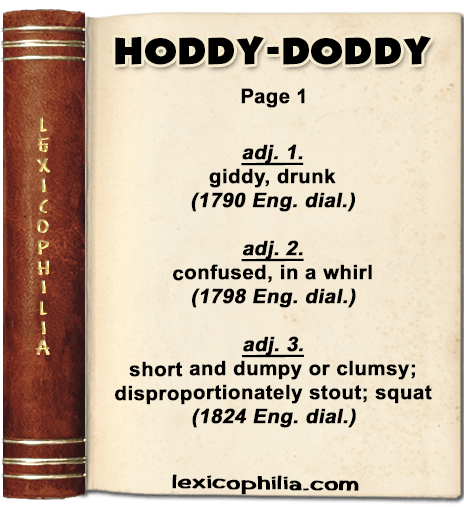
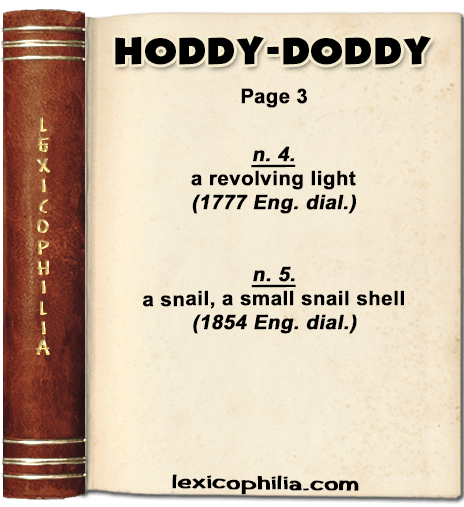
Word of the Day: HODDY-DODDY


ETYMOLOGY
the element dod is evidently the same as in dodman (a shell-snail);
hoddy-dodhoddy-doddy, & hodman-dod, are perhaps from nursery reduplications;
but the element hoddy- appears itself to have come to be associated to mean ‘snail’ (or ? horned);
for n. 2. (a cuckold) – with reference to the ‘horns’ of a cuckold


EXAMPLE (for n. 1.)
“…My living lieth here and there, of God’s grace,
Sometime with this good man, sometime in that place;
Sometime Lewis Loiterer biddeth me come near;
Somewhiles Watkin Waster maketh us good cheer;
Sometime Davy Diceplayer, when he hath well cast,
Keepeth revel-rout, as long as it will last;
Sometime Tom Titivile keepeth us a feast;
Sometime with Sir Hugh Pie I am a bidden guest;
Sometime at Nichol Neverthrive’s I get a sop;
Sometime I am feasted with Bryan Blinkinsop;
Sometime I hang on Hankyn Hoddydoddy’s sleeve;
But this day on Ralph Roister Doister’s, by his leave
…”

From: Ralph Roister Doister,
By Nicholas Udall, a1556

Word of the Day: SACRIPANT


ETYMOLOGY
from French Sacripant, from Italian Sacripante, a character in Boiardo’s Orlando innamorato


EXAMPLE
“…He is surprised by a nymph of exquisite loveliness, who vainly assails his constancy, and who is  at length seized by the supervening  Itifal, a Sacripant of  knighthood.  The adventures in general  are spun out and interrupted by flat conversations…”

From: Historic Survey of German Poetry
By William Taylor, 1829

Word of the Day: ZOOPHILIST


ETYMOLOGY
from  zoo + -philist; from Greek ϕίλος (loving, dear) + ‑ist


EXAMPLE
“…A foreigner in America has recently discovered a species of animal which is likely to become as great a favourite among our female zoophilists, and may, perhaps, in future, banish the lap-dog from the drawing-room and the bed-chamber…”

From: The London and Paris Observer:
Or Weekly Chronicle of News, Science, Literature, and the Fine Arts
Volume 5, 1829

Word of the Day: GARBOIL


ETYMOLOGY
apparently from Old French garbouille (confused mess, confusion, disorder), of uncertain and disputed origin;
From the O.E.D.: “it is likely that this word and the related garboil v. have been associated with garble v. and garble n., and probably regarded as variants of these”


EXAMPLE
“…and after long and mature debating off the mattar, forasmuch as itt appeared the Mayor to have ben a great sturrer of this garboyle, and to be a man that att sondry tymes hadde deluded wyth delayes the sayde commissioners whereby the matter cowlde grow to none ende…”

From: Selections from the Records of the City of Oxford
Edited by Willilam H, Turner, 1880
1543, May 22. Decree of the Privy Councell in the matters of Difference between the University and City.

Word of the Day: MALLIFUFF


ETYMOLOGY
from Mallie (= English Molly (a girl,. a woman)) + fuff (something easily blown about, a puff)


EXAMPLE
“…And what for should I not be early abroad if I have business? Am I like one of your windlestrae mallifuff madams that cannot stir from their arm-chair till they are drammed up with their green-tea?…”

From: Elizabeth de Bruce
By Christian Isobel Johnstone, 1827