Word of the Day: SNUFFY


ETYMOLOGY
from snuff + -y


EXAMPLE
“…I’m sure she makes a very Tarquinius Sextus of me, and all about this Serenade,—I protest and vow, incomparable Lady, I had begun the sweetest Speech to her—though I say’t, such Flowers of Rhetorick—’twou’d have been the very Nosegay of Eloquence, so it wou’d; and like an ungrateful illiterate Woman as she is, she left me in the very middle on’t, so snuffy I’ll warrant…”

From: Sir Patient Fancy
By Aphra Behn, 1678

Word of the Day: COCKLE-BRAINED


ETYMOLOGY
of uncertain origin;
perhaps from cockle (to move or rock unsteadily; to totter or wobble)


EXAMPLE
“…Their bind was just a Scots pint over-head, and a tappit-hen to the bill, and no man ever saw them the waur o’t. It was thae cockle-brained callants of the present day that would be mair owerta’en with a puir quart than douce folk were with a magnum…”

From: St. Ronan’s Well
By Sir Walter Scott, 1823

Word of the Day: EDIBILATORY


ETYMOLOGY
badly formed on edibilis (edible),
after adjs. in –atory


EXAMPLE
“…“Amen to your creed!” said I: “edibilatory Epicurism holds the key to all morality: for do we not see now how sinful it is to yield to an obscene and exaggerated intemperance?…”

From: Pelham, Or, Adventures of a Gentleman
By Edward Bulwer Lytton, 1828

Word of the Day: TARADIDDLE


ETYMOLOGY
the first element, tara, is of obscure origin;
+ diddle (n. a swindle, deception) (vb. to cheat, to swindle)


EXAMPLE
“…Bar. My dear Anna Matilda, I don’t know myself; so how can I tell you?
Mrs. B. There’s a bare-faced tarradiddle, Mr. Barbottle…”

From: The Duel:
Or, My Two Nephews 
A Farce, in Two Acts
By R. B. Peake, 1823

Word of the Day: LICKSPITTLE


ETYMOLOGY
from lick (vb.) + spittle (a house or place for the reception of the indigent or diseased)


EXAMPLE
“…Yes – and to hear his lickspittles speak, you would think that a man of great and versatile talents was a miracle; whereas there are some thousands of them publicly acknowledged in England at this day…”

From: Noctes Ambrosianae (J. Wilson) in Blackwood’s Edinburgh Magazine,
Volume XVIII, July-December, 1825

Word of the Day: MINACIOUS


ETYMOLOGY
from Latin minac-minax (threatening), from minae (threats) + -ax + -ous


EXAMPLE
“…or with a pleasant horrour and chilness look upon some silent Wood, or solemn shady Grove; whether the face of Heaven smile upon us with a chearfull bright azure, or look upon us with a more sad and minacious countenance, dark pitchy Clouds being charged with Thunder and Lightning to let fly against the Earth; whether the Aire be cool, fresh and healthful, or whether it be soultry, contagious and pestilential, so that while we gasp for life we are forc’d to draw in a sudden and inevitable Death…”

From: An Explanation of the Grand Mystery of Godliness
By Henry More, 1660

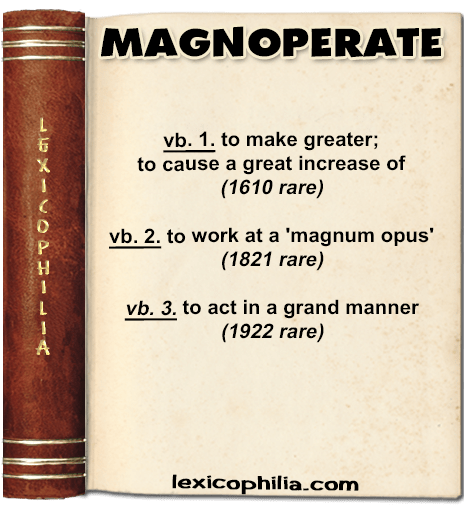
Word of the Day: MAGNOPERATE

ETYMOLOGY
from Latin magnopere (greatly) (short for magno opere [with great labour, especially, much]) + -ate

EXAMPLE
“…so that after-ages may rightly admire what noble Mecaenas it was that so inchayned the aspiring wits of this understanding age to his only censure, which will not a little magnoperate the splendor of your well knowne honor to these succeeding times…”

From: Baculum Geodæticum 
By Arthur Hopton, 1610

Word of the Day: ECKLE-FECKLE

ETYMOLOGY
of obscure origin;
perhaps allied to eekfow (blithe, having an affable demeanour)

EXAMPLE
“…I ne’er weas ca’ad a crankous kimmer,
A crabbed, craiken, crack-brained limmer.
Auld grannie ay was eckle feckle
Nor hogry mogry, nor kenspeckle –
Ay ready for a couthie clacky,
A pint o’ yill, a bit o’ baccy
…”

From: Willie Wabster’s Wooing and Wedding on the Braes of Angus
By Dorothea M. Ogilvy, Julia O. Robertson, 1873

Word of the Day: WHATABOUTS

ETYMOLOGY
from what (pronoun, adj., & adv.), after whereabout(s

EXAMPLE
“…I wish you were as much in intercourse with the Colonial Office as with the Treasury, for then you might know all of my goings on, and whatabouts and whereabouts from Henry Taylor…”

From: Selections from the Letters of Robert Southey
By Robert Southey, a1843

Word of the Day: CATTER-BATTER

ETYMOLOGY
? for the first element ‘catter’ perhaps from Dutch kater (tomcat) + batter (to fight)

EXAMPLE
“…By Gemini ! you never heard such a catter- batter! The whole court-room stamping and laughing fit to split, and the ushers calling order, and the tipstaffs running, and his worship gobbling like a cailzie-cock…”

From: Blackwood’s Magazine
Volume 225, 1929