Word of the Day: NIBSOME

ETYMOLOGY
from nib (a person of superior social standing or wealth; a gentleman [slang]) + – some


EXAMPLE
“…I ne’er was a nose, for the reg’lars came 
  Whenever a pannie was done:— 
Oh! who would chirp to dishonour his name,
And betrays his pals in a nibsome game 
  To the traps?—Not I for one! 
Let nobs in the fur trade hold their jaw
  And let the jug be free:— 
Let Davy’s dust and a well-faked claw 
For fancy coves be the only law, 
And a double-tongued squib to keep in awe 
  The chaps that flout at me!
…”

From: The House Breaker’s Song
By G. W. M. Reynolds in Pickwick Abroad, 1839

Word of the Day: TERRACULTURE


ETYMOLOGY
irregularly from Latin terra (earth) + culture


EXAMPLE
“…We venture at the outset to introduce a new term, and that for the only justifiable reason, viz: because there is no single word heretofore in use in our language expressive of the idea we wish to express. Agriculture is the culture of the field, and includes the operations of farming or the tillage of large portions of land. Horticulture is the culture of the garden, and has reference to the production of kitchen vegetables, fruits and flowers. We have often felt at a loss for a word to include all these, and as Terraculture, or the culture of the earth, exactly expresses the idea, and as it is derived from the Latin in a manner exactly similar to the other terms, we think there must result a decided advantage from its introduction. It comprehends all things which are produced from the earth, by the labor of man and beast, through the agency of vegetable life. Every thing that germinates and grows by receiving its nourishment from the soil, belongs to this department…”

From: The Franklin Farmer,
Devoted to Improvements in the Science of Agriculture, the Practice of Husbandry, and the Mind, Morals, and Interests, of the Cultivators of the Soil.
Vol. I., Edited by Tho. B. Stevenson, 1837-8
Word of the Day: BAWTIE


ETYMOLOGY
from Old Sc. bawtébawtie (a dog’s name), extended to dogs;
bawd is a Sc. term for a hare


EXAMPLE
“…I rew the race that Geordie Steill
Brocht Bawte to the kingis presence.
I pray God lat hym neuer do weill,
Sen syne I gat na audience.
For Bawte now gettis sic credence,
That he lyis on the Kingis nycht goun.
Quhare I perforce for my offence,
Man in the clois ly lyke ane loun
….”

From: The Warkis of the Famous and Vorthie Knicht Schir Dauid Lyndesay of the Mont, alias, Lyoun King of Armes
By David Lindsay, 1568
‘The Complaint and Publiet Confessioun of the Kingis Auld Hound, callit Bagsche, directit to Bawte, the Kingis best belouit dog, and his Companʒeonis’


PRONUNCIATION
BAW-tee

Word of the Day: RUVID


ETYMOLOGY
from Italian ruvido (rough, rugged, rude, uncivilized, ill-mannered),
from Latin rugidus (creased, wrinkly),
from ruga (crease, small fold, wrinkle) + ‑idus (‑id)


EXAMPLE
for adj. 1

“…Gaza now is called Habalello, and is composed of twelve hundred fire-houses, and sensible against the incursions of Arabs: The ruvid Cittizens, being Turkes, Moores, Jews, domeseticke Arabians, with a few Georgians, & Nostranes …”

From: The Totall Discourse of the Rare Adventures & Painefull Peregrinations of long Nineteene Yeares Travayles from Scotland, to the most famous Kingdomes in Europe, Asia, and Affrica.
By William Lithgow, 1632

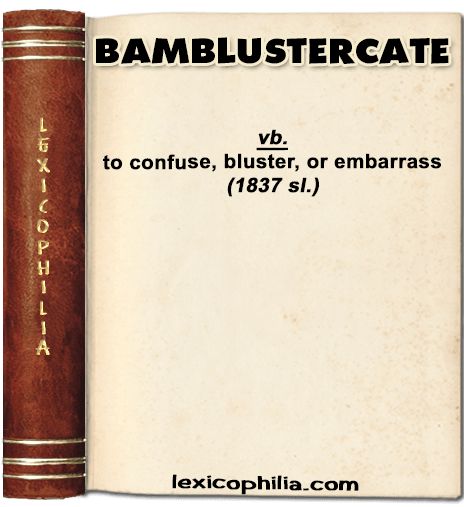
Word of the Day: BAMBLUSTERCATE


ETYMOLOGY
from bam (to hoax, to make fun of to impose upon the credulous) + bluster


EXAMPLE
“…”In course,” continued Joe, more soothed: “none but a Jolly would go to say anything again it, or doubt the woracity o’ the thing. Well, shipmates, to heave ahead, I’m saying I was reg’larly bamblustercated when one of the genelmen up in the niches squeaks out, ‘King Herod, I’ll just thank your for a thimble-full of the stuff.'” …”

From: Bentley’s Miscellany, Volume II, 1837
‘Nights at Sea’

Word of the Day: IDIOTICON


ETYMOLOGY
from Greek ἰδιωτικόν, neut. sing. of ἰδιωτικός (idiōtikos – private, unprofessional, ordinary);
taken in the sense of peculiar to oneself


EXAMPLE
“…The one Idea which gives the Tone to each play not seldom implied in the Titles, which deserve to be mentioned as an Idioticon of Shakespears…”

From: Coleridge’s Lectures 1808–19: On Literature, 1987

Word of the Day: DAFFYDOWNDILLY


ETYMOLOGY
n. 1. a playful expansion of daffodilly. (from daffodil + -y);
n. 2: so called in Yorkshire from the slight similarity of the Greek name Daphne with Daffodil


EXAMPLE

“…Herbes, branchis & flowers for windowes & potts
• 1 Bayes, sowe or set in plants in Ianuarie.
2 Batchelers buttens,
3 Botles, blewe, red & tauney,
4 Collembines.
5 Campions.
6 Daffadondillies.
7 Eglantine, or swete bryer.
8 Fetherfewe.
9 Flower armour, sowe in Maye.
10 Flower deluce,
11 Flower gentil, whight & red.
12 Flower nyce.
13 Gelyflowers, red, whight & carnacions, set in Spring, & Heruest in potts, payles or tubs, or for sommer in bedds.
14 Holiokes, red, whight & carnacions.
15 Indian eye, sowe in Maye, or set in slips in March.
16 Lauender, of al sorts
…”

From: Fiue Hundreth Points of Good Husbandry
By Thomas Tusser, 1573

Word of the Day: GOFFLE


ETYMOLOGY
alteration of gobble


EXAMPLE
“…A dinner nice the oad folks have,”
At race-time, ollis ‘ood, –
That day, they had a toad-in-hole,
A dish that’s deadly gud

But when oad Styles to goffle it,
Bargun, he soon ded cry out: –
“Missus! I thinks as how, taa-day,
“Yow’ve put the meller’s eye out!…”

From: John Noakes & Mary Styles:
Or, “An Essex Calf’s” Visit to Tiptree Races
By Charles Clark, 1839

Word of the Day: QUARTER-CLEFT


ETYMOLOGY
from quarter + cleft (n. and adj. split asunder)


EXAMPLE
“…It is the fashion to talk of Lord Ellenborough in contemptuous terms, as a mere nincompoop, or quartercliff, or what else you will, that implies feebleness of intellect and deficiency of talents; but those who so describe him either mistake his character, or wilfully misrepresent it…”

From: Fraser’s Magazine for Town and Country
Vol. IV. August, 1831 to January 1832
Parliamentary Eloquence, No. IV, House of Lords, by Oliver Yorke