Word of the Day: QUARTER-CLEFT


ETYMOLOGY
from quarter + cleft (n. and adj. split asunder)


EXAMPLE
“…It is the fashion to talk of Lord Ellenborough in contemptuous terms, as a mere nincompoop, or quartercliff, or what else you will, that implies feebleness of intellect and deficiency of talents; but those who so describe him either mistake his character, or wilfully misrepresent it…”

From: Fraser’s Magazine for Town and Country
Vol. IV. August, 1831 to January 1832
Parliamentary Eloquence, No. IV, House of Lords, by Oliver Yorke

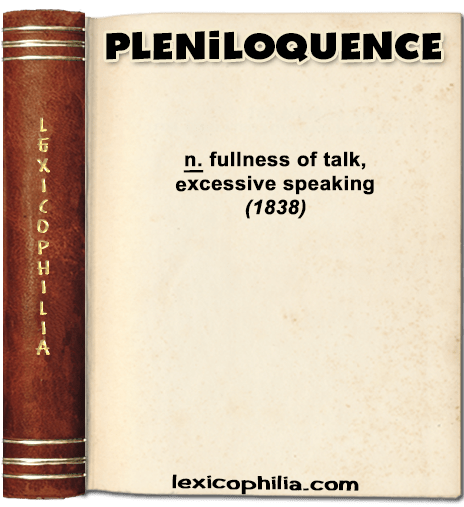
Word of the Day: PLENILOQUENCE


ETYMOLOGY
from Latin plenus (full) + loquentia (talking)


PRONUNCIATION
plen-I-luh-kwuhns


EXAMPLE
“…Mr. Emerson, writing to his friend Carlyle, August 6, 1838, thanking him for his “friendliest seeking of friends for the poor oration” (“The American Scholar”) says: I have written and read a kind of sermon to the Senior Class of our Cambridge Theological School a fortnight ago; and an address to the Literary Societies of Dartmouth College, for though I hate American pleniloquence, I cannot easily say No to young men who bid me speak also. … The first, I hear, is very offensive. I will now try to hold my tongue till next winter…”

From: The Complete Works of Ralph Waldo Emerson: Nature addresses and Lectures
Notes, 1838

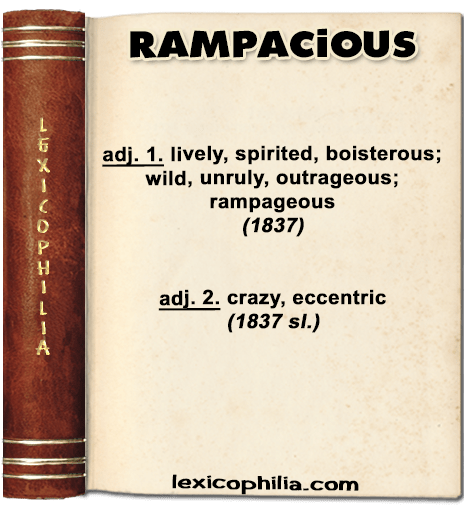
Word of the Day: RAMPACIOUS


ETYMOLOGY
variant of rampageous, after adjectives ending in -acious


EXAMPLE
“…In the main street of Ipswich, on the left-hand side of the way, a short distance after you have passed through the open space fronting the Town Hall, stands an inn known far and wide by the appellation of the Great White Horse, rendered the more conspicuous by a stone statue of some rampacious animal with flowing mane and tail, distantly resembling an insane cart-horse, which is elevated above the principal door…”

From: The Pickwick Papers
By Charles Dickens, 1836

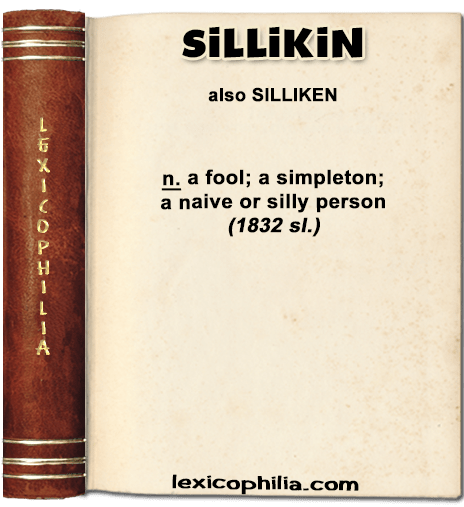
Word of the Day: SILLIKIN


ETYMOLOGY
from silly (adj.) + -kin


EXAMPLE
“…In every small band, or knot of young thieves, there will always be found one or two sillikins, as they denominate those whom they can persuade to be foremost in any undertaking, by taunts of cowardice and threats of dissolving partnership…”

From: Fraser’s Magazine for Town and Country
Volume VI, August to Decemeber, 1832
The Schoolmaster’s Experience in Newgate

Word of the Day: SMARTFUL


ETYMOLOGY
from smart (sharp physical pain) + -ful


EXAMPLE
“…What kind harted husband: can se his kind wife,
In like carefull case, without wo at his hart.
What naturall father can se: for his life,
His naturall childerne, in dread quake and start.
Without his hart smarting, in most smartfull smart.
I thinke, ye thinke none: and euin so thinke I.
Meruell not then: though the spider be toucht nie…”

From: The Spider and the Flie 
By John Heywood, 1556

Word of the Day: FREMESCENT


ETYMOLOGY
as if from Latin fremescentem, pr. pple. of fremescere
freq. vb. from Latin fremere (to roar)


EXAMPLE
“… The tide advances; Syndic Roederer’s and all men’s straits grow straiter and straiter. Fremescent clangor comes from the armed Nationals in the Court; far and wide is the infinite hubbub of tongues …”

From: The French Revolution: A History
By Thomas Carlyle, 1837

Word of the Day: MISOCAPNIST


ETYMOLOGY
from miso- +‎ stem of Ancient Greek καπνός (kapnós, “smoke”) +‎ -ist


EXAMPLE
“…smoking at all times, in all places, and in all companies, offending the nostrils of all misocapnists with the fumes of his mundungus, and disgusting all decent people with his ptyalism, as an auricular sage, with great delicacy, terms the perpetual ejection of saliva…”

From: A Paper: -of Tobacco
By Joseph Fume (real name: William Andrew Chatto), 1839

Word of the Day: QUADRIVIOUS


ETYMOLOGY
from Latin quadrivium (place where four ways meet) + -ous 


EXAMPLE
“…By means of small galleries directed from the cellars of houses in the vicinity of any square or quadrivious spot, which it is likely a body of troops might occupy as a position, it will be very easy to establish and to spring mines with considerable effect…”

From: Defensive Instructions for the People
By Francis Maceroni

Word of the Day: TOBACCONALIAN


ETYMOLOGY
from tobacco, after bacchanalian


EXAMPLE
“…As we passed on, the number of promenaders increased, but scarcely a lady was now to be seen. Every other gentleman we met was enveloped in a cloud, not of bacchanalian, but tobacconalian incense, which gave a peculiar atmosphere to the Levee…”

From: The South-West
By Joseph Holt Ingraham, 1835

Word of the Day: PHOTOGENY

ETYMOLOGY
from photo- (comb. form; relating to light) + -geny (comb. form; general sense = mode of production)

EXAMPLE
“…IMPROVEMENTS IN THE DAGUERREOTYPE. — Numerous improvements have been lately made in the beautiful art of photogeny….”

From: Burton’s Gentleman’s Magazine
A Chapter on Science and Art
By Edgar Allen Poe
Volume VI, April, 1840