Word of the Day: CHATTERMAG


ETYMOLOGY
from chatter + mag (a chatterbox)


EXAMPLE
“…Now then, stop that; we don’t want no such dal’d nonsense; we come here to work. Now then, you women, divide into twos, and begin at both ends, or we shan’t get any work done for your chattermagging…”

From: Stubble Farm;
Or, Three Generations of English Farmers
By Hubert A. Simmons, Vol. II, 1880
Chapter I. P. 14

Word of the Day: SAMSONISTIC


ETYMOLOGY
from Samson (in reference to his enormous strength) + -istic


EXAMPLE
“…The new Governor-General seemed to be impressed with the idea that all political officers, small and great, were in fault. Forthwith he commenced dealing out upon them the most ferocious and Samsonistic blows. The shower unfortunately fell, like Don Quixote’s strokes on a certain occasion, upon an innocent race of puppets…”

From: Dry Leaves from Young Egypt
Being a Glance at Sindh Before the Arrival of Sir Charles Napier,
By An Ex-Political (Edward Backhouse Eastwick), 1849
Chapter XII. A Flea

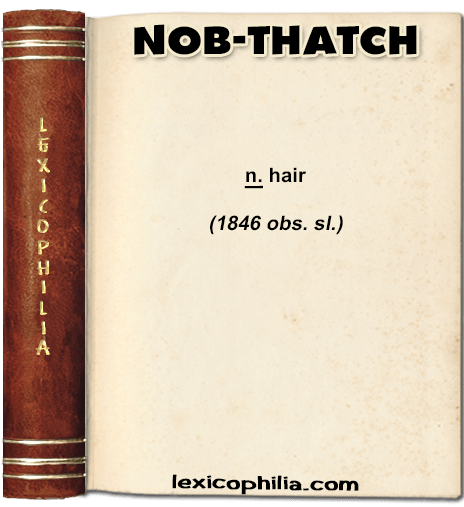
Word of the Day: NOB-THATCH


ETYMOLOGY
from nob (the head) + thatch (covering)


EXAMPLE
“…Sir, I have been three months in the House of Correction, and was discharged yesterday. Mr Chesterton’s “nick” is yet fearfully visible among my hair, whence a great paucity of nob-thatch…”

From: Littell’s Living Age
Volume 11, 1846
The Complaint of a Pickpocket; John Sheppard

Word of the Day: GRUNDYITE

ETYMOLOGY
after Mrs. Grundy, a character mentioned in the play Speed the Plough (1798) by Thomas Morton (1764?-1838), English playwright


EXAMPLE
“…Meantime there is some meaning in having a gentleman and a classic at the head of affairs, who may now and then direct the stream of public bounty to us, poor devils, whom the Grundyites would not only remunerate, but kick out of society as barely respectable…”

From: Alfred Lord Tennyson: A Memoir
Letters 1842-1845
By Alfred Tennyson, 1897

Word of the Day: QUILKIN

ETYMOLOGY
? from Celtic Cornish kwilken (a frog)

EXAMPLE
“…And yet ’tis the bestest thing as could fall ‘pon the gal. Er was lookin’ for the cheel in a month or so, they do say., Poor sawl! – so cold as a quilkin now, and the unborn baaby tu…”

From: Lying Prophets
A Novel, By Eden Phillpotts, 1896
Chapter Eight, The Destination of Joan

Word of the Day: QUALTAGH


ETYMOLOGY
from Manx quaaltaghqualtagh (the first person one meets after leaving the house, the first person one meets on New Year’s Day, literally ‘someone who meets or is met’),
from quaail (meeting, also action of meeting) + -agh, suffix expressing belonging, with insertion of -t-, perhaps by association with an unattested reflex of Early Irish comaltae (foster-brother, companion)


EXAMPLE
“…Again we assemble, a merry New Year,
To wish to each one of the family here,
Whether man, woman, or girl or boy,
That long life and happiness all may enjoy.
May they of potatoes and herrings have plenty,
With butter and cheese, and each other dainty,
And may their sleep never, by night or by day,
Disturbed be by even the tooth of a flea,
Until at the Quaaltagh again we appear
To wish you, as now, all a happy New Year!
…”

From: An historical and statistical account of the Isle of Man
– Joseph Train, 1845


Note: A company of young lads or men generally went in old times on what they termed the Qualtagh, at Christmas or New Year’s Day, to the houses of their more wealthy neighbours; some one of the company repeating in an audible voice the following rhyme:

Ollick ghennal erriu as blein feer vie;
Seihll as slaynt da’n slane lught thie
Bea as gennallys eu bio ry cheilley,
Shee as graih eddyr mraane as deiney
Cooid as cowryn, stock as stoyr.
Palchey phuddase, as skaddan dy-liooar;
Arran as caashey, eeym as roayrt ;
Baase, myr lugh, ayns uhllin ny soalt;
Cadley sauchey tra vees shiu ny lhie,
As feeackle y jargan, nagh bee dy mie
.”

‘When this was repeated they were then invited in to partake of the best that the house could afford. (See example above for a translation.)

From: Dictionary of the Manks language, with the corresponding words or explanations in English, interspersed with many Gaelic proverbs
– Archibald Cregeen, 1835

Word of the Day: ROWDY-DOW

also Scottish and dialect form ROW-DE-DOW

ETYMOLOGY
 originally a variant of row dow dow ( a series of sounds as produced by beating a drum)
later possibly influenced by rowdy dowdy (characterized by noisy roughness)

EXAMPLE
“…There has been a terrible rowdydow in the operatic green-room…”

From: Dashes at Life with a Free Pencil
By Nathaniel Parker Willis, 1845