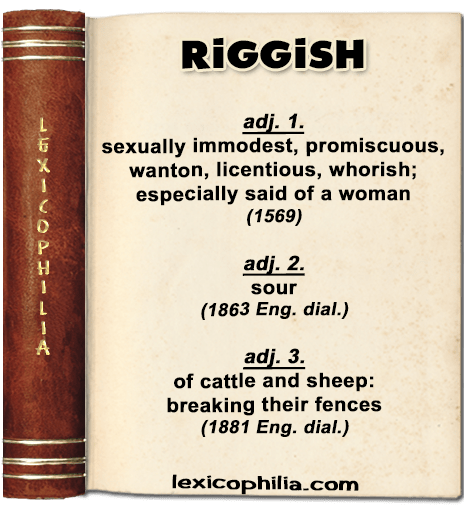
Word of the Day: RIGGISH

ETYMOLOGY
of uncertain origin
n. 1. possibly from rig (a wanton girl or woman)

EXAMPLE (for adj. 1.)
“… As it is to be seene, namely at Rome, what reuenues and rents, that great and soueraign ruffian getteth by his whoores. And afterward of the drouning and killing of children, and secretly murthering, and casting in corners and ditches, as is vsually practised amongst these riggish and lecherous prelates. …”

From:  Jan van der Noot’s Theatre, wherein be represented the miseries that follow the Voluptuous Worldings
By Jan van der Noot
Translated by Theodore Roest, 1569

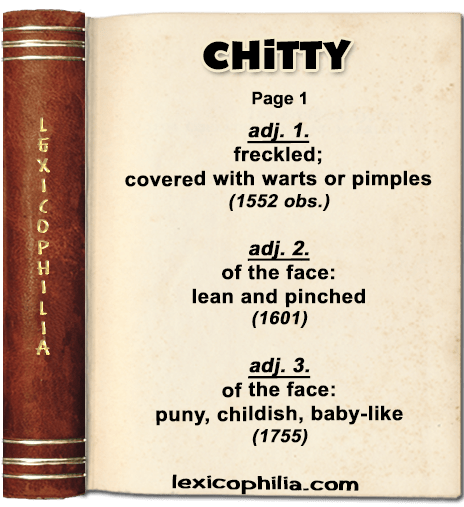
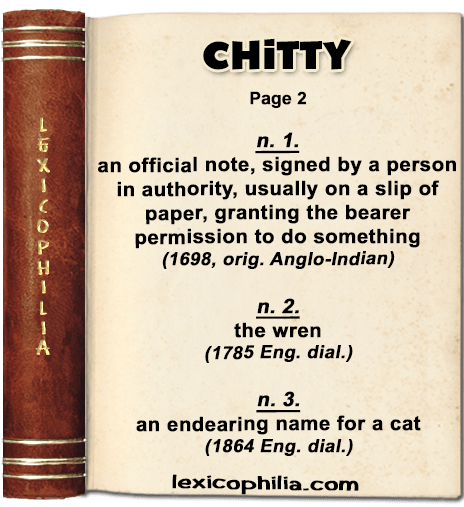
Word of the Day: CHITTY

ETYMOLOGY
adj. 1.: from chit (a freckle or wart, obsolete) + -y
adj. 2. & 3..: apparently deduced from chitty-face, (thin face), but afterwards associated with chit (the young of a beast)
n. 1.:  from Hindi chiṭṭhi, Marathi chitthi, chithi and its cognate
Hindi ciṭṭhi (document, letter, note, promissory note, pass), of uncertain origin

EXAMPLE (for adj. 1.)
“… How shall I stifle now my rising Phlegm,
Are all, are all his Thoughts employ’d on them
Shall they such
Chitty Jades so happy be,
And can he not bestow one word on me;
Hence from my Sight, avoid this wicked Room,
Go you ungracious Minxes, get you home.
…”

From: The Rival Milliners: or, the Humours of Covent Garden
A Tragi-Comi-Operatic-Pastoral Farce
By Robert Drury, 1737

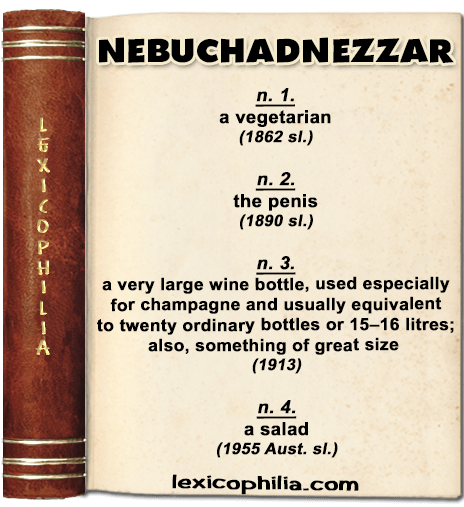
Word of the Day: NEBUCHADNEZZAR

ETYMOLOGY
from the name of Nebuchadnezzar (died c562 BC) ruler of the Babylonian empire (604–562 BC), after French nabuchodonosor (large wine bottle used for champagne)

EXAMPLE (for n. 3.)
“… That didn’t prevent me strewing my whole room with little bits of paper, when I undressed that night. Fireworks ensue, then (children dismissed) supper and afterwards, the most magnificent Nebuchadnezzars, and finally a good form of blind-man’s buff, where everyone stands round the room in a circle and the blind man walks up and prods someone, telling him at the same time to make a noise … sch as the sound of rain falling on mud – and the speaker has to be recognised by the sound of his voice. …”

From: Letters of Aldous Huxley
By Aldous Huxley, 1969
Letter to Leonard Huxley, 11 November, 1913

PRONUNCIATION
neb-yuh-kuhd-NEZ-uh

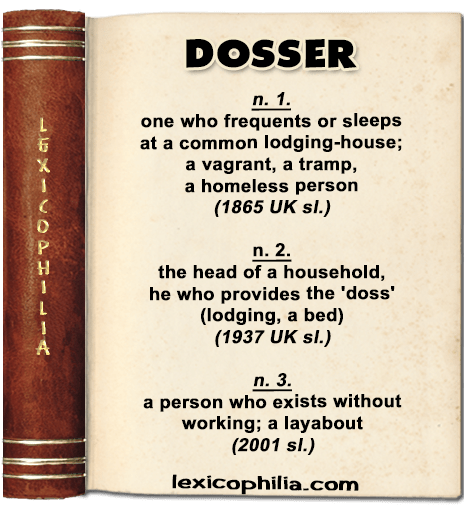
Word of the Day: DOSSER

ETYMOLOGY
from doss (n. lodging, a bed) (vb. to sleep)

EXAMPLE
“… Most of the ‘dossers’ were transient customers, people who were always on the move. …”

From: New York Police Gazette
Leaves from the Diary of a Celebrated Burglar; Being a Compilation of the Events and Occurences of the Most Exciting, Interesting and Extraordinary Character in the Life of a Thief
By Anonymous, 1865

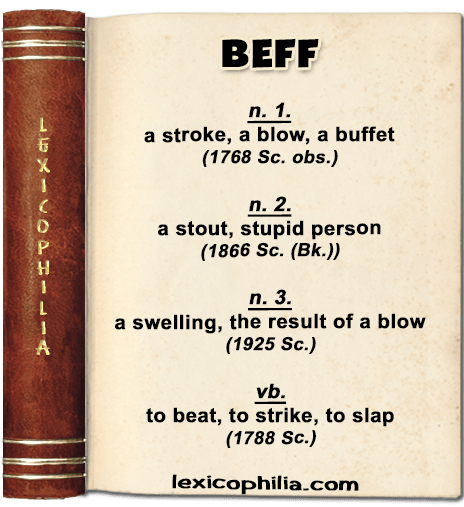
Word of the Day: BEFF

ETYMOLOGY
n. 1. possibly a variant of baff (a blow with anything flat or soft)
n. 2. possibly a variant of baff (a big, clumsy person)
vb. possibly a variant of beft (to strike, to give blows)

EXAMPLE (for n. 1.)
“… Ye shak your head, but o’ my fegs,
Ye’ve set auld Scota on her legs;
Lang had she lien wi’
beffs and flegs,
Bumbaz’d and dizzie,
Her fiddle wanted strings and pegs,
Wae’s me, poor hizzie.
…”

From: Aberdeen Journal, June 1768
The Poems of Beattie
By James Beattie

Word of the Day: EDACIOUS

ETYMOLOGY
from Latin edaci- (nominative edax), from edere (to eat) + -ous

EXAMPLE (for n. 1.)
“… Nor is this the sole circumstance that should, in mere justice, be
considered in connection with the rise of Christian monachism; for
before the mere facts can be understood, and certainly before the due
measure of blame can be assigned to the parties concerned, it is
indispensable that we divest ourselves of the prejudices, physical,
moral, and intellectual, which belong to our austere climate, high-toned
irritability,
edacious appetites, and pampered constitutions; to our
rigid style of thinking, and to our commercial habits of feeling.
…”

From: Natural History of Enthusiasm
By Isaac Taylor, 1829

Word of the Day: BACKFRIEND

ETYMOLOGY
from back (n.) or (adv.) + friend;
possibly originally a friend who ‘kept back,’ and did not come forward to assist, and so was no real friend

EXAMPLE (for n. 1.)
“… And as for my lorde chamberleyn, he is nott yit comen to town. When he comythe, than schall I woote whatt to doo. Syr John off Parre is yowre freende and myn, and I gaffe hym a fayre armyng sworde wyth-in thys iij dayes. I harde somwhatt by hym off a bakk freende off yowrys; ye schall knowe moore here-afftre. …”

From: Paston Letters and Papers of the Fifteenth Century
By Paston family, 1472
Published for the Early English Text Society – Edited by Norman Davis, Richard Beadle, and Colin Richmond. 2004

Word of the Day: PLISKY

ETYMOLOGY
of obscure origin

EXAMPLE (for n. 1.)
“… They ‘re fly’d at the heart, it’l be a black Bargain for poor Scotland: for the Engleses are owr auld farren for us, and there’s little Ground to think, they ‘ll gee
us a seen Vantage wee their will, they neer liked us sae well; and its naе forgotten yet, the foul
Plisk they play’d us about our Caledonia Business; …”

From: The Scottish Antiquary Or Northern Notes and Queries
Volume XII, January 1898
A Copy of a Letter from a Country Farmer To His Laird, a Member of Parliament, 1706

Word of the Day: JIMJAMS

ETYMOLOGY
a reduplicated term, of which the elements are unknown;
from the mid 16th century – in the singular, originally denoted a knickknack or small article

EXAMPLE (for n. 1)
“… Andy Collins, an Irishman, who has lived alone in his cabin, about a mile below us, for a year or more, has been a hard drinker ever since we have known him. He bought his rum by the gallon and kept soaked all the time. Tuesday night he had a bad attack of the jim-jams, and his nearest neighbor, O’Neil, heard him yelling and shrieking like all possessed. …”

From: The Diary of a Forty-Niner
By Chauncey Canfield, 1906
Chapter XVI, February 1, 1852

Word of the Day: DISCUTABLE

ETYMOLOGY
from French discutable,
from discuter (to discuss),
(from Latin discutere (to discuss) + -able)

EXAMPLE
“… A definite and complete study of all literary works of the period inspired by the event would be not only an enterprise worthy of an inquisitive erudition, but also a useful help in tracing a line of demarcation between legend and history, and would throw a flood of light on many insoluble or discutable points. …”

From: The Saturday Review of Politics, Literature, Science and Art, 1893
Christopher Columbus and Lope de Vega