Word of the Day: RUMBUSTICAL

ETYMOLOGY
possibly an alteration of rumbustious (boisterous, unruly);
or perhaps an alteration of obsolete English robustic (robust, robustious), 
from robust + -ic + -al

EXAMPLE
“… I will, your worship: but I am glad his honour, the Major, is not to be jocum tenus for your worship, he’s so much upon the roguish order with the women, now and ten. I did not care to mention it to your worship before; but as true as I’m alive he was a little rombustical to our Bridget, no longer ago than last Sunday was se’night, as she was coming home from church. …”

From: The Flitch of Bacon; a comic opera
By Henry Bate Dudley, 1779

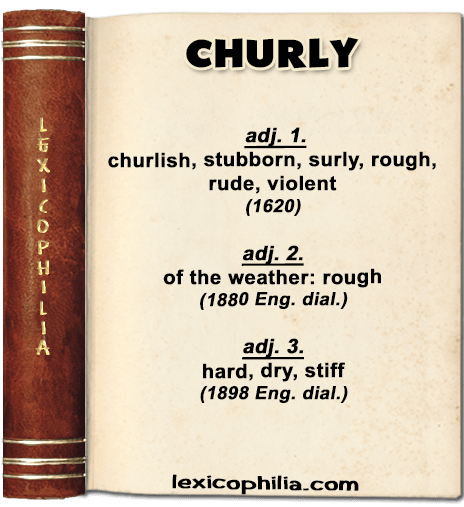
Word of the Day: CHURLY

ETYMOLOGY
from churl -y

EXAMPLE
“… But all this while, the shop where Jonah sleeps,
Is tost, and torne, and batter’d on the deeps,
And well-nigh split upon the threatning Rock,
With many a boystrous brush, and
churley knock.
God help all desp’rate voyagers, and keepe
All such, as feele thy wonders on the deepe.
…”

From: Divine poems: containing the History of -Jonah. Ester. Job. Samson.; Sions – sonets. Elegies.
By Francis Quarles, 1638

Word of the Day: BUBBLY-JOCK

ETYMOLOGY
from bubbly (full of bubbles) + the Scots male forename Jock 

EXAMPLE (for n. 1.)
“… there was the turkey, whom the poetical Scott calls the bubbly-jock, gobbling in the distance, with a melodious gurgle as of an oboe played softly; …”

From: With Harp and Crown, A Novel
By Walter Besant and James Rice, 1800

Word of the Day: TROIL

ETYMOLOGY
vb.: from Old French troilliertruilliertreuiller, from Middle High German trüllen

EXAMPLE (for vb.)
“… Thus with treison and with trecherie · þow troiledest hem boþe,
And dudest hem breke [here] buxomnesse · þorw false by-heste;
Thus haddest þou hem oute · and hyder atte laste.
…”

(Thus with treason and with treachery · thou troiledest them both,
And diddest them break their buxomness · through false byhest;
Thus haddest thou them out · and hither at the last.
)

From: The Vision of William concerning Piers the Plowman
By William Langland, 1393

Word of the Day: TIB

ETYMOLOGY
perhaps the same as Tib, a shortened hypocoristic form of the female name Isabel; now rather rude or slighting (except playfully);
also with dim. -y or -ieTibbie, a common female name in the north

EXAMPLE
“… .Trupeny. Mary then prickmedaintie come toste me a fig,
Who shall then know our
Tib Talke apace trow ye?

An. Alyface. And why not Annot Alyface as fyne as she?

Trupeny. And what had Tom Trupeny, a father or none?

An. Alyface. Then our prety newe come man will looke to be one …”

From: Ralph Roister Doister 
By Nicholas Udall, a1556

Word of the Day: CUFFER

ETYMOLOGY
for. n. 1. & n. 2. from cuff (to strike with the fist or open hand, to buffet) + -er
for n. 4. from cuff (to discuss, to talk over) + -er

EXAMPLE (for n. 1.)
“… LET US LEARN THE LAWS OF FASTING, that we run not uncertainly, nor beat the air, nor be as such cuffers who fight as it were with their shadow. Fasting is a medicine; but physick, although it be never so good, that is prescribed, oftimes becomes unprofitable, by reason of the imprudence of him that useth it. …”

From: The Paschal or Lent-Fast, Apostolical & Perpetual at first deliver’d in a sermon preached before His Majesty in Lent and since enlarged
By Peter Gunning, 1662

Word of the Day: WRINGLE-WRANGLE

ETYMOLOGY
reduplication of wrangle (n.) with change of vowel as in jingle-jangletingle-tangle, etc.

EXAMPLE
“…It was a most delightful godsend to the paper in which it appeared, and it came at a time when the House was not sitting, and there was no wringle-wrangle of debates to furnish material for the columns of big type which are supposed to sway the masses. …”

From: All Sorts and Conditions of Men: An Impossible Story
By Walter Besant, 1882