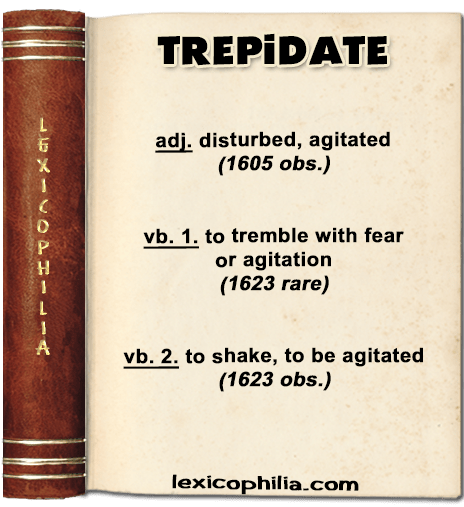
Word of the Day: TREPIDATE


ETYMOLOGY
adj.: from Latin trepidatus, past participle of trepidare
vb.: participial stem of trepidare (to hurry, bustle, be agitated or alarmed)


EXAMPLE
“…The celestiall spheres in continuall volubilitye..their diurnall or daylye course from the East to the West, their retrograde and vyolent motion from the West to the East, their trepidat motion from the South to the North…”

From: A Confutation of Atheisme
By John Dove, 1605

Word of the Day: MISOCAPNIST


ETYMOLOGY
from miso- +‎ stem of Ancient Greek καπνός (kapnós, “smoke”) +‎ -ist


EXAMPLE
“…smoking at all times, in all places, and in all companies, offending the nostrils of all misocapnists with the fumes of his mundungus, and disgusting all decent people with his ptyalism, as an auricular sage, with great delicacy, terms the perpetual ejection of saliva…”

From: A Paper: -of Tobacco
By Joseph Fume (real name: William Andrew Chatto), 1839

Word of the Day: QUADRIVIOUS


ETYMOLOGY
from Latin quadrivium (place where four ways meet) + -ous 


EXAMPLE
“…By means of small galleries directed from the cellars of houses in the vicinity of any square or quadrivious spot, which it is likely a body of troops might occupy as a position, it will be very easy to establish and to spring mines with considerable effect…”

From: Defensive Instructions for the People
By Francis Maceroni

Word of the Day: CONFRAGOSE


ETYMOLOGY
from Latin confragosus (broken, rough, uneven),
from Latin confringere and fragosus, from stem frag- of frangere (to break)


EXAMPLE
“…But, what appeared most stupendous to me, was the rock of St. Vincent, a little distance from the towne, the precipice whereof is equal to any thing of that nature I have seene in the most confragose cataracts of the Alpes, the river gliding between them at an extraordinary depth. Here, we went searching for diamonds, and to the Hot Wells, at its foote…”

From: The Diary of John Evelyn
27 June 1654

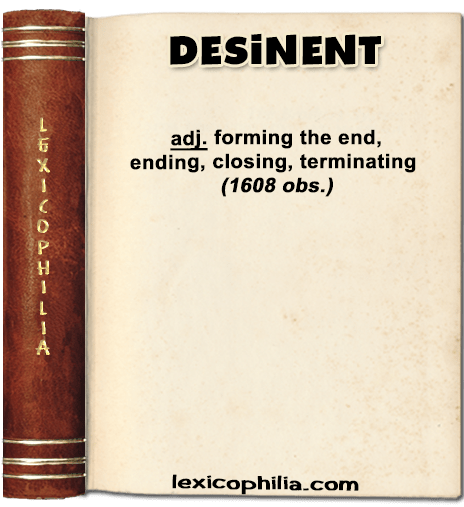
Word of the Day: DESINENT


ETYMOLOGY
from Latin desinentem, present participle of desinere (to leave off, close),
from de- + sinere (to leave)


EXAMPLE
“… In front of this sea were placed six tritons, in moving and sprightly actions, their upper parts human, save that their hairs were blue, as partaking of the sea-color: their desinent parts fish,  mounted above their heads, and all varied in disposition. From their backs were borne out certain light pieces of taffata, as if carried by the wind, and their music made out of wreathed
shells…”

From: The Masque of Blackness in Characters Two Royall Masques
By Benjamin Jonson, 1608