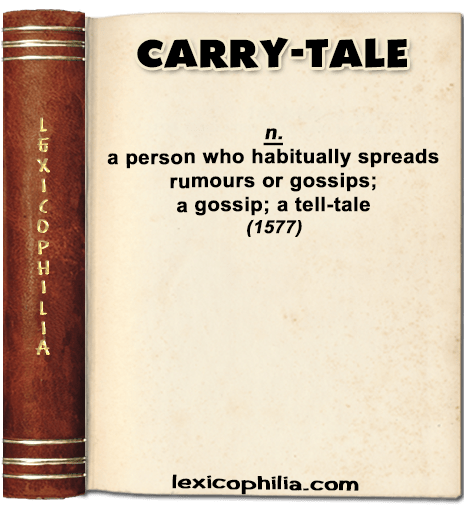
Word of the Day: CARRY-TALE

ETYMOLOGY
from carry (vb.) + tale

EXAMPLE
“… After the solemnitie of this marriage, there appeared outwardlie to the world great loue and friendship betweene the duke and the earle, but by reason of carie tales and flatterers, the loue continued not long, …”

From: The Firste (laste) Volume of the Chronicles of England, Scotlande, and Irelande
By Raphael Holinshed, 1577
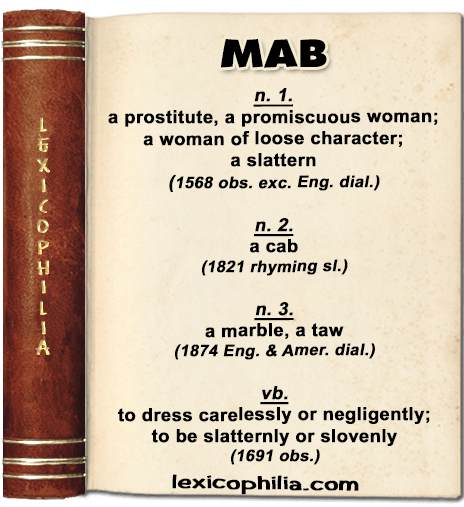
Word of the Day: MAB

ETYMOLOGY
n. of uncertain origin uncertain;
perhaps from the female forename Mab, shortened in Middle English from Mabel, from Amabel
vb. related to mab (a promiscuous woman), perhaps as a variant of mob (to dress oneself untidily

EXAMPLE (for n. 1.)
“… Mido. Take my life for a penny, whither shall I ren?
Esau. Come out, thou little fiend, come out, thou skittish gill.
Abra. Out, alas, alas! Esau will us all kill.
Esau. And come out, thou mother Mab; out, old rotten witch!
As white as midnight’s arsehole or virgin pitch. Where be ye? come together in a cluster.
…”

From: A Newe Mery and Wittie Comedie or Enterlude, Newely Imprinted, Treating vpon the Hhistorie of Iacob and Esau, 1568

Word of the Day: ERGOPHOBIA

ETYMOLOGY
from Greek ἔργον (work) + -phobia

EXAMPLE
“… to which might be added ergophobia, or mobid shrinking from active effort of every sort, etc. But these expressions add very little to definiteness of description. …”

From: Essentials of the Principles and Practice of Medicine
A Handbook for Students and Practitioners
By Henry Hartshorne, 1881
Part I, Principles of Medicine. Section I. General Pathology
Neuro-Pathology

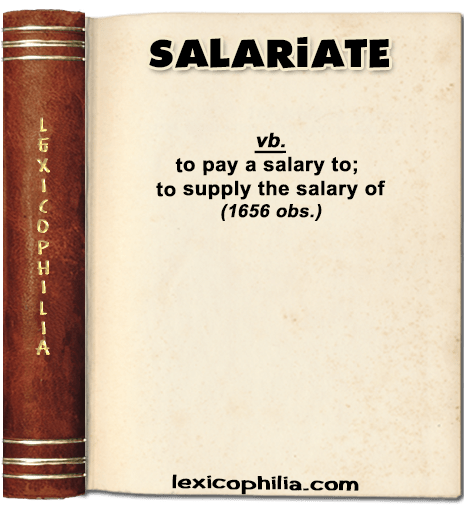
Word of the Day: SALARIATE

ETYMOLOGY
from Latin salarium (salary) + -ate

EXAMPLE
“… The Sanhedrim of Israel being the Supream, and a constant Court of Judicature could not choose but be exceeding gainful. The Senate of the Bean in Athens, because it was but annual, was moderately salariated, but that of the Areopagites being for life bountifully; what advantages the Senators of Lacedemon had, where there was little mony or use of it, was in honour for life. …”

From: The Common-Wealth of Oceana
By James Harrington, 1656

Word of the Day: WINDY-WALLETS

ETYMOLOGY
from windy (1. speaking at length; 2. of food or drink: causing flatulence) + wallet (possibly from Scottish sense of a fund of stories, poems, recollections, etc.)

EXAMPLE
“… Gowkscroft and Barnside,
Windy-wallets fu’ o’ pride;
Monynut, and Laikyshiel,
Plenty milk, plenty meal;
Straphunton Mill, and Bankend,
Green cheese as teugh as bend;
Shannabank and Blackerstane,
Pike the flesh to the bane;
Quixwood, and Butterdean,
Lu’ o’ parritch to the een!
…”

From: The Popular Rhymes, Sayings, and Proverbs of the County of Berwick
By George Henderson, 1856

Word of the Day: STENTORONIC

ETYMOLOGY
irregular from Stentor (a Greek warrior in the Trojan war, ‘whose voice was as powerful as fifty voices of other men’) + -ic

EXAMPLE
“… And to chain up the tongues of five hundred cackling gossips he held, and with great reason, an exploit worth recording. Indeed he appears to have taken the most effectual method with them, that is, to out-clamour them: For thus he measures out his own Stentoronic voice. …”

From: The Doctrine of Grace: or, the Office and Operations of the Holy Spirit vindicated from the Insults of Infidelity, and the Abuses of Fanaticism
By William Warburton, 1763

Word of the Day: PROPUDIOUS

ETYMOLOGY
from Latin propudiosus (shameful, infamous), from propudium (a shameful action),
(from pro- pudere (to make ashamed) + -ium) + -osus (-ous)

EXAMPLE
“… Yea in the Cirque or Race-yard, (where was the greatest Concourse of People) they de-cryed Iulian; calling vpon Niger, the chiefest Officer of the sacred Empire, to vindicate the Roman State, and hasten to free them from that propudious Gouernour . ….”

From: Herodian of Alexandria His History of Twenty Roman Cæsars
Interpreted out of the original Greek by James Maxwell, 1629

Word of the Day: HODDY-NODDY

ETYMOLOGY
reduplicated from noddy (a fool, a simpleton)

EXAMPLE
“… Lastly it is no where to be shewed, that Christ gaue any speciall commaundement, that Peter should remooue his seat from Antioche to Rome. If this hoddy Noddy thinke otherwise, let him if he canne, bring foorth his proofes, and shew where this commaundement is to be séene. …”

From: A briefe replie to a certaine odious and slanderous libel, lately published by a seditious Iesuite,
By Matthew Sutcliffe, 1600

Word of the Day: CONKERBELL

ETYMOLOGY
alteration of cockabellcockerbell, variants of cocklebell (an icicle);
probably after English dialect conker (snail-shell)

EXAMPLE
“… An’ leetle Bob! tha daps o’s veather,
Hoi, wull, us did count on un, reather :
Yer Bobby yer’s tha crickett,
Tha chield’s avroared, tha
conkerbells
Be hangin’ to un — Yett theesel,
Bob — Yen thick auther thicket.
…”

From: Jim and Nell: a Dramatic Poem in the dialect of North Devon
By William Frederick Rock, 1867