
ETYMOLOGY
from carrion (the human body) + case (a covering)
EXAMPLE
“He wore a tight, white, long-sleeved, button-up carrion-case.”
ETYMOLOGY
from carrion (the human body) + case (a covering)
EXAMPLE
“He wore a tight, white, long-sleeved, button-up carrion-case.”

ETYMOLOGY
from rattle (succession of short, sharp sounds) + noddled
EXAMPLE
“… Well, take this monster all together, and hees a clubfooted, hamble shanck’t, burstengutted, long-neck’t, rattlenodled, large lugg’d eagle eyd Hircocerous, a meere chimera, one of the devils best boys ; but having served him an apprentiship he’s now set up for himself and came out with his wares the last summer cave tertio. …”
From: Confused Characters of Conceited Coxcombs
By K.W., 1661
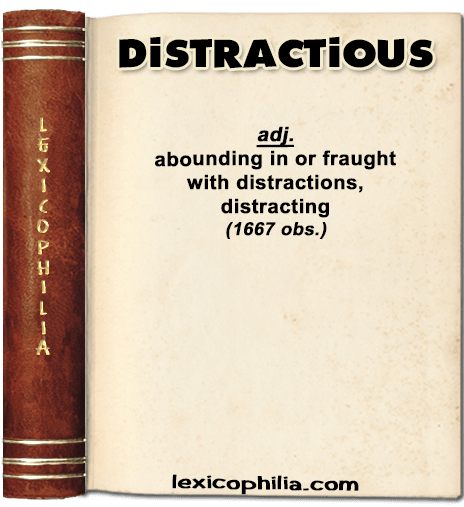
ETYMOLOGY
from distraction + -tious
EXAMPLE
“… There were indeed bruits of fear, and there were companies of suspicious persons who at the best, live upon the vices of the Nation, and who like Coasters ride out at Sea, to expect prey from wrecks, and small Boats which they can Master and prey upon, such Cormorants of pillage and snaps of ruine My Lodgings were an eminent instance of before they were burned yet open violence there was none to speak of, but much even of exemplary Justice, and charitable Mercy, In the time of the Fires raging, and of the distractious impetuosity; which I write not to vindicate the dissolute Multitude of pretended Labourers, and other instruments of carriage (who exhansed the rates of their own portadge, while perhaps their Wives, Children, and Servants, or some of them, were busie at other work, all becoming theirs which their hook could reach, or their Net drag away.) …”
From: A short narrative of the late dreadful fire in London
By Edward Waterhouse, 1667

ETYMOLOGY
from Latin sterquilinium (a dunghill), (from stercus (dung))
EXAMPLE
“… The itching of scriblers, was the scab of the time; It is just so now, that any triobolary pasquiller evry tressis agaso, any sterquilinious raskall, is licenc’d to throw dirt in the faces of Soveraign Princes in open printed language: But I hope the times will mend, and your Man slo if he hath any face, you have so well corrected him, So I rest …”
From: A New Volume of Letters
By James Howell, 1647
Letter to Dr. D. Featley, 1 Aug. 1644

ETYMOLOGY
from gig (a light two-wheeled one-horse carriage) + lamp
EXAMPLE (for n. 1.)
“… A “Wo-ho-ho, my beauties!” brought the smoking wheelers upon their haunches; and Jehu, saluting with his elbow and whip finger, called out in the husky voice peculiar to a dram-drinker, “Are you the two houtside gents for Hoxfut?” To which Mr. Green replied in the affirmative; and while the luggage (the canvas-covered, ladylike look of which was such a contrast to that of the other passengers) was being quickly transferred to the coach-top, he and Verdant ascended to the places reserved for them behind the coachman. Mr. Green saw at a glance that all the passengers were Oxford men, dressed in every variety of Oxford fashion, and exhibiting a pleasing diversity of Oxford manners. Their private remarks on the two new-comers were, like stage “asides,” perfectly audible.
“Decided case of governor!” said one.
“Undoubted ditto of freshman!” observed another.
“Looks ferociously mild in his gig-lamps!” remarked a third, alluding to Mr. Verdant Green’s spectacles.
“And jolly green all over!” wound up a fourth. …”
From: The Adventures of Mr. Verdant Green
By Cuthbert Bede, (real name Edward Bradley), 1853

ETYMOLOGY
from Latin internigrant-, internigrans (interspersed with black);
from inter- (between or among) + nigrans (dark-coloured, black), use as adjective of present participle of nigrare (to be black);
from nigr-, niger (black)
EXAMPLE
“The old canvas was internigrant from the soot of the chimney fire”
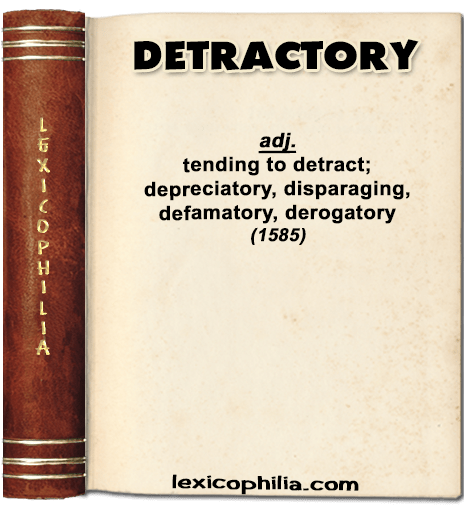
ETYMOLOGY
from Latin detractorius (disparaging, slanderous), from detractor (a defamer, slanderer) + -ory
EXAMPLE
“… Let him say al this, and much more, which idle and slothfull Christians are accustomed to bring for their excuse: let him alleage the same as much and as often times as he wil: it is but an excuse, and a false excuse, and an excuse moste dishonourable and detractorie to the force of Christ holie grace purchased vnto vs by his bitter passion …”
From: A Christian Directorie guiding men to their saluation
By Robert Parsons, 1585
ETYMOLOGY
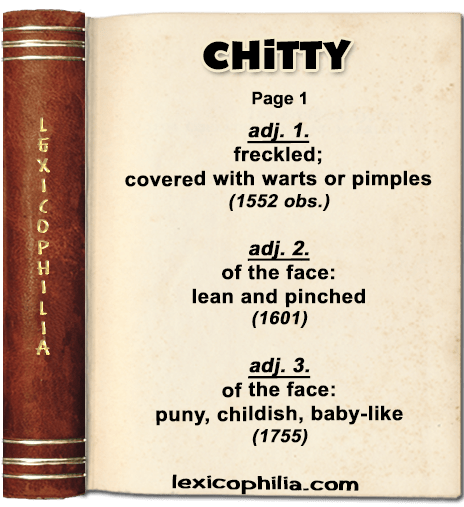
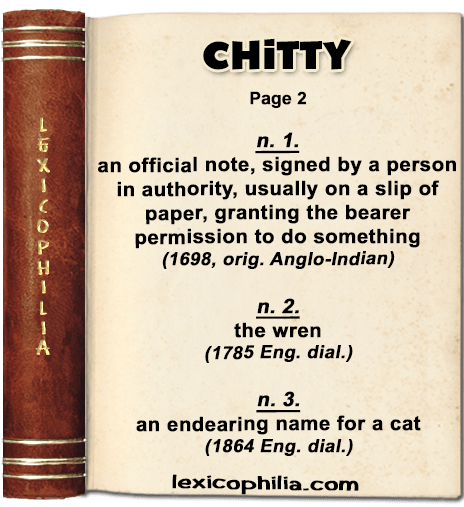
adj. 1.: from chit (a freckle or wart, obsolete) + -y
adj. 2. & 3..: apparently deduced from chitty-face, (thin face), but afterwards associated with chit (the young of a beast)
n. 1.: from Hindi chiṭṭhi, Marathi chitthi, chithi and its cognate
Hindi ciṭṭhi (document, letter, note, promissory note, pass), of uncertain origin
EXAMPLE (for adj. 1.)
“… How shall I stifle now my rising Phlegm,
Are all, are all his Thoughts employ’d on them
Shall they such Chitty Jades so happy be,
And can he not bestow one word on me;
Hence from my Sight, avoid this wicked Room,
Go you ungracious Minxes, get you home. …”
From: The Rival Milliners: or, the Humours of Covent Garden
A Tragi-Comi-Operatic-Pastoral Farce
By Robert Drury, 1737

ETYMOLOGY
from muss (a game in which small objects are thrown down to be scrambled for; a scramble);
the verb muss occurs in Lincolnshire dialect ( to scramble for, to take forcibly and by surprise)
EXAMPLE
“… because this their Cadet, from his very Cradle, had shewed so strong a Propension to hoarding, that being but five or six Years old, he denied himself the Enjoyment of such Knicknacks as were given him, and would scramble for and smuss those of other Children, his Play-fellows; yet was he so very careful and saving of his own, that he let his Fruit and Sweatmeats spoil and grow mouldy rather than he would eat them. …”
From: Histoire du Prince Titi,
A.R. The history of Prince Titi, a royal allegory
By Themiseul de Saint-Hyacinthe
Translated by Eliza Stanley, 1736

ETYMOLOGY
probably an alteration of cheslop, a variant of cheslip (a woodlouse), after bob (a bunch or cluster, as of leaves, flowers, fruit, etc.)
EXAMPLE
“I saw several chizzle-bobs crawling out from under the damp wood that was stored in the shed”
 Lexicophilia