Word of the Day: LEIGHSTER

ETYMOLOGY
representing Old English type líegestre, feminine agent-noun to leogan,
from lie (to tell a lie)

EXAMPLE
“… “Yif ich say ich hadde a hi-leman,
“That ich leighe meselue opon :
“Than ich worth of old and yong
“Be hold
leighster and fals of tong.
“Yete me is best take mi chaunce,
“And sle me childe, and do penaunce.
…”

From: Lai le Freine, c1325
in Metrical romances of the thirteenth, fourteenth, and fifteenth centuries: published from ancient manuscripts
By Henry William Weber, 1810

Word of the Day: CELEBRIOUS

ETYMOLOGY
from Latin celebris (crowded, much frequented; festive), variant of celeber (famous, well-known) + -ous

EXAMPLE (for adj. 1.)
“… Howe happy are those men, who for their constant standing in the gappe, against Sathan & Antichrist, are every day illustrated, and made celebrious, by the maligning
of the adversaries of truth? Their soules are in peace, and their glory is promulgated by their enemies trumpets, who the more they oppugne them, the more we doe loue them, and eternise the memory of them.
…”

From: The Reasons vvhich Doctour Hill hath brought, for the vpholding of papistry, which is falselie termed the Catholike religion
By George Abbot, 1604

Word of the Day: BAISIER

ETYMOLOGY
from Old French baisier (modern baiser) (to kiss)

EXAMPLE
“… Fynably Medea conueyed Iason vnto his chambre dore and their began there amorouse baisiers & kyssinges vnto the time that it was force that Medea must withdrawe her & thenne she recommanded Iason in the garde of the goddes and shette fast the dore. …”

From: The History of Jason
By Raoul Le Fevre
Translated by William Caxton, 1477

Word of the Day: HUNDRED-LEGS

ETYMOLOGY
from hundred + legs

EXAMPLE
“… They have also lizards three or four feet in length, and in great numbers; and also creatures called centipedes, or hundred legs, very venomous and troublesome. …”

From: The Beauties of Nature and Art
Displayed in a Tour Through the World
Volume X, 1774
Chapter I. Of South America
Sect. II. Animals

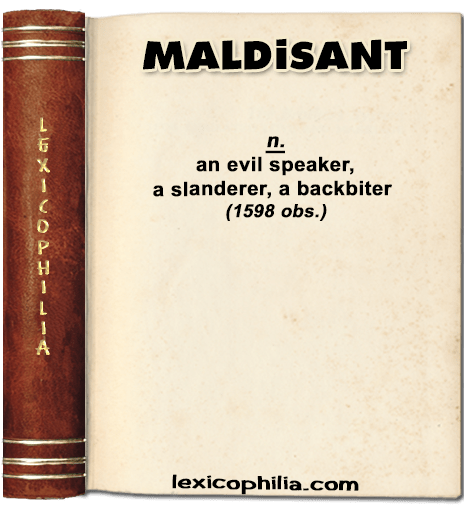
Word of the Day: MALDISANT

ETYMOLOGY
from French maldisant (evil speaker), use as noun of present participle of maldire, maudire (to speak evil), from maledicere; from male (badly) + dicere (to speak, say)

EXAMPLE
“… He is to blame (faith Martiall, and further he brandes him with a knavish name) that will be wittie in another mans booke. How then will scoffing readers scape this marke of a maledizant? whose wits have no other worke, nor better worth then to flout, and fall out?…”

From: A Worlde of Wordes, or, Most Copious, and Exact Dictionarie in Italian and English
Collected by John Florio, 1598

Word of the Day: MAN OF BELIAL

ETYMOLOGY
from Belial, the spirit of evil personified; 
used from early times as a name for the Devil or one of the fiends, and by Milton as the name of one of the fallen angels

EXAMPLE
“… Semey stones and stokkes and myre on Dauid kest;
The Sinagoge spittinges and thornes & buffets on Crist fest.
Semey callid Dauid “
man of Belial” and “manquhellere:
The Synagoge Crist “a wyche, gyloute and mysdoete”.
…”

From: The Mirour of Mans Saluacioun:
a Middle English translation of Speculum humanae salvationis : a critical edition of the fifteenth-century manuscript illustrated from Der Spiegel der menschen Behältnis, Speyer, Drach, c1429
Edited by Avril Henry, Scolar Press edition, 1986

Word of the Day: GENETRIX

ETYMOLOGY
from Latin genetrixgenitrix (female parent, mother; originator, creator),
from gen- stem of gignere (to beget, give birth)

EXAMPLE
“… The roundelayes, and charming lullabies,
That my indulgent
genetrix did warble?
What are my braines grown dry, or my bloud cold?
Or am I on a sudden waxen old?
I thought, though Cupids aire-deviding shaft,
Soone penetrated the well tempered
Corslet: which the hot-halting god of fire,
Made for his boysterous rivall, it should not find,
Or make a way to vulnerate my mind.
…”

From: Εροτοπαιγνιον (Erotopaignion), or, The Cyprian Academy
By Robert Baron, 1647

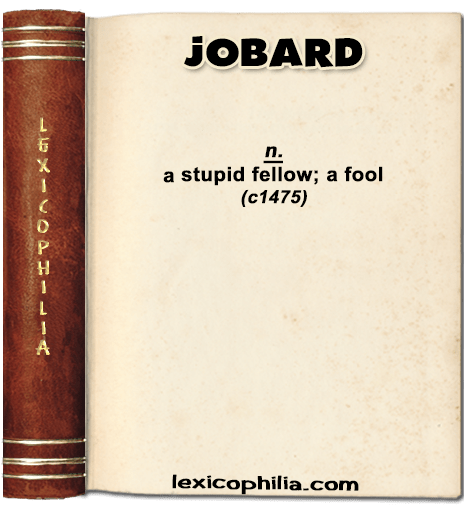
Word of the Day: JOBARD

ETYMOLOGY
from French jobard (a person who is easily fooled or very credulous)

EXAMPLE
“… False supplantyng, clymbyng of foolis
Unto chayers of worldly dignite,
Looke of discrecioune sette
jobbardis upon stoolis,
Whiche hathe distroyed many a comunalte,
Marchol to sitte in Salamons see,
What folwithe after no reason no justice,
Injuste promocioune and parcialite,
By false prerogatyf theyr neyghburghs to dispise.
…”

From: A Selection from the Minor Poems of Dan John Lydgate
Printed for the Percy Society, 1840
The Moralite of the Hors, the Goose, and the Sheepe
Composed c1440

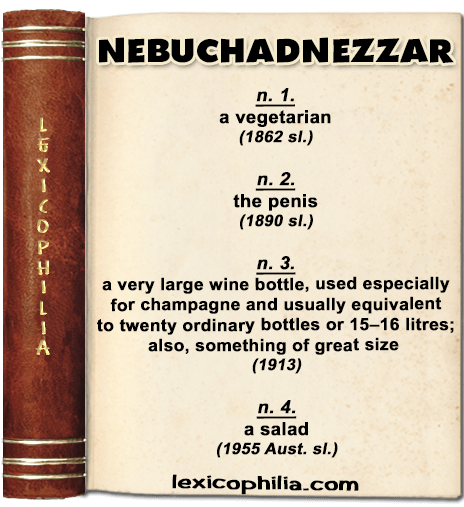
Word of the Day: NEBUCHADNEZZAR

ETYMOLOGY
from the name of Nebuchadnezzar (died c562 BC) ruler of the Babylonian empire (604–562 BC), after French nabuchodonosor (large wine bottle used for champagne)

EXAMPLE (for n. 3.)
“… That didn’t prevent me strewing my whole room with little bits of paper, when I undressed that night. Fireworks ensue, then (children dismissed) supper and afterwards, the most magnificent Nebuchadnezzars, and finally a good form of blind-man’s buff, where everyone stands round the room in a circle and the blind man walks up and prods someone, telling him at the same time to make a noise … sch as the sound of rain falling on mud – and the speaker has to be recognised by the sound of his voice. …”

From: Letters of Aldous Huxley
By Aldous Huxley, 1969
Letter to Leonard Huxley, 11 November, 1913

PRONUNCIATION
neb-yuh-kuhd-NEZ-uh

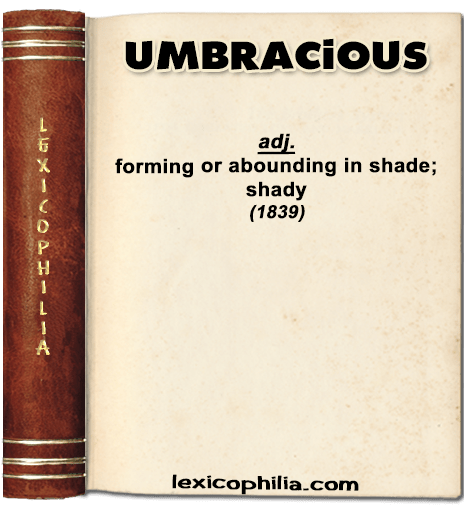
Word of the Day: UMBRACIOUS

ETYMOLOGY
irregular from Latin umbra (shade, shadow) + -acious

EXAMPLE
“… About the same period also an approach was made, by altering and levelling the ground, and planted with elms, sycamores, and chestnuts on each side, which have already become very umbracious, and will in the course of a few more years, when he who planted them rests beneath their shade, form a stately avenue. …”

From: The History and Topography of the Isle of Axholme
By William Brocklehurst Stonehouse, 1839