Word of the Day: BABBART

ETYMOLOGY
probably from a first element of uncertain origin + ‑ard (suffix)

EXAMPLE
“… The hare, the scotart,
The bigge, the bouchart,
The scotewine, the skikart,
The turpin, the tirart,
The wei-betere, the ballart,
The go-bi-dich, the soillart,
The wimount, the
babbart,
The stele-awai, the momelart,
The evil-i-met, the babbart,
The scot, the deubert,
The gras-bitere, the goibert,
The late-at-hom, the swikebert,
The frendlese, the wodecat,
The brodlokere, the bromcat,
…”

From: The Middle English “Names of the Hare
(Bodleian Library MS Digby 86)
Word of the Day: SIT-UPONS

ETYMOLOGY
from sit (vb.) + upon (prep.), after to sit upon

EXAMPLE
“… I need scarcely say that he kept a tiger, and that the tiger was a perfect model of a brute. He wore a sky-blue coat with silver buttons, a pink-striped waistcoat, green plush sit-upons, and flesh-coloured silks in-doors; out of doors the lower garments were exchanged for immaculate white doeskins, and topboots — virgin Woodstocks on his hands, and a glazed hat upon his head with forty-two yards of silver-thread upon it to loop up the brims to two silver buttons. …”

From: Peter Priggins, The College Scout
By Theodore Hook, 1841

Word of the Day: GRAVILOQUENCE

ETYMOLOGY
from Latin gravis (grave, weighty, important) + loquiloquent- (to speak)

EXAMPLE
“… I treasure her unsentimental, enterprising, and no-nonsense-responsible spirit, her gravitas and graviloquence. I’d like to be capable (at least at times) of such classical conservatism, a necessary leaven for my mushy murky utopian pink political daydreaming …”

From: The Theater of Maria Irene Fornes, 1999

Word of the Day: DISCLANDER

ETYMOLOGY
noun: from Anglo-Norman desclandredesclaundredisclaunderdisclaundre (slander, slanderous statement, scandal, public outrage)
verb: from disclander (noun)

EXAMPLE (for vb. 1.)
“… Þis gode men with ioie inov : heore leue of him heo nome,
And þannes heo wenden sone i-nouȝ : to þe court of rome.
Þare neren heo nouȝt faire onder-fonge : for þe bischopes comen bi-fore
And desclaundreden seint thomas : þat he was fals and for-suore.
Ake naþeles þe grace heo hadden : þat to þe pope heo miȝten go.
him-sulue heo tolden in priuete : al seint thomases wo: …”

From: Laud Manuscript, c1300
In The Early South-English Legendary ; or, Lives of Saints
Edited by Carl Horstmann, 1887

Word of the Day: DEBATIVE

ETYMOLOGY
from debate (vb.) + -ive

EXAMPLE
“… It is a wonder to behold, that in one man should appeare so many tokens of valour, as first to be the ouerthrow of so mighty a kingdome: next of the setting vp & revniting again of the same: Againe, that whersoeuer he tooke part, victory was euermore attendant vppon his actions; which was the onely cause they honored him aboue men, and little lesse than a God, they were driuen into a debatiue meditation, whether they offered him more wrong in his banishment, or more honnor in calling him home: …”

From: The Historie of Iustine Containing a Narration of Kingdomes, from the beginning of the Assyrian Monarchy, vnto the Raigne of the Emperour Augustus
Translated by G.W., 1606

Word of the Day: BLUE PIPE

EXAMPLE
“…The blew Pipe groweth likewise in manner of a smal hedge tree, with many shootes rising from the roote like the former, as our common Priuet doth, whereof it is a kind. The branches haue some small quantitie of pith in the middle of the wood, and are couered with a darke black greenish barke or rinde. The leaues are exceeding greene and crumpled or turned vp like the brims of an hat, in shape very like vnto the leaues of the Poplar tree: among which come the flowers, of an exceeding faire blewe colour, compact of many small flowers in the forme of a bunch of grapes:…”

From: The Herball, or Generall Historie of Plantes
By John Gerard, 1597

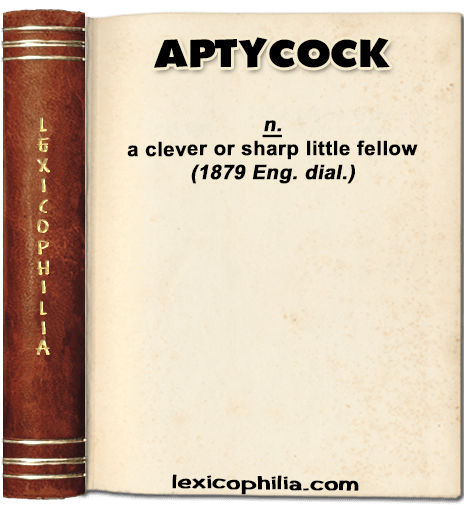
Word of the Day: APTYCOCK

ETYMOLOGY
from apt (intelligent, quick-witted) + -cock – a well-known suffix in surnames, as Alcock, Badcock;
probably from the use of ‘cock’ as a familiar term of appreciation for a man who fights with pluck and spirit

EXAMPLE
“…Tom marched away to school earlier than usual that afternoon, while the women went to the door and watched him trudge off, both mightily proud of his performance and his battered brown face.
“He be a reg’lar li’l
apty-cock, sure ‘nough!” said Joan.
Mrs. Tregenza answered with a nod, and looked along the road after her son.
…”

From: Collection of British Authors
Vol, 3228, 1897
Lying Prophets, By Eden Phillpotts

Word of the Day: BUCOLISM

ETYMOLOGY
from bucol-ic + -ism

EXAMPLE
“…The attempt produces a farrago which, in point of Greek, is disgraceful to the reputation of the University; for what can be more lamentably absurd than to see the lowest” bucolisms” of Theocritus thrust in as the necessities of a Sapphic ode require? The Greek Professor might very profitably publish a canon on this subject. …”

From: Introductions to the study of the Greek classic poets
By Henry Nelson Coleridge, 1830