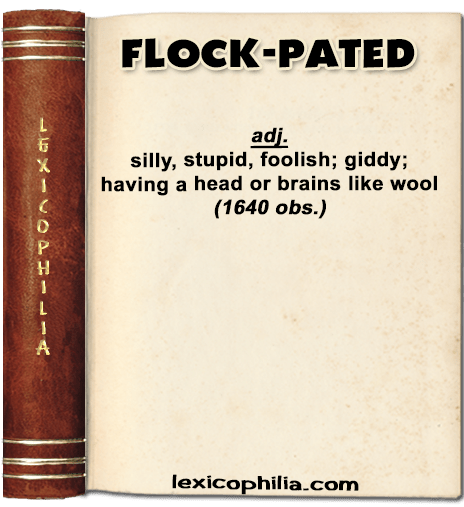
Word of the Day: FLOCK-PATED

ETYMOLOGY
from flock (material consisting of the coarse tufts and refuse of wool or cotton, used for quilting garments, and stuffing beds, cushions, mattresses, etc.) + pated (having a head or mind of the specified kind)

EXAMPLE
“…He that would be a Scholler,
Must hate your drinks that is muddy:
But a cup of good Canary
Will make him the better to study.
O this is a good old Woman, etc.

And he that would be a Poet,
Must no wayes be flocke-pated:
His ignorance if he show it,
He shall of all Schollers be hated.
O this is a good old Woman, etc.

He that would be a Goodfellow,
Of meanes must be prepared:
If that he love drinke and Tobacco,
Or else he shall be jeared.
O this is a good old Woman, etc.
….”

From: “The Merry Old Woman”, c1640
In The Roxburghe Ballads, Ballad Society, 1869-99
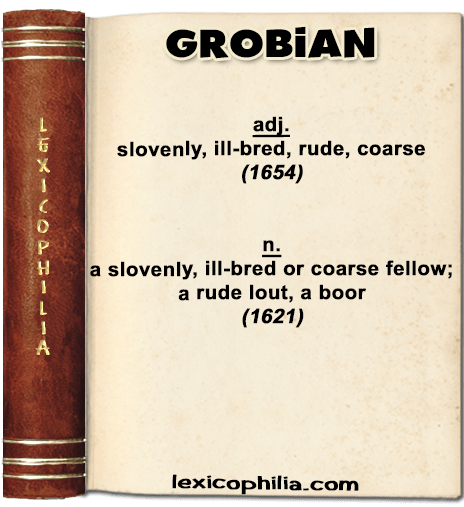
Word of the Day: GROBIAN

ETYMOLOGY
from German Grobian, from medieval Latin Grobianus, name of an imaginary personage, often referred to by writers of the 15th – 6th century in Germany as the type of boorishness,
from German grob (coarse, rude)

EXAMPLE
“…In breefe, he became from an Idiot and a Clowne, to be one of the most compleat Gentlman in Cyprus and did many valorous exploits, and all for the loue of Mistris Iphiginia. In a word, I may say thus much of them all, let them be neuer so clownish, rude and horrid, Gobrians and sluts, if once they be in loue, they will be most neat & spruce and beginne to trick vp, and to haue a good opinion of themselues. …”

From: The Anatomy of Melancholy VVhat It Is
By Robert Burton, 1621

Word of the Day: WRINGLE-WRANGLE

ETYMOLOGY
reduplication of wrangle (n.) with change of vowel as in jingle-jangletingle-tangle, etc.

EXAMPLE
“…It was a most delightful godsend to the paper in which it appeared, and it came at a time when the House was not sitting, and there was no wringle-wrangle of debates to furnish material for the columns of big type which are supposed to sway the masses. …”

From: All Sorts and Conditions of Men: An Impossible Story
By Walter Besant, 1882

Word of the Day: SHITTLE-WITTED

ETYMOLOGY
from shittle (obsolete, fickle, flighty, inconstant) + witted

EXAMPLE
“… I am aferd þat Jon of Sparham js so schyttyl-wyttyd þat he wyl sett hys gode to morgage to Heydon, or to sum oþer of vwre gode frendys, but jf I can hold hym jnne þe better ere ȝe kom hom…”

From: Paston Letters and Papers of the Fifteenth Century
Margaret Paston to Jon Paston, 1448

Word of the Day: ADDULCE

ETYMOLOGY
originally from Middle French adoulcir, also written addoulcir; (mod. adoucir) (to sweeten):
—late Latin addulcire; from ad (to) + dulcis (sweet); subsequently refashioned after Latin

EXAMPLE
“…And thenne shalle not the Rigour and the reffuse of my noble lady be myned and adoulced by my habondaunt prayers and oroisons. yes verily. that shall she be or nature shall faylle. And if not the goddes shall be iniuste and agaynst me…”

From: The History of Jason
By Raoul Le Fevre
Translated by William Caxton, 1477

PRONUNCIATION
uh-DULS

Word of the Day: CRUDELITY

ETYMOLOGY
from French crudelité, from Latin crudelitas (cruelty), from crudelis (cruel)

EXAMPLE
“…The thyrd synne is vnmyserycorde and crudelyte For he whyche playeth wold fayne take from his felowe bothe breche and sherte the whiche thynge the theuys whyche dyspoyle and robbe the pylgrymes doon not…”

From: Here begynneth the prologue or prohemye of the book callid Caton
Translated by William Caxton, 1483

Word of the Day: POCOCURANTE

ETYMOLOGY
Italian, poco curante, (caring little), from poco (a little, rather) + curante (present participle of curare (to care)); from Latin curare (to cure, to heal), ? from the name of Seigneur Pococurante, a fictional apathetic Venetian senator in Voltaire’s Candide (1759)

EXAMPLE
…Leave we my mother – (truest of all the Poco-curante’s of her sex!) – careless about it, as about every thing else in the world which concerned her; – that is, – indifferent whether it was done this way or that, – provided it was but done at all …”

From: The Life and Opinions of Tristram Shandy, Gentleman
By Laurence Sterne, 1762

PRONUNCIATION
poh-koh-kyuh-RAN-tee

Word of the Day: EPICHORIAL

ETYMOLOGY
from Greek ἐπιχώριος (in or of the country) (from ἐπί- (epi-) + χώρα (country) + ‑ιος) + -al

EXAMPLE
“…this double suffering will shortly be succeeded by a very peculiar, perfectly epichorial, and most distracting method of separating dust from carpets (of which more anon); while you must, at all times, be prepared for the infernal bagpipe, modulated by the blind for the benefit of the deaf, to say nothing of the stridulous flute, which it hath pleased Pan, Apollo, or Nemesis, hitherto to restrain to the classical region of the college. …”

From: The New Monthly Magazine and Literary Journal
Volume 3, 1833
“The City of the Clyde”
Letter from Henry d’Arcy, Esq., to Charles Vernon, Esq.

Word of the Day: CLOTH-MARKET

ETYMOLOGY
from cloth + market

EXAMPLE
“…Neverout. Miss, your Slave: I hope your early Rising will do you no Harm. I hear you are but just come out of the Cloth-Market.
Miss. I always rise at Eleven, whether it be Day or no.
Col. Miss, I hope you are up for all Day?
Miss. Yes, if I don’t get a Fall before Night
…”

From: A complete collection of genteel and ingenious conversation, according to the most polite mode and method now used at court, and in the best companies of England,
By Jonathan Swift, 1738

Word of the Day: EAR-DROPPER

ETYMOLOGY
from ear + dropper

EXAMPLE
“… But, that he was a Creature of the Duke’s, and commended to him by Bishop Williams, the Historian is strangely out again. It is possible an Ear-dropper might hear such things talk’d at Cock-pits and Dancing-schools, miserable Intelligence to thrust into an History …”

From: Scrinia Reserata a Memorial Offer’d to the Great Deservings of John Williams, D. D.
By John Hacket, a1670