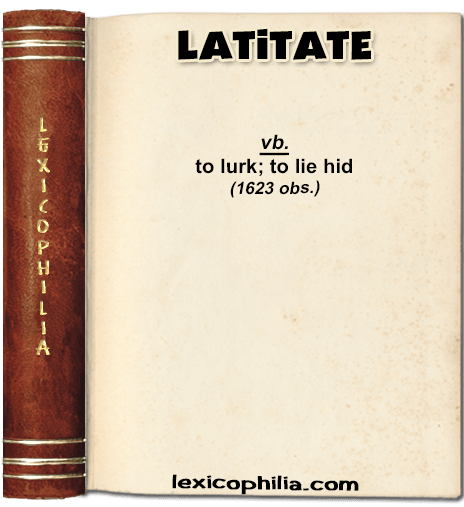
Word of the Day: LATITATE

ETYMOLOGY
from Latin latitat-, participial stem of latitare (to lie hid)

EXAMPLE
“…According to the statement of Townsend, a gardener and discharged servant of Sheriff Lax, but which was afterwards proved to be highly coloured, and in parts wholly false, one of the sheriffs had fled to the Recorder’s bed-room and taken refuge behind the state bed; and other aldermen were latitating in the upper bed-rooms. …”

From: Modern State Trials
By William Townsend, 1850
Trial at Bar of Charles Pinney, Esq. Mayor of Bristol,
On a Criminal Information for Neglect of Duty, in the Court of King’s Bench,
October 25, 26, 27, 29, 30, 31, and November 1, 1832

Word of the Day: REELING-RIPE

ETYMOLOGY
from reeling (moving with a swaying or staggering motion) + ripe (adj.)

EXAMPLE
“…  SEBASTIAN He is drunk now. Where had he wine?
ALONSO And Trinculo is reeling ripe. Where should they
 Find this grand liquor that hath gilded ’em?
 ⌜To Trinculo.⌝ How cam’st thou in this pickle?
TRINCULO  I have been in such a pickle since I saw you
 last that I fear me will never out of my bones. I
 shall not fear flyblowing
. …”

From: The Tempest
By William Shakespeare, a1616

Word of the Day: TOMLING

ETYMOLOGY
from tom (a male cat) + -ling

EXAMPLE
“…We are promised to succeed him a Black Tomling, whom I have named Prester John – that hierarch being the most remarkable black potentate whom I could call to mind. Long live Prester John! and may he be more fortunate than his predecessors, Othello and Pulcheria. …”

From: Selections from the Letters of Robert Southey
Edited by John Wood Warter, Vol. III, 1856
Letter from R.S. to G.C.B., April 29, 1821

Word of the Day: CLUNCH-FISTED

ETYMOLOGY
from clunch (to clench) + fist + -ed

EXAMPLE
“…He (that is, He that will confesse Abraham to have paid no other tithes then, Heb. 7. 4.) delivers to the world, Abraham to Godward, to have been piteously penurious. That of his dues to Religion he was a niggardly Micher: That he was an Abraham clunchfisted, and all that this way went he thought it onely wast: that the good child Judas, that he did, he did learn of his Father Abraham, Quorsum perditio haec?…”

From: A Discourse of Proper Sacrifice
By Edward Dering, 1644

Word of the Day: WAG-TONGUE

ETYMOLOGY
from wag (vb.) + tongue (n.)

EXAMPLE
“…but now indeet her tongue is loosened, and she talks, yes indeet, she does talk nineteen to the dozen and more. A silent woman she was. It is the nearest approach to a miracle I ever care to see. A chatterbox she is, and worse – a regular woman wag-tongue, a regular woman wag-tongue. I cannot get in a word edgeways now …”

From: Macmillan’s Magazine
Volume LXXXVI, May to October,1902
A Woman Wag-tongue

Word of the Day: VINOMADEFIED

ETYMOLOGY
from Latin vinum (wine) + madefieri (to be soaked) + -ed

EXAMPLE
“…The Prince unwilling to miss of his mark, and not having in all the quivers of his reason one shaft wherewith to hit it, resolved to interpose some authority with his argumentations, and where the foxes skin could not serve, to make use of the Lyons: to the prosecuting of which intent, he with his vinomadefied retinue, resolved to press in upon the Page, and, maugre his will, to get up staires, and take their fortune in the quest of the Chamber they aimed at: for albeit the stradling as wide as he could, of pretty Pomponacio at the door whereat they made account to force their passage, did for a while retard their designe, …”

From: Εκσκυβαλαυρον, Ekskybalauron: or, The Discovery of a Most Exquisite Jewel, more precious then diamonds inchased in gold, the like whereof was never seen in any age
By Thomas Urquhart, 1652

Word of the Day: HOLE-CREEPER

ETYMOLOGY
from hole (n.) + creeper (n.)

EXAMPLE
“…He qualified himself as to the good eating which the statute requires, by ‘hole-creeping’ after his neighbours’ geese and pigs – est communis holecreppar anserum et porcellorum tenentium – and as to the good drinking, we have seen the clandestine but thrice-abundant provision which he made for that. …”

(est communis holecreppar anserum et porcellorum tenentium = is a common hole-creeper of geese and piglets)

From: The Quarterly Review
Vol. XCII. Published in December, 1852, and March 1853
No. CLXXXIV. History of the Ancient Barony Castle Combe in the County of Wilts,
By George Poulett Scrope, 1462

Word of the Day: LENNO

ETYMOLOGY
from Gaelic leanabh (baby, infant, child)

EXAMPLE
“…Ye’s neir pe pidden work a turn
At ony kind o’ spin, mattam,
But shug your
lenno in a scull,
And tidel highland sing, mattam;
Had awa’, had awa’,
Had awa’ frae me, Donald;
Your jogging sculls and highland sang
Will sound but harsh wi’ me, Donald.
…”

From: Scotish Song
By Joseph Ritson, 1714
Song XI.  Had Awa’ Frae Me, Donald

Word of the Day: QUADRAGENARIOUS

ETYMOLOGY
from Latin quadragenarius (forty years old) + -ous

EXAMPLE
“…Tis my fancy that, having won for himself a fortune, he went on in the same resistless way and won for himself a wife: “taking the biggest,” as usual, by cutting out valiantly from under the guns of a dozen rivals some stout buxom widow suited to his estate and to his medium years – one of those plumply mellow quadrigenarious bodies who especially appeal to the vigorous and well-salted emotion which with sailor-men stands for love …”

From: Harper’s New Monthly Magazine, February, 1895
New York Colonial Privateers’, By Thomas A. Janvier

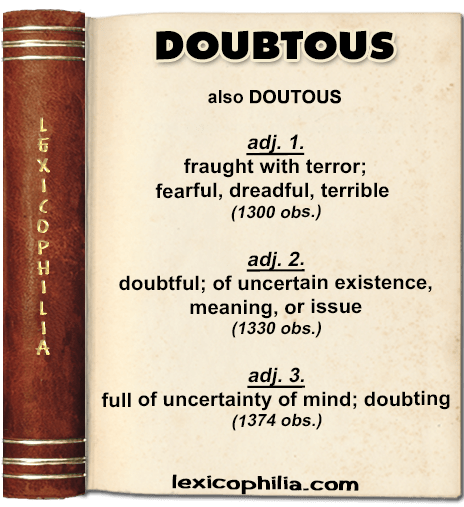
Word of the Day: DOUBTOUS

ETYMOLOGY
Middle English from Old French dutusdotusdoutous;
from modern French douteux, from doute (doubt n.)

EXAMPLE 1 ( for adj. 1)
“…no for al is moch honoure
þat he ne worþ wel sone dede
Þe eiȝt dai so is
dotus 
and þat ful wel þou salt se
ful of tene and angus
…”

From: Early English Poems and Lives of Saints with those of the wicked birds Pilate and Judas
Edited by Frederick James Furnivall, 1862
Fifteen Signs before Judgment‘, a1300

EXAMPLE 2 (for adj. 1)
“… And she said to hym: ‘My swete frend̛, yf it were possyble, soo wold I fayne doo, but it may not be. And wete it wel, that my departyng fro you is more gryeuous & doubtous a thousand tymes to me than to you, but it is the wyƚƚ & playsire of hym that can do & vndoo al thinges.’ and, with these wordes, she embraced & kyssed hym fuƚƚ tenderly, sayeng: ‘Farwel, myn owne lord & husbond̛; Adieu, myn herte, & al my joye; Farwel, my loue, & al myn wele …”

From: Melusine
By Jean d’Arras, c1500
(Published by Early English Text Society, 1895)