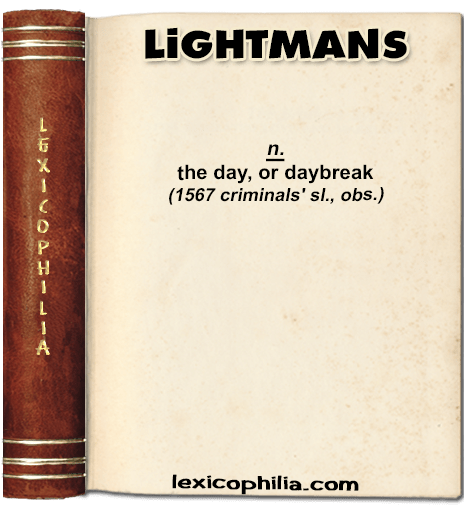
Word of the Day: LIGHTMANS

ETYMOLOGY
from light (adj.) + –mans (suffix forming nouns from adjectives and nouns in 16th century and early 17th century cant)

EXAMPLE
“…Bene lyghtmans to thy quarromes in what lipkē hast thou lipped in this darkemanes; whether in a lybbege or in the strummell? …”
(God morrowe to thy bodye, in what house hast thou lyne in all night whether in a bed, or in the strawe?)

From: A Caueat for commen Cvrsetors vulgarely called Uagabones
By Thomas Harmon, 1567

Word of the Day: BESWINK

ETYMOLOGY
from Old English beswincan, from be- swincan (to toil, to labour)
definition 2: probably for beswinge (as per OED)

EXAMPLE (for vb. 2.)
“… “Here now,” quod hunger “and holde it for a wisdome:
Bolde beggeres and bigge þat mowe her bred
biswynke,
With houndes bred and hors bred holde vp her hertis,
Abate hem with benes for bollyng of her wombe;
And ȝif þe gomes grucche bidde hem go swynke,
And he shal soupe swettere whan he it hath deseruid
….”

From: The Vision of William concerning Piers the Plowman
By William Langland, 1377

Word of the Day: NIPFARTHING

ETYMOLOGY
from nip (to pinch, bite, squeeze tightly) + farthing

EXAMPLE
“…A goodlye dishe, who taughte the this?
why doste thou thus compare
Extremyties? Is there no shifte,
all spende, or els all spare?
I woulde the not a 
nipfarthinge,
nor yet a niggarde haue,
Wilte thou therefore, a drunkard be,
a dingthrifte, and a knaue?…”

From: A Medicinable Morall, that is, the two bookes of Horace his satyres
By Horace
Translated by Thomas Drant, 1566

Word of the Day: SLIMSLACK

ETYMOLOGY
from slim (adj.) + slack (adj.)

EXAMPLE
“…Thou planter of Amfrisus, inhabiter of Parnassus, louer of Helicone; lord of fount Caballyne, patrone of the Laurell, inuentor of the Harpe, master of Astrologie, and prince of Phisicke, helpe these poore slimslacks, who haue need of internal remedies, for the restitution of their disturbed braine, destitute witte, obfuscate vnderstanding, lost memorie: …”

From: translation of The Hospitall of Incurable Fooles
By Tomaso Garzoni, 1600

Word of the Day: DUBEROUS

ETYMOLOGY
corruption of ‘dubious’

EXAMPLE
“…The Squire,” said he, ” hadn’t a-made him no proposal at all, and was duberous if his charackter would serve. Now, says I to myself, seeing as how the cat jumps, if so be as I steps in, before nothing and scrape of pen, where ‘s the harm ? …”

From: Lawrie Todd, or, The Settlers in the Woods
By John Galt, 1830

Word of the Day: LIMOUS

ETYMOLOGY
from Latin limosus, from limus (mud, slime)

EXAMPLE
“…This doon, the sydes make up with structure,
And footes VIII it hold in latitude.
With barres bigge is goode to make it sure ;
Or wall it well with ragge or flyntes rude.
In square or round this werk thai may conclude.
If water ther be lymous or enfecte
Admyxtion of salt wol it correcte. …”

(Make it eight feet wide and secure it with courses of wood, the walls being of ragstone or flint. A mixture of salt will correct muddiness.)

From: Palladius on Husbondrie: from the unique MS. of about 1420 A.D. in Colchester Castle

Word of the Day: SISTER-FOLD

ETYMOLOGY
from sister + fold (a clasp or embrace, obs.)

EXAMPLE
“…Are these of such fantastic mould,
Seen distant down the fair arcade,
These Maids enlink’d in sister-fold,
Who late at bashful distance staid,
Now tripping from the greenwood shade,
Nearer the musing champion draw,
And, in a pause of seeming awe,
Again stand doubtful now?
…”

From: The Bridal of Triermain
By Walter Scott, 1813

Word of the Day: MALEFICIOUS

ETYMOLOGY
from Latin maleficium (malefice, a wicked enchantment, sorcery)  + -ious

EXAMPLE
“…Or again, the foresaid change of a sound into a morbid body proceeds from the breath, or from the depraved spirit and aspect of the eyes, permeating, dissipating or infecting, or any other way changing the very tender substance of the Child. At which time, if any thing superstitious or maleficious come from the wickedness of the Devil, the Assistence of Holy Church being first desired, we must proceed to such Remedies as may dissipate, dissolve and weaken the breath, wind, or foul and contagious spirit …”

From: A Guide to the Practical Physician shewing, from the most approved authors, both ancient and modern, the truest and safest way of curing all diseases, internal and external, whether by medicine, surgery, or diet
By Theophile Bonet, Translated from Latin, 1684

Word of the Day: NEMOPHILOUS

ETYMOLOGY
from Greek νέμος [némos] (wooded pasture, glade) + ‑philous

EXAMPLE
“…The remainder may be classed with regard to requisite moisture as Hygrophilous, Xerophilous, or Noterophilous, the former division including most shade-loving or Nemophilous plants, the Dryads of Martius, and the Xerophiles most but not all Calcophiles or lime-loving plants…”

From: Journal of Botany, British and Foreign
Edited by James Britten, Vol. IX, 1880
‘Proceedings of Societies. Geologists’ Association’

Word of the Day: GROUT-HEAD

ETYMOLOGY
from grout (sediment, dregs, lees), taken as the type of something big and coarse; 
for definition 2: there is confusion with great; perhaps the sound recalled the Dutch groot

EXAMPLE
“…professed her self a nonne in the yeare of our lord a. M. and. lxxv. to serue the deuyll in the monkes hypocresy, & in ye burnynge heates of Sodome. So daynty mowthed wer these greasy grouteheades, and so crafty in their generacyon, that they could fynde out kynges doughters to serue their lustes, and yet apere chast ghostly fathers to the world. Thurstinus a monke of Cane in Normandy…”

From: The First Two Partes of the Actes or vnchast examples of the Englysh Votaryes gathered out of their owne legenades and chronycles
By John Bale, 1551