Word of the Day: TACITURNOUS


ETYMOLOGY
from Latin taciturnus (taciturn) + -ous


EXAMPLE
“…The Legate was more taciturnous, and seldom entered into conversation with the Embassador, who, very prudently, forbore to ask questions about China in his presence…”

From: An Historical Account of the Embassy to the Emperor of China
By Earl George Macartney Macartney, 1797

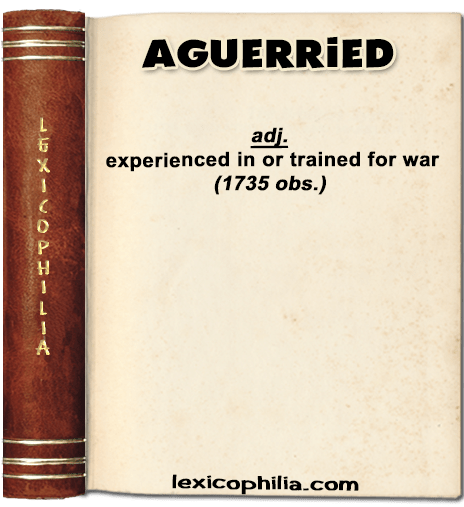
Word of the Day: AGUERRIED


ETYMOLOGY
from French aguerri, (to accustom to war) + -ed


EXAMPLE
“…But, said he, we have an army to defend us in case of an invasion; an army maintain’d in time of peace, and the best aguerried of any troops in Europe that have never seen an enemy…”

From: Letters from a Persian in England to his Friend at Ispahan
By George Lyttelton, 1735

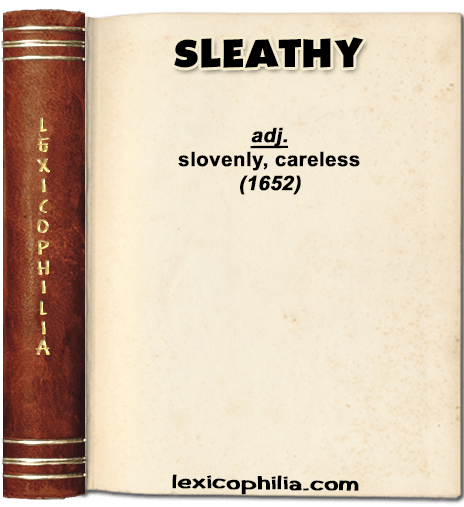
Word of the Day: SLEATHY


ETYMOLOGY
? from Old Norse slœ́ða (to drag, trail) (so Norwegian slöda; also, to work carelessly)


EXAMPLE
“…Again, the combination of labourers and Poor people may very much prejudice, besides their slothfull and sleathy slubbering of it, if not exceeding carefully overseen…”

From: The English Improver Improved Or the Survey of Husbandry Surveyed
By Walter Blith, 1652

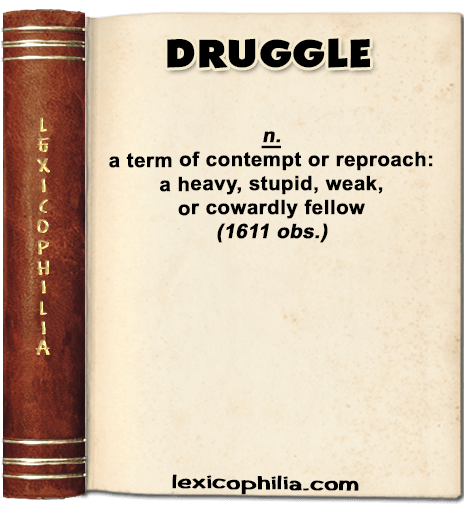
Word of the Day: DRUGGLE


ETYMOLOGY
of uncertain origin;
possibly from drug (n.) + ‑le


EXAMPLE
“…The Bunsellers or Cake-bakers were in nothing inclinable to their request; but (which was worse) did injure them most outragiously, calling them pratling gablers, lickorous gluttons, freckled bittors, mangie rascals, shiteabed scoundrels, drunken roysters, slie knaves, drowsie loiterers, slapsauce fellows, slabberdegullion druggels, lubbardly lowts, cosening foxes, ruffian rogues, paultrie customers, sycophant-varlets, drawlatch hoydons, flouting milksops, jeering companions, staring clowns, forlorn snakes, ninnie lobcocks, scurvie sneaksbies, fondling fops, base lowns, sawcie coxcombs, idle lusks, scoffing Braggards, noddie meacocks, blockish grutnols, doddi-pol-jolt-heads, jobernol goosecaps, foolish loggerheads, slutch calf-lollies, grouthead gnatsnappers, lob-dotterels, gaping changelings, codshead loobies, woodcock slangams, ninnie-hammer flycatchers, noddiepeak simpletons; Turdie gut, shitten shepherds, and other such like defamatory epithetes...”

From: The Works of the Famous Mr. Francis Rabelais
Translated by Thomas Urquhart, 1653
Word of the Day: BAJULATE


ETYMOLOGY
from bajulat-, participial stem of bajulare (to carry), from bajulus (porter);

BADGER – a person who buys corn and other commodities and carries them elsewhere to sell; an itinerant dealer who acts as a middleman between producer (farmer, fisherman, etc.) and consumer; a cadger, hawker, or huckster


EXAMPLE
“…Hence it is, that in the late Order for regulating the wages of Coach-men, at such a price a day and distance from London, Sussex alone was excepted, as wherein shorter way or better pay was allowed. Yet, the Gentry of this County well content themselves in the very badness of passage therein, as which secureth their provisions at reasonable prices; which, if mended, Higglers would mount, as bajulating them to London.…”

From: The History of the Worthies of England
By Thomas Fuller, 1662

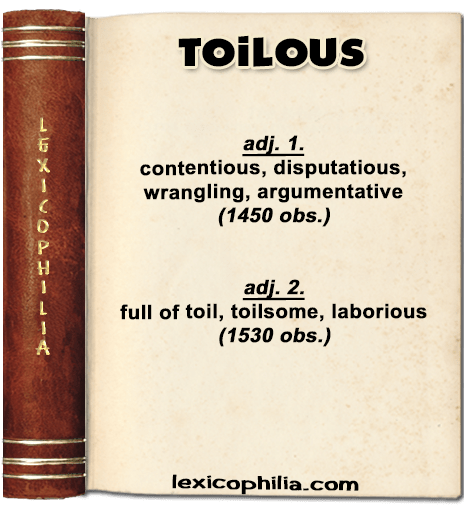
Word of the Day: TOILOUS


ETYMOLOGY
from toil (strife, turmoil, dispute) + -ous


EXAMPLE
“….R
to riotus, to reueling, ne rage not to rudeli.
S
to straunge, ne to stirynge, ne straungeli to stare.
T
to toilose, ne to talewijs, for temperaunce is beest.
V
to venemose, ne to veniable, & voide al vilonye.
W
to wielde, ne to wraþful, neiþer waaste, ne waade not to depe
..”

From: Aristotle’s A B C
in The Babees Book,
Lambeth Manuscript. a1430

Word of the Day: OLFACT


ETYMOLOGY
from Latin olfact-, ppl. stem of olfacere (to smell)


EXAMPLE
“…The Indian is indeed light, but black and amare; the Syrian is flave, tuberous, to the gust acrimonious, to the olfact fragrant. The Arabians constitute onely two sorts thereof, the amare, and the sweet. And Clusius thinks there is but one kinde of Costus, and that it is onely called sweet, in reference to the more amare and acrimonious. Such a difference as this in sapour, we daily experience in Plants, which while fresh and new, are more sweet and suave; when inveterate, croded with worms, and corrupted, more amare, acrimonious, and insuave…”

From: A Medicinal Dispensatory
Of such Medicinal Materials as are requisite for Compositions made and kept in Apothecaries Shops
By  J. de Renou
Translated by Richard Tomlinson, 1657

Word of the Day: MALLIFUFF


ETYMOLOGY
from Mallie (= English Molly (a girl,. a woman)) + fuff (something easily blown about, a puff)


EXAMPLE
“…And what for should I not be early abroad if I have business? Am I like one of your windlestrae mallifuff madams that cannot stir from their arm-chair till they are drammed up with their green-tea?…”

From: Elizabeth de Bruce
By Christian Isobel Johnstone, 1827

Word of the Day: TUSSICATE


ETYMOLOGY
from Latin tussicus (afflicted with tussis a cough)


EXAMPLE
“…Phisition Mirus talkes of saliuation,
Of Tophes and Pustules, and Febricitation;
Who doth ingurgitate, who tussicate,
And who an vlcer hath inueterate.
Thus while his Inkehorne termes he doth apply,
Euacuated is his ingenie.
..”

From: Chrestoleros. Seuen Bookes of Epigrames
By Thomas Bastard, 1598