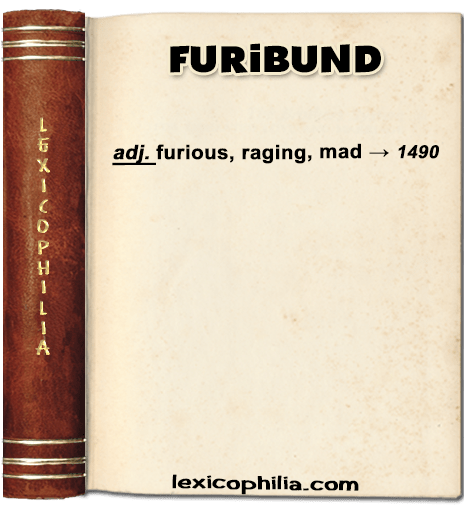
Word of the Day: FURIBUND

ETYMOLOGY
from Latin furibundus (from furere = to rage); the earlier forms through French furibond

EXAMPLE
“… In sayeng the whiche wordes by eneas / dydo lokyng at one side torned hir eyen sodaynli wythout to speke neuer a worde / as a persone furybounde & furyous: and or euer that she coude saye ony thyng. …”

From:The Boke yf Eneydos, compyled by Vyrgyle, which hathe be translated oute of latyne in to frenshe, and oute of frenshe reduced in to Englysshe by me Wyllm Caxton
By William Caxton, 1490

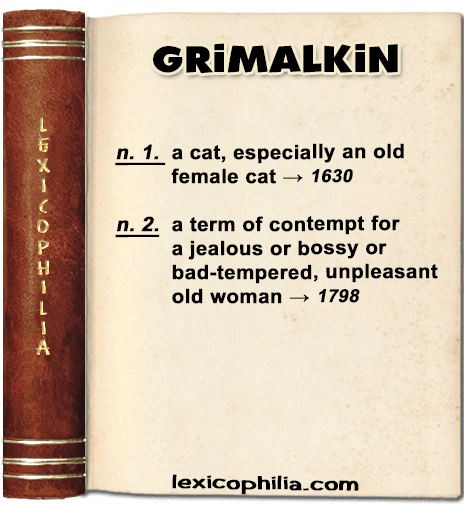
Word of the Day: GRIMALKIN

ETYMOLOGY
? Shakespeare’s Gray-Malkin, in “Macbeth,” 1605 = Gray cat

EXAMPLE
“… Your Muses, th’one a Youth, and one an Infant,
Gaue me two Panegericks at one Instant:
The first Pen, the first line it pleas’d to walke in,
Did make my Art a Rat, and like
Grimalkin,
Or a kinde needfull Vermin-coursing Cat.
By Art I play, but will not care your Rat.
I thanke you that you did so soone determine,
To Anagram my Art into a Vermine,
For which I vow, if e’re you keeps a Dayrie,
Of (now and then) a Cheese I will impaire yee.
…”

From: All the vvorkes of Iohn Taylor the water-poet
By John Taylor, 1630

PRONUNCIATION
grim-AL-kin

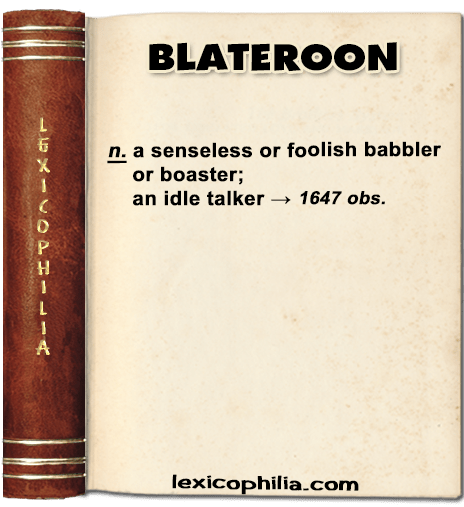
Word of the Day: BLATEROON

ETYMOLOGY
from Latin blatero-onem (babbler), from blaterare

EXAMPLE
“… I will endeavour to lose the memory of him, and that my thoughts may never run more upon the fashion of his face, which vou know he hath no cause to brag of; I hate such blateroons:
Odi illos ceu claustra Erebi
I thought good to give you this little mot of advice, because the Times are ticklish, of committing- secrets to anv, tho’ not to — Your most affectionate Friend to serve you,
j. H.
…”

From: A New Volume of Letters
By James Howell, 1647

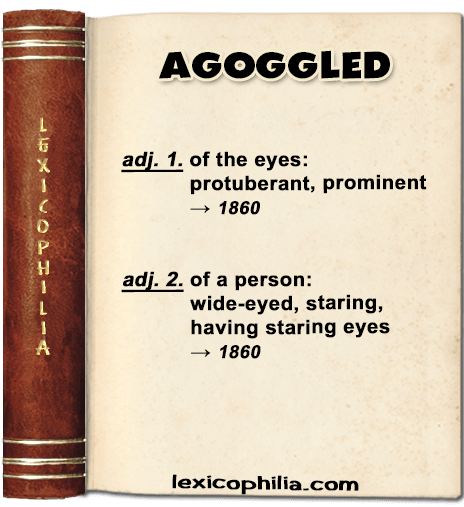
Word of the Day: AGOGGLED

ETYMOLOGY
from a- (prefix) + goggled (of the eyes: protuberant, prominent)

EXAMPLE
“… But it ‘s true, nevertheless. What would you say if a white mouse, or two of them, should save the life of your wife?
“I would say it was wonderful,” replied the farmer, with eyes a-goggled by amazement. …”

From: Curious Storied Traditions of Scottish Life
By Alexander Leighton, 1860
“The Woman with the White Mice”

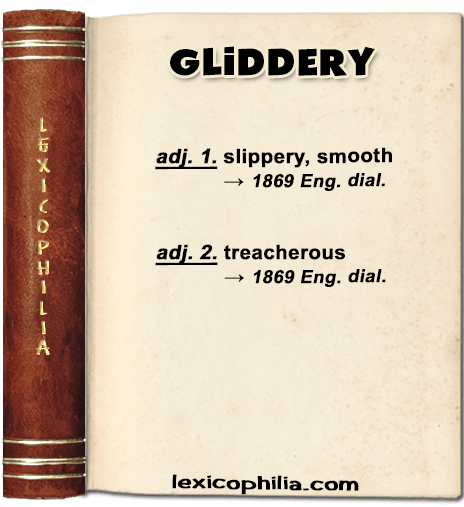
Word of the Day: GLIDDERY

ETYMOLOGY
from glidder (to glaze over; to cover with ice) + -y

EXAMPLE
“… Two men led my mother down a steep and gliddery stair-way, like the ladder of a hay-mow; and thence, from the break of the falling water, as far as the house of the captain. And there at the door, they left her trembling, strung as she was, to speak her mind. …”

From: Lorna Doone: a Romance of Exmoor
By Richard Doddridge Blackmore, 1869

Word of the Day: ACCLAMATE

ETYMOLOGY
from Latin acclamat-, past participial stem of acclamare (to praise publicly and enthusiastically, to applaud)

EXAMPLE
“… that but for shame hee had drawne the Roman legions out of Britain, and so timorous of weapons, that Tiridates riueted his sword to the sheath thereof, for his assurance (because hee would not vnknightly yeeld to goe vngirt, though it were vpon condition, to receiue the diadem of Armenia) was now notwithstanding, with as shrill, and ioyous showts acclamated Imperator, as if in person hee had conquered Armenia by the sword….”

From: Nero Caesar, or, Monarchie Depraved
By Edmund Bolton, 1624

Word of the Day: SWEET-BREASTED

ETYMOLOGY
from sweet + breasted (breast = a person’s singing voice, obs.)

EXAMPLE
“… I like his feather well: a proper man,
Of good discourse, fine conversation,
Valiant, and a great carrier of the businesse,
Sweet breasted, as the Nightingale, or Thrush:
Yet I must tell you; you forget your selfe,
My Lord Vitellies love, and maintenance
Deserves no other Jack ith’ box, but he:
What though he gather’d first the golden fruit,
And blew your pigges-coat up into a blister,
When you did wait at Court upon his mother;
Has he not wel provided for the barne?
Beside, what profit reap I by the other?
If you wil have me serve your pleasure, Lady,
Your pleasure must accommodate my service; …”

From: Comedies and Tragedies written by Francis Beaumont and John Fletcher, 1647
Love’s Cure, or The Martial Maid“, a1640

Word of the Day: BLAST-BOB

ETYMOLOGY
from blast + bob (a light blow as with anything rebounding)

EXAMPLE
“… Much lyke as in forrest a long set dottrel, or oaktree,
With northen blusters too parts contrayrye retossed:
Thee winds scold strugling, the threshing thick crush crash is owtborne,
Thee boughs frap whuarring, when stem with blastbob is hacked:
Yeet the tre stands sturdy: for as yt toe the skytyp is haunced,
So far is yt crampornd with roote deepe dibled at helgat’s:
So this courragious gallant with clustered erraunds
Is cloyed and stinging sharp car’s in brest doe lye thrilling.
His mynd vnuariant doth stand, tears vaynelye doe gutter. …”

From: Thee First Foure Bookes of Virgil his Æneis
Translated into English heroical verse by Richard Stanyhurst, 1582